






By Eunhice Corpuz
#Refreshments: Love has a peculiar way of returning to a place where it thought it had already left behind, and if so, would you dare to begin again? In celebration of Pride Month, Jade Castro’s latest Boys’ Love (BL) series ‘All the Things I Leave You (Patawid)’ (2025) has officially made its local big-screen debut. The film encapsulates the serene, timeless urban landscape of Ilocos Norte, taking viewers to a place where old flames are rekindled, and love is born anew.
Setting a new milestone for local BL, All the Things I Leave You (Patawid) makes history as the first series-to-movie adaptation to utilize Ilocano as its primary language, elevating regional representation on-screen. It revisits the love story of two young men who are inexplicably identical to their grandparents.
Starring Benedix Ramos as Jorge and Justin Paul Basobas as Kiko, the story takes an unexpected turn, as they discover a love story left unfinished — one they must fiercely overcome to secure a happy ending.
The movie begins by showcasing the serene beauty of San Nicolas, Ilocos Norte, centering on a restaurant owned by Jorge’s grandfather, Tino, whom he adores the most. It is the very shop that Jorge dreams of running one day.
Coincidentally, this is exactly where Jorge crosses paths with Kiko, who one day walks into the restaurant to apply as a social media manager and delivery rider.
Their initial encounter did not exactly leave a good impression on Jorge. After Kiko accidentally ruins his clothes, Jorge intentionally keeps his distance, standing firm in his resolve that they will never be friends.
However, as the story unfolds, Jorge’s reservation begins to fade as he eventually finds his heart melting while learning to trust Kiko.
This evolving relationship reveals that when we finally lower our defenses and trust someone we once got off on the wrong foot with, maybe it’s because they weren’t that bad after all.
But just as things are falling into place for the two, tragedy strikes. Jorge’s grandfather unexpectedly passes away, leaving him devastated, shocked, and forced to face a world without his anchor.
Yet Kiko remained by his side.
During the final days of Lolo Tino’s wake, Kiko and Jorge find a vintage cigar box filled with unread letters and old photos of two people who looked strikingly identical to them, unlocking a mystery from the past.
As they read through the letters, they discover that Jorge’s grandfather had fallen in love with a man named ‘Bong,’ with whom he shared a profound love and built a lifetime of dreams.
Long before Jorge and Kiko’s love story began, there were Tino and Bong — star-crossed lovers who expressed their devotion through profound sacrifices and stolen letters, with each one starting like this: Ay-ayatek a Bong (My Beloved Bong).
In their youth, Tino and Bong dared to hope for a world where they could belong to each other, free from the heavy restraints and uncertainties of their time. For them, simply being together was the ultimate dream.
The film intimately captures this devotion in a scene where they lie together on the grass beneath the night sky, sharing quiet whispers under the frail, flickering light of a candle-lit lamp.
“Anya ngata no matayak? Birokennak aya? (What if I die? Will you look for me?)” —Tino
“Wen (Yes).” —Bong
Yet fate proved cruel to the two lovers who asked for nothing more than a lifetime together. Their dreams were torn apart when Tino was forced to leave Bong behind to become a sakada — one of the many Ilocano immigrant farmers recruited to work the fields of Hawaii.
It is a heartbreakingly familiar trope within the queer community — one defined by rigid expectations and forced separation. This painful pattern persists simply because society refuses to carve out a space for their love to openly exist.
Ultimately, whether or not older generations within the queer community had the chance to love openly, Tino and Bong’s story serves as a profound reminder that their love did exist. It was genuine, it was real, and it deserves to be remembered.
In the end, Tino and Bong gave us a timeless love story destined to be commemorated. It beautifully captured how love can survive the heaviest of societal uncertainties — proving that even when time or circumstance forces an ending, the love itself remains undying.
This is exactly how the film draws a parallel between the two love stories — subtle yet persistent. It encapsulates how these deep-seated societal barriers can ultimately be overcome if the will to love is strong enough.
The film’s universality makes it hit incredibly close to home, even if you don't speak the language on-screen. For a moment, it allures the collective heartbeat of the audience, speaking in a language that only love can make you truly understand.
With one letter left to read, Jorge and Kiko paused, completely overwhelmed by the profound sadness echoing from the past.
Tragically, as the film progresses, history begins to repeat itself when Kiko is accepted to study in Manila, leaving Jorge behind in San Nicolas.
As they face the same painful crossroads, the film begins to ponder whether Jorge and Kiko will allow history into another tragic finale or take a leap of faith and fight for a lifetime their grandfathers never had?
For them, it was a choice between a familiar, fatal ending or a hope of a shared destiny.
Jorge chased after Kiko, desperate to convince him that fighting for their love was the legacy their grandfathers were denied. Kiko, however, refused to turn back. He stood his ground, chose to walk away, and left the weight of their history — and Jorge — behind.
It’s a classic cliché in modern romance: if we just take the risk, we might stand a chance at a lifetime together. But perhaps clichés exist for a reason.
When two people dare to try, their shared dreams become reality, and their love becomes a fortress capable of resisting any outside constraints. Most especially, when their hearts and souls are nourished by devotion, their love becomes timeless.
In the end, Kiko and Jorge fought to break through from the shadows of the past. Through a solemn and sincere confrontation, they finally become their grandparents’ greatest dream — to love and belong to one another in this lifetime.
Ultimately, this BL film captures the raw, youthful emotions of people yearning for a kinder reality — a space finally free from rigid standards, where one can just simply be loved exactly as they hope.
It is a film that portrays silent acceptance and unwavering support from their families, where they simply allow Jorge and Kiko to be who they are.
Given that Ilocano culture is traditionally known for being deeply conservative, this gentle portrayal offers a refreshing perspective: loving someone transcends gender and knows no boundaries.
As we celebrate Pride Month, this new release in Philippine cinema leaves us with a reminder that some love stories may end before their time, but the hope they left and engraved can endure across generations, waiting for another lifetime to continue where they left off.
“Uray inya iti mapasamak, haan ta agsina (No matter what happens, we won’t separate).”
And so, we can only hope for more storylines like this — narratives that don't need to be forced, but are instead allowed to flow just as they are.
Jorge and Kiko’s love story proves that a shared lifetime is entirely possible, even in the quiet corners of a provincial town. By choosing each other without abandoning their individual dreams, they show that love can thrive alongside uncertainty when both are willing to compromise. Because in the end, it is the love that you share with someone that creates a sanctuary — a dream where peace is finally attained, and connections endure across lifetimes.
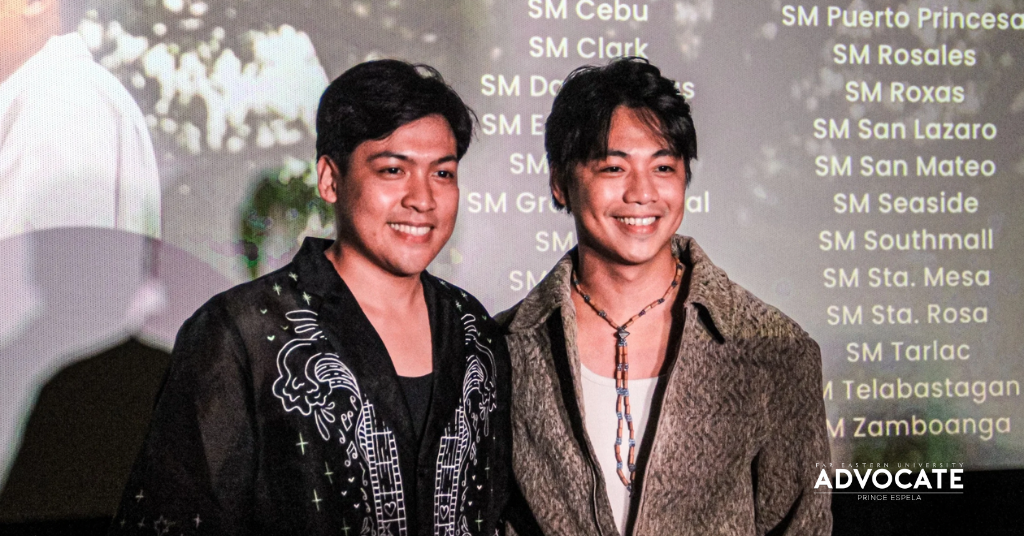
(Photo by Prince Espela/FEU Advocate)