






By Ishia Eleanor F. Marquez
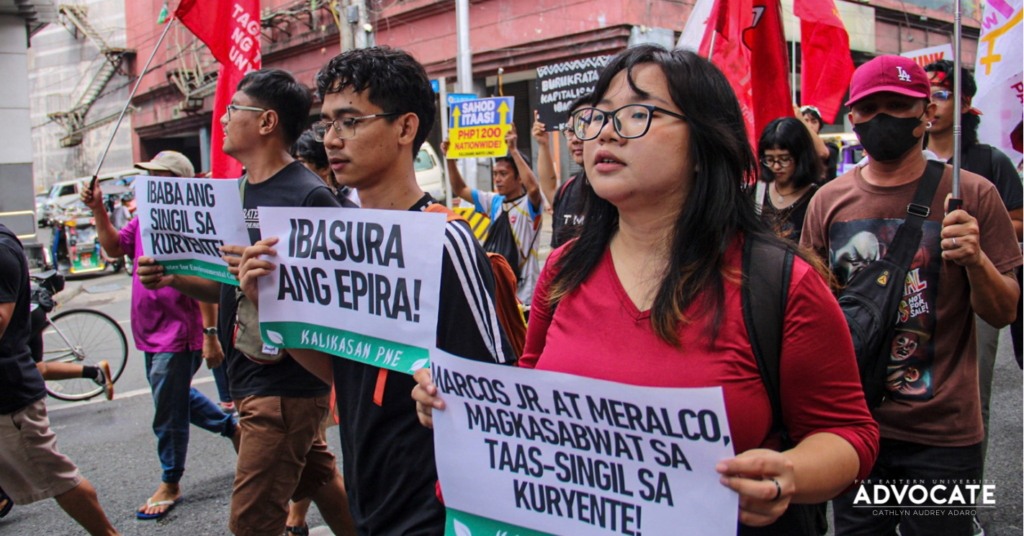
In commemoration of the 25th anniversary of the Electric Power Industry Reform Act (EPIRA), various sectors condemned the deregulation of the power industry amid growing concerns over rising electricity costs during a demonstration held at Mendiola earlier today, June 8.
Implemented during the term of former President Gloria Macapagal-Arroyo, the Republic Act No. 9136, also known as the EPIRA, mandated the privatization of the energy sector to supposedly lower electricity costs and attract investment.
However, despite EPIRA’s aim, electricity rates continue to rise nationwide, with leading electricity company Meralco implementing a ₱0.53-per-kilowatt-hour increase, bringing the rate from ₱13.81 in March to ₱14.35 last April.
Calls for reforms
In his speech, Bagong Alyansang Makabayan Secretary-General Raymond ‘Mong’ Palatino emphasized that the EPIRA only benefits private corporations, while Filipinos continue to bear the burden of rising electricity rates.
“Sa bawat pagtaas ng singil ng kuryente, dagdag [din ang] kita ng mga kapitalista at ng mga korap na nasa pamahalaan… wala akong duda [na] ito [ng EPIRA] ang dahilan [ng pag] papahirap sa mamamayan (With every electricity rate increase, the capitalists and corrupt in the government profit. I have no doubts that EPIRA is the reason for the people’s suffering),” he stated.
Aside from eliminating additional charges imposed on electricity, Palatino also urged the authorities to place the energy market under state control in an interview with FEU Advocate.
“Ibaba ang presyo ng kuryente sa pamamagitan ng pag-alis sa VAT [Value-Added Tax] and other aggressive taxes sa kuryente… tapos reverse privatization. Dapat may state control sa energy industry (Lower the electricity prices by removing the VAT and other aggressive taxes on electricity, then reverse privatization. There should be state control over the energy industry),” the secretary-general emphasized.
Meanwhile, in a separate interview, Agham Youth National Chairperson Migo Pagdanganan cited numerous problems that the country faces in the energy sector, including rotational brownouts.
“Ang layunin nito ay para mawala ang krisis sa kuryente… Pero kitang-kita natin ngayon na hindi ito nangyayari, patuloy pa rin ‘yung rotational brownout [at] patuloy na tumataas ‘yung presyo ng kuryente (Its goal was to eliminate the crisis on electricity. But we can clearly see that it is not happening as the rotational brownouts continue and the electricity prices continue to increase),” he said.
Amid the rising rates, citizens across Luzon and Visayas continue to experience rotational brownouts that started last May 14 due to power shortages.
The National Grid Corporation of the Philippines placed several areas in Luzon and Visayas under red and yellow warnings, indicating that the electricity supply is critical and cannot meet the high demand.
This pushed them to implement a Manual Load Dropping, which involves cutting electricity in certain areas for two to three hours to prevent a total power-grid collapse.
As one of the science-technology-based organizations, the Agham Youth National chairperson also underscored the importance of implementing a pro-people energy policy anchored on national industrialization.
“Kaya dapat i-junk ang EPIRA [law] dahil ito ay nakaka-encourage sa privatization ng ating public utility services… [Dapat] gumagawa tayo ng industries mula sa resources natin na nagsisilbi sa atin… at hindi sa ibang bansa (That is why the EPIRA law should be junked as it encourages the privatization of public utility services. We should be the ones making our own industries from our own resources that serve our people, not other countries),” Pagdanganan asserted.
Similarly, Gabriela Women’s Partylist Representative Sarah Elago urged the government to implement renewable energy, emphasizing that it should benefit consumers and the environment alike.
Various speakers also called on the government to investigate private electricity companies imposing ‘questionable’ fees, including distribution, transition, and generation charges.
“Patong-patong na ang binabayaran natin [sa kuryente]… Meron pang other charges na hindi natin alam kung saan napupunta… Dagdag pa diyan ang other taxes… at iba pang universal charge na sinisingil (We are paying numerous electricity charges. We don’t know where the other charges go, in addition to other taxes and other universal charges being imposed),” Elago explained.
Beyond calls for reform in the energy sector, the progressive groups demanded an increase in local workers’ wages, additionally condemning the recent events in the Senate as well as the ongoing Middle East war.
As part of the nationwide protest, various environmental coalitions also staged protests in front of the Department of Agriculture and the Department of Agrarian Reform, demanding better protection for the ecosystem.
(Photo by Cathlyn Audrey Adaro/FEU Advocate)