








By Kristine Aimee M. Millonte and Shayne Elizabeth T. Flores
Underlining the Far Eastern University (FEU) Commission on Elections’ (COMELEC) lack of transparency in their provisions, various FEU student organizations filed a formal petition seeking to withhold the proclamation and office assumption of several candidates whose abstention votes exceeded the votes cast following the proclamation of winners for the 2026 FEU Elections.
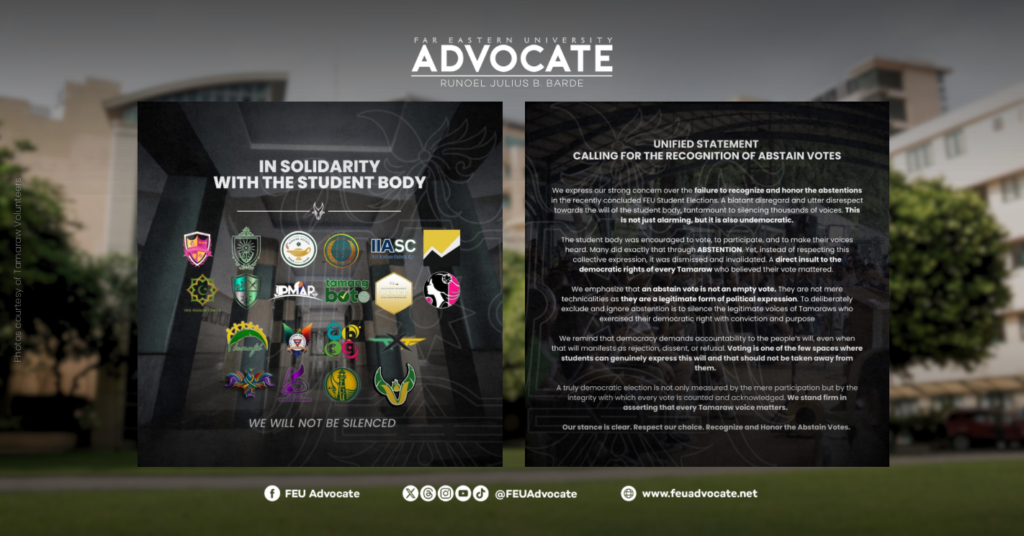
The petitioners include FEU Institute of Tourism and Hotel Management Student Council, FEU Nursing Society, FEU Political Science Society, FEU International Studies Society, Institute Of Internal Auditors Student Chapter - FEU, FEU Organization of Junior Finance Executives, FEU Drug Abuse Prevention Core Group, FEU College Y Club, FEU TAMang Boto, and FEU Peace To All Youth Organization.
Additionally, Junior People Management Association of the Philippines - FEU Chapter, One FEU Music And Records, FEU Buklurang Mag-aaral sa Filipino, FEU Peers - Manila, FEU Anti-Bullying Core Group, Young Women’s Christian Association - FEU Chapter, FEU Tams FX, Tamaraw Volunteers Manila, FEU Sexuality and Gender Alliance, and FEU Muslim Circle also signed the petition.
The unified petition came after FEU COMELEC proclaimed candidates of abstain-heavy races, specifically citing their compliance with 2026 Omnibus Election Code (OEC) and Implementing Rules and Regulations (IRR) in a Facebook post announcing the official winners last May 7.
“In several races this election cycle, abstain votes exceeded the votes cast for candidates. While abstain is a recognized and valid expression under the Omnibus Election Code and IRR, it does not affect the determination of winners. Under existing election rules, candidates with the highest number of valid votes shall still be proclaimed accordingly, provided that the required voter turnout threshold of at least 20% has been met for the election to be considered valid,” the caption read.
In response, the petitioners raised concern about FEU COMELEC’s interpretation of abstention, asserting that the Commission must recognize its democratic value and legal significance.
“To treat abstentions as legally insignificant despite their overwhelming numerical superiority over affirmative votes would effectively render the abstention mechanism meaningless and contrary to the democratic spirit of student representation,” one argument read.
The petitioners cited Article IX Section 4 of the OEC which formally recognizes abstention as an electoral option in the e-ballot, asserting that its inclusion necessarily establishes abstention as a “valid electoral expression.”
They further argued that to proclaim candidates despite abstention-heavy results risks "normalizing leadership without genuine mandate.”
The resolutions sought by the petition include the withholding of proclamation and assumption of office of the concerned candidates, the recognition of abstention as an expression of non-confidence, and the conduct of special elections.
‘Abstain’ in the context of FEU elections
In previous years, ‘abstain’ in the FEU elections, though acknowledged in the election code, was not formally included as a voting option in the e-ballot.
Similar to the Philippine general elections, students who would like to abstain may refrain from voting for any candidate by leaving the voting section blank.
It was only this year that students could directly express their abstention after the inclusion of the ‘abstain’ button.
As stated in Article IX Section 4 of the 2026 OEC, “voters are allowed to choose ‘abstain’ in cases where they deem it necessary.”
Despite this, no provision in the OEC and IRR stated that abstention does not affect the determination of winners.
As referenced by FEU COMELEC in their aforementioned statement, Article VIII Section 13 of the IRR indeed stipulates that “candidates who obtain the highest number of valid votes for each position shall be declared winners.”
However, the provision can be deemed vague as it does not specifically establish the abstain vote as invalid. There was also no context on what constitutes a ‘valid vote.’
It can also be noted that FEU COMELEC only clarified the premise of the abstain option on the day of the proclamation of winners.
As such, students reacted immediately, slamming the Commission’s lack of transparency in disclosing critical information about the validity of abstention.
Student concerns
In an online interview with FEU Advocate, fourth-year psychology student Joshua Craig De Guzman shared that while he has only recently reviewed the specific provisions of the OEC and IRR, FEU COMELEC should have properly communicated the limited bearing of the abstain vote to the student body.
“Any provision that renders a voter's choice — including the choice to abstain — consequential only in theory but not in practice should have been explicitly and rigorously socialized before the first ballot was cast. As it stands, the current interpretation feels like a mechanical technicality used to bypass student sentiment,” he said.
Along with the introduction of abstention as a voting option, this year’s elections saw an improved voter turnout of 35 percent from last year’s 24.27 percent.
While De Guzman acknowledged that the increase in voters is a direct result of providing students an option to express their dissatisfaction through abstention, he denounced FEU COMELEC’s refusal to count it as a valid vote.
“By including the ‘abstain’ option, the COMELEC gave the student body a voice, only to effectively silence it during the proclamation by declaring those votes non-factors. This approach is not only contradictory but also deceptive. You cannot invite participation through a specific mechanism and then ignore the data that mechanism produces,” he underlined.
The psychology senior also described the proclamation of the candidates as ‘problematic’ as it disregards abstention as a vote of ‘no confidence.’
“Proceeding with the proclamation despite such clear opposition suggests that the FEU COMELEC is prioritizing the occupation of seats over the democratic will of the student body. This disregard for the genuine voice of the students undermines the very foundation of student representation,” he stated.
As such, De Guzman urged FEU COMELEC to revisit the given frameworks in order to truly serve students, rather than preserving the status quo.
Meanwhile, third-year communication student and League of Filipino Students - FEU Chairperson Jham Evangelista maintained that the rising voter turnout means that the student body is still hopeful. Thus, FEU COMELEC must respond by fostering a student-centered system.
“The exceeding numbers of abstain is a protest not solely due to lack of confidence in candidates, but [also] raises the bar for systemic change. The community has shown up and has increased the turnout but for the very reasons we all know that is negative. To change that, the political landscape of our University must change and the concerns of the students must be heard. The system must have a clear direction towards genuine representation that values the community,” the communication student remarked.
FEU COMELEC’s response
In an earlier interview with the FEU Advocate, FEU COMELEC Co-chairperson Josh Miguel Tagle mentioned that he had previously raised the concern of giving abstention votes electoral weight prior to the elections, proposing to revisit the provisions of the OEC.
However, he noted that these were not pursued due to time constraints and the Commission’s initial conservative approach toward the revisions for this year's elections.
“Gusto ko lang i-admit na medyo limited rin ‘yung powers ko as the co-chair kasi it's still a bit faculty-centered… Given that mas may power si faculty and how mas may laman ‘yung arguments nila versus us students, who were also juggling academics, who were also juggling internship, etc. Ayun, we just settled with what's there or what the admin told us or ano ‘yung naging middle ground (I just want to admit that my powers as co-chair are somehow limited as FEU COMELEC is still a bit faculty-centered. Given that the faculty has more power and their arguments have more basis than us students, who were also juggling academics, internship, etc., we just settled with what’s there or what the administration told us as middle ground),” Tagle explained.
On the other hand, he stated that the existing provisions allow the students and candidates to contest election results through established procedures.
“Ngayon, I believe in our OEC, mayroon namang avenues for the candidates to protest the results,” Tagle said, adding that he personally would have preferred an immediate revision of the policy.
According to Article IX Section 13 of the IRR, “an election protest may be filed by any candidate or accredited political party within one week from the proclamation of winners. All protests shall be filed with COMELEC.”
As per Section 17, the scope of the protest may involve “alleged irregularities in the conduct of elections, violations affecting the integrity of the results, questions on the validity of votes or canvassing, or other matters affecting the outcome of the election.”
The co-chairperson later issued a separate statement on Facebook, expressing his support for the students’ petition clarifying his personal stance.
Meanwhile, FEU COMELEC responded to the petition by stating in a Facebook post that it shall convene an Electoral Tribunal to formally hear and resolve the issues regarding the proclamation.
“The Commission recognizes the significance of the issues raised, particularly as these involve questions relating to voter intent, representation, and the interpretation of provisions under the Omnibus Election Code and its Implementing Rules and Regulations. In view of this, the Commission shall convene an Electoral Tribunal to formally hear the petition. Petitioners, together with representatives of the affected political parties and candidates, shall be given the opportunity to present their respective positions and arguments before the Tribunal,” the statement read.
FEU Advocate has reached out for a formal interview with FEU COMELEC regarding the petition, but they declined, stating that further comments may “preempt the decision that will be arrived [at] by the members.”
(Layout by Runoel Julius Barde/FEU Advocate)