





By Shayne Elizabeth T. Flores
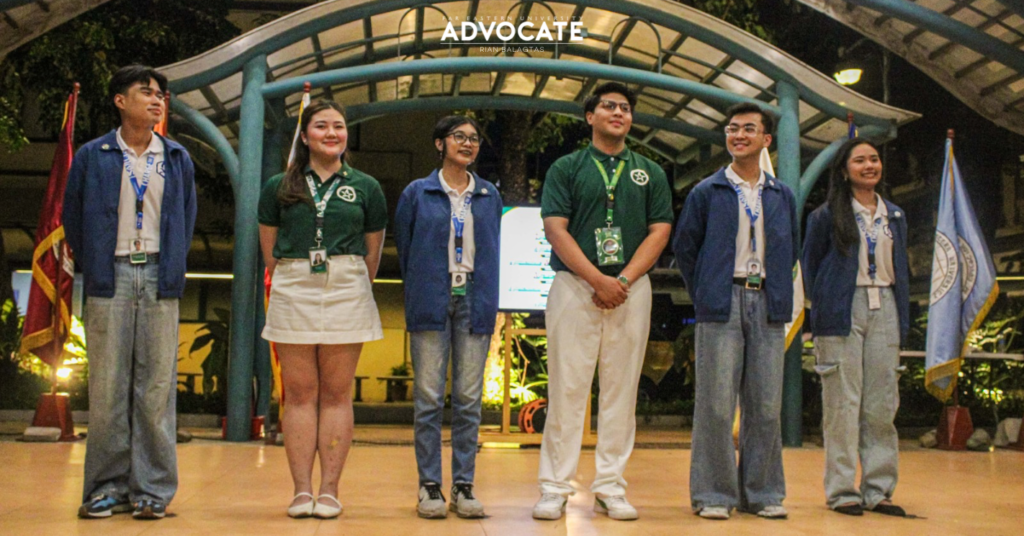
Rising from last year’s low turnout of 24.27 percent, Far Eastern University (FEU) posted an overall voter turnout of 35 percent, with improved voting rates observed across institutes, announced during the proclamation of winners at Pavilion 1 last May 7.
Per FEU Commission on Elections’ (COMELEC) data, 7,018 out of 20,045 Tamaraws casted their votes, while 13,027 students did not vote.
While notable, the voter turnout is still less than the data observed previously in 2023 and 2024, which recorded 44.79 and 36.46 percent, respectively.
According to the 2026 Omnibus Election Code (OEC) Article IX Section 6, a minimum voter turnout of 20 percent is required to declare a successful conduct of elections.
In an interview with FEU Advocate, FEU COMELEC Co-Chairperson Josh Miguel Tagle regarded the election result as a feat that stopped the declining voter turnout trend.
“‘Yung trend kasi right now, bumababa siya as you can see from 2022 until this year. And dito na nag-stop ‘yung trend. Fortunately, at the very least, we're able to stop the trend. Hindi na siya bumababa. We're able to increase it [more] than last year (The voter turnout trend is declining as you can see from 2022 until this year. And this is where the trend stopped. Fortunately, at the very least, we’re able to stop the trend. It’s not decreasing anymore. We’re able to increase it more than last year),” he said.
91st FEUCSO lineup
Amassing 3,722 votes, incumbent FEU College Y Club President Jasper Calara was hailed as the 91st FEUCSO President.
As the lone presidential candidate from the Kadiwa Student Coalition (KSC), Calara’s voters managed to outweigh the 3,133 students who opted to abstain.
However, current FEUCSO Legal Department Director and Isanliyab Servant Leaders’ Union’s unopposed standard bearer Eliza Lasala won vice president with 2,936 votes, despite 3,904 students choosing to abstain.
Lasala is only one of the several cases in this election cycle where votes for abstention exceeded the votes for candidates.
Despite this, FEU COMELEC maintained that the abstain option has no bearing in the determination of winners in compliance with the OEC and Implementing Rules and Regulations, which mandates that the candidates with the highest number of valid votes should still be proclaimed. This is provided that the minimum 20-percent voter turnout threshold has been met.
Students, however, pointed out that the OEC and IRR does not explicitly state the function of the abstain option, raising concerns on the FEU COMELEC ‘misleading’ students about their choices.
Meanwhile, FEUCSO Events Management Executive Committee member Gian Valenzuela claimed the secretary position with 2,439 votes against One FEU Music and Records President Mariah Alysa Parole.
For the treasurer post, unopposed FEU Political Science Society Treasurer Mei Kuo overcame the abstain votes upon securing 3,385 voters.
With 2,647 votes, FEUCSO Finance Associate Director Alyanna Madrideo won as auditor over FEUCSO Advocacy and Campaigns Associate Director Chi Suavillo.
Lastly, FEUCSO Marketing and Content Executive Committee member Jayson Conde was proclaimed press relations officer as he won 3,429 votes, which was more than the abstain voters.
Institute voter turnout
In contrast to the 2025 Elections where some institutes posted voter turnouts less than the required 20 percent, all institutes managed to exceed the minimum voter threshold this year.
Despite having the least population of 435 students in the Manila Campus, the Institute of Education produced the highest voter turnout of 45.7 percent with 199 voters.
This is followed by FEU Makati with a 43.1-percent voter turnout, equivalent to 131 votes out of 304 students.
Known as the biggest institute with 6,182 students, the Institute of Health Sciences and Nursing garnered a total of 2,492 voters, hailing a 40.3-percent voter turnout.
Meanwhile, the Institute of Arts and Sciences gained a 38.4-percent voter turnout as 2,044 out of 5,322 students voted.
Additionally, 624 out of 2,124 Institute of Tourism and Hotel Management students voted, resulting in a 29.4-percent voter turnout.
Both the Institute of Architecture and Fine Arts and Institute of Accounts, Business, and Finance posted the lowest voter turnout of 28.2 percent, producing 473 voters out of 1,676 students and 1,054 out of 3,733, respectively.
COMELEC evaluates election results, admits lapses
Despite the observed improvement in student participation, Tagle acknowledged that they were still not able to reach their initially set goal of a 50-percent voter turnout.
“‘Yung goal to [reach] 50 [percent], hindi namin makamit. Though we did our best efforts, I believena… it was still necessary na i-declare namin siya as a goal. Kasi ‘yun ‘yung ideal, eh. Kasi 50 is 50 percent of the students. So, in a good democracy, talagang at least 50 percent talaga ‘yung bumoboto sa students (We were not able to achieve our 50-percent goal. Though we did our best efforts, I believe that it was still necessary to declare that as our goal because it is the ideal, it is 50 percent of the students. In a good democracy, a 50-percent student voter turnout is really observed),” he stated.
The FEU COMELEC co-chairperson also reflected on the factors that contributed to the less than 50-percent voter turnout, citing the low candidate turnout among others.
“We're talking about elections where walang kalaban. Therefore, nagiging talk show na lang siya sa debates. Nagiging quote-unquote boring siya kasi wala nang kalaban… Mas better kasi if may kalaban siya talaga…Kasi mas engaged ‘yung students… if they actually see people debating (We’re talking about elections where candidates are unopposed. Therefore, the debates merely become talk shows. It becomes quote-unquote boring since there are no opponents. It is better if candidates are opposed as students become more engaged when they actually see people debating),” Tagle noted.
Moreover, the co-chair emphasized the need for institutional changes, particularly by fixing the FEU COMELEC system.
While system improvements were observed this year as manifested by the organization’s more consistent postings and resolution updates compared to previous years, the co-chairperson admitted that lapses persisted in FEU COMELEC’s oversight of the elections.
Among these is the intersecting timeline of the Grand Debate, voting days, and proclamation of winners as pointed out by students.
According to Tagle, they originally planned to conduct the proclamation of winners today, May 8. However, this was not made possible due to the administration’s modified work schedule as part of FEU’s energy conservation measures.
“The FEU admin has informed us na bawal mag-event on Friday so we were forced to adjust… We had a dilemma. It's either ika-cut short namin ng one day ‘yung election or isasabay namin sa Grand Debate. So we chose to give more time for students, sinabay na namin sa Grand Debate (The FEU admin has informed us that we cannot hold an event on Friday so we were forced to adjust. We had a dilemma. It’s either we cut the election by one day or we hold it along with the Grand Debate. So we chose to give more time for students, we held it with the Grand Debate simultaneously),” he explained.
Additionally, the co-chairperson cited bureaucracy and understaffing as other problems that contributed to the lapses.
Tagle shared that while the administration is supportive of their endeavors, improvements on communication and prioritization amid the conduct of the elections could be made.
FEU COMELEC was also only convened this year in March, which the co-chair regarded as ‘too late’ since it allowed less time to gather more members.
Furthermore, Tagle addressed the rising student concerns about the proclaimation of candidates whose votes were less than the abstain voters.
“Right now, it only acts as a parang survey of student sentiments… Ganito karaming students ang may ayaw dito sa candidate na ito kasi abstain sila, etc… I did wish that we would have revised that. Kaso ‘yun lang, they’re just internal discussions, internal arguments on how to go about it. Ako, I was in favor of revising. Some of them, they're not. And, ayun, unfortunately, the latter won (Right now, it only acts somehow as a survey of student sentiments. This is how much of the student body dislikes this certain candidate since they abstained, etc. I did wish that we would have revised that. But they’re just internal discussions and arguments on how to go about it. I was in favor of revising, but some of them are not. Unfortunately, the latter won),” he said.
Moving forward, Tagle stated that he plans to submit a reform proposal to FEU COMELEC aimed at resolving said lapses and improving the conduct of future elections.
FEU Advocate is currently probing on persisting student concerns about the function of the abstain option, along with FEU COMELEC’s plans to address it.
(Photo by Rian Balagtas/FEU Advocate)