





By Jiann Delumen
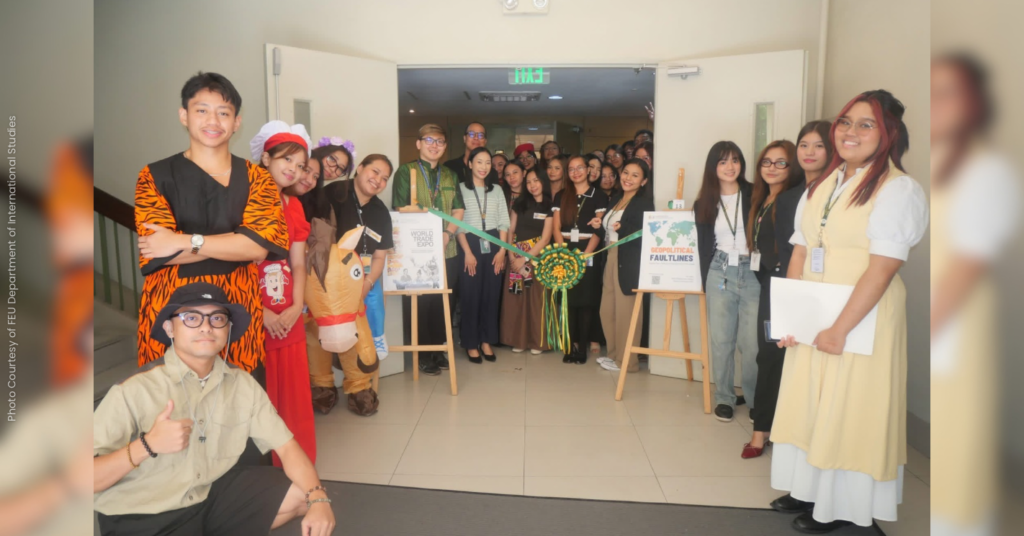
Far Eastern University (FEU) Department of International Studies (IS) underscored how trade, conflict, and globalization remain as interconnected global realities through the fifth Geopolitics Exhibit and World Trade Expo at the University Conference Center last May 6.
Organized by first-year and fourth-year Bachelor of Arts (BA) in International Studies students, the dual exhibits explored how international trade systems, geopolitical tensions, and cross-border relations influence both state policies and everyday life.
Among the initiatives was the World Trade Expo, organized by fourth-year students under their Trade and Development course, which featured discussions on regional trade profiles, imports and exports, tariffs, quotas, and international trade agreements, alongside products and innovations from different regions worldwide.
In an online interview with FEU Advocate, IS senior Princess Andrea Lantoria shared that the expo served as their final summative assessment, with students grouped and assigned geographic regions to ensure a wide range of global perspectives.
“Our professor, Mr. Wayne Uyseco, made sure all regions will be tackled by the students to promote diverse perspectives and products,” she explained.
According to Lantoria, the exhibit sought to demonstrate how globalization extends beyond theoretical discussions by illustrating how goods, policies, and economies remain interconnected across countries.
“Globalization is not just an abstract concept that is far from people’s reach,” she emphasized, noting that international trade reflects lived realities through the movement of products and services between nations.
The senior also underscored the relevance of experiential learning for students pursuing careers in international studies, citing how the event strengthened students’ research, analysis, presentation, and creative skills through weeks of preparation.
“With all the weeks of preparation, we were able to maximize our research skills, especially with regard to knowing the specificities of the region and the countries we handled, their trade practices, priorities, and policies,” she remarked.
Lantoria added that the students also incorporated sustainable and locally tailored materials into their booths to make presentations more authentic and engaging.
Meanwhile, first-year BA IS students mounted the fifth Geopolitics Exhibit, which examined how geography, borders, and resources shape political behavior and global tensions.
The exhibit featured interactive maps and presentations discussing issues such as tensions in the West Philippine Sea, trafficking and smuggling in the Balkan region, and fragile security conditions in South Asia.
IS freshman Samantha Nadine Baluyut noted that the exhibit formed part of their Geography and Global Challenges course requirement, with all groups from both sections tasked to present geopolitical maps.
“The maps primarily showed how geopolitical conflicts today are interconnected across regions and issues,” Baluyut stated.
She also stressed the importance of exposing students to geopolitical discussions, noting that such issues affect societies beyond the academic sphere.
“I hope that the visitors will keep in mind that learning about geopolitical issues is not confined solely to students of International Studies, but is a vital discourse that should be opened up across more educational spaces and mainstream platforms,” she conveyed.
Through the simultaneous exhibits, IS students translated discussions on globalization, trade, and geopolitical conflict into interactive learning initiatives.
(Photo courtesy of the FEU Department of International Studies)