








By Kristine Aimee Millonte
#Refreshments: In the most literal and loneliest space, a man wakes up with no memory of who he is or why he exists there, unaware that he’s been sent on a mission to save a dying world. In ‘Project Hail Mary’ (2026), Andy Weir — the mind behind ‘The Martian’ — returns to the screen once again, placing humanity and beyond in the quiet, unforgiving expanse of space.
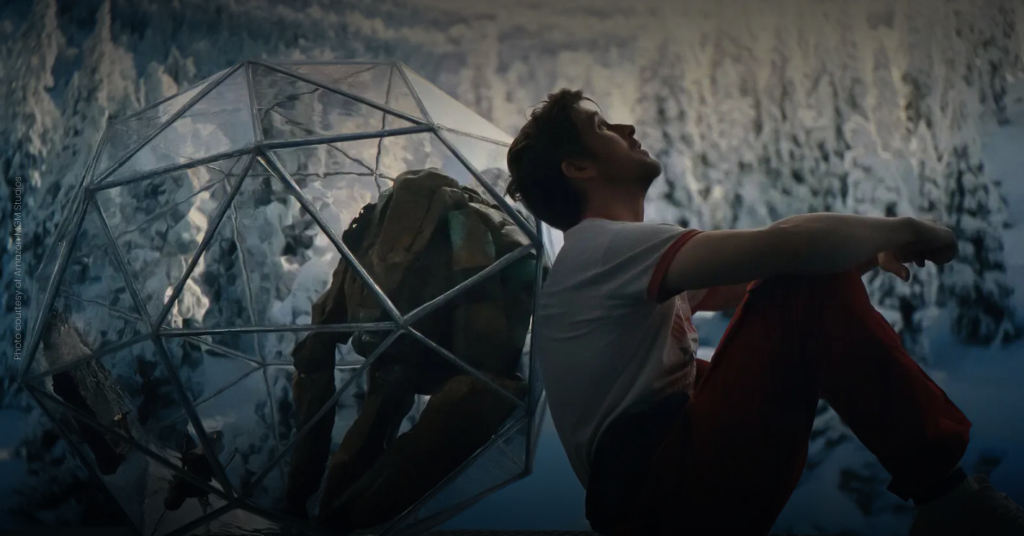
The story starts when Ryland Grace, portrayed by Ryan Gosling, wakes up as the sole survivor aboard a spacecraft. He has no clear idea of how he got there, only fragments of memories that gradually resurface and an impossible mission ahead of him, which immediately places him in a situation where survival depends on piecing together his own identity.
The mission involves the launching of ‘Project Hail Mary,’ a one-way journey to deep space to find a solution against the star-eating astrophages. These alien microbes infect the stars, draining even Earth’s own Sun, pushing humanity toward an irreversible extinction.
Once the Earth loses its main energy source, civilization will collapse, and food production will fail, making the mission humanity’s first yet final attempt at continued existence.
But as extinction becomes statistically certain, survival stops being a shared human right. Everything turns into a calculated allocation of who gets sent to fix it and who is left to bear the sacrifice.
As Grace’s identity slowly returns in disjointed pieces, the film reveals that before becoming a science teacher, he was first a reluctant PhD holder in Molecular Biology. His research focused on the possibility of life forms existing without water — an idea largely dismissed by the scientific community for being ‘too unconventional.’
This frames him as a less celebrated kind of protagonist, set against the backdrop of infallible sci-fi geniuses typically idealized in the genre.
He even grapples with a harsher truth: that he was never truly chosen for this mission. He was not the most brilliant nor the most willing, yet he is sent on a one-way journey built on the expectation of sacrifice.
This reframes the idea of saving humanity itself. In Grace’s world, survival is not distributed equally — it is delegated. And what looks like heroism from afar is, at its core, institutional decision-making disguised as fate, wherein authorities decide who is expendable, but frame it as necessity.
Gosling once again portrays a man defined by hesitations, but instead of playing jazz at Seb’s, here, he is “the not in astronaut”: a man who never quite fit the role he was forced into, yet is the only one left to do so.
But Grace, really alone? Was he always alone? Question.
Then comes Rocky.
As an alien engineer from the Eridian species, Rocky is on his own parallel mission to save his own planet. At first, two minds attempted to bridge an impossible language barrier. What begins as confusion slowly becomes understanding, then coordination. After all, they share a common goal: to keep their respective worlds from fading.
On their way to saving Earth, saving Erid, and saving each other in the process, they devise plans together, watch each other sleep, and learn each other’s worlds.
By the time the mission reaches its final stretch, Project Hail Mary has also redefined what it means to save a world. It is no longer a story about one man chosen for greatness, but about two unlikely lives refusing to let the other disappear.
It also disrupts the fantasy of self-sufficiency often celebrated in survival narratives. Even in the vast emptiness of space, the film insists that no system — biological, planetary, or political — endures in isolation.
The world has long been plagued by crises. From climate change to widening political divides and information warfare, long before space became the setting, survival here on Earth has already been inequitable; sustained by some, endured by others.
And so, Project Hail Mary is quite, literally, full of Grace — and Rocky — but more importantly, full of the insistence that no one is ever meant to save the stars alone.
(Photo courtesy of Amazon MGM Studios)