





By Julienne G. Tan
Every 12th of June, the Philippines commemorates the declaration of independence from colonial rule with flag-raising ceremonies, speeches, and renewed calls for patriotism. Yet independence has always demanded more than remembrance. It requires competent institutions that prioritize public service, because when those entrusted to govern fall short, it is the ordinary Filipinos who bear the consequences.
However, recent years have increasingly tested this expectation of competent and accountable leadership. From governing struggles and impeachment proceedings to repeated quorum failures and viral hearing moments, the supposed highest democratic institution of our country has increasingly found itself at the center of public mockery.
Beyond the headlines and memes, it raises questions about governance itself: What happens when legislative work slows amid political turmoil? And what does independence truly entail when many Filipinos continue to wait for institutions to fulfill the promises attached to democratic representation?
A chamber at war with itself
In the eyes of many Filipinos, the Senate has become another stage for political spectacle. What began as usual political disagreements evolved into a series of escalating confrontations that exposed deep fractures within one of the country's most powerful institutions.
The unraveling of the alliance between President Ferdinand Marcos Jr. and Vice President Sara Duterte marked a turning point, spilling far beyond Malacañang, reshaping alliances within the Senate, and shifting routine legislative work into a battleground for competing political camps.
This fracture became impossible to ignore last May 11, when Senator Ronald ‘Bato’ dela Rosa resurfaced after six months of being away from the Senate to cast what he later described as the deciding vote that installed Senator Alan Peter Cayetano as Senate president. Dela Rosa later claimed in an interview with Kapuso Mo, Jessica Soho, that fellow senators had urged him to return to secure the leadership change.
His reappearance came just as the chamber prepared to receive the impeachment complaint against Vice President Duterte, highlighting how Senate proceedings had become increasingly shaped by the shifting of major political alliances. Dela Rosa, at the time, was listed as ‘wanted’ by the International Criminal Court for alleged crimes against humanity tied to the Duterte administration's anti-drug campaign.
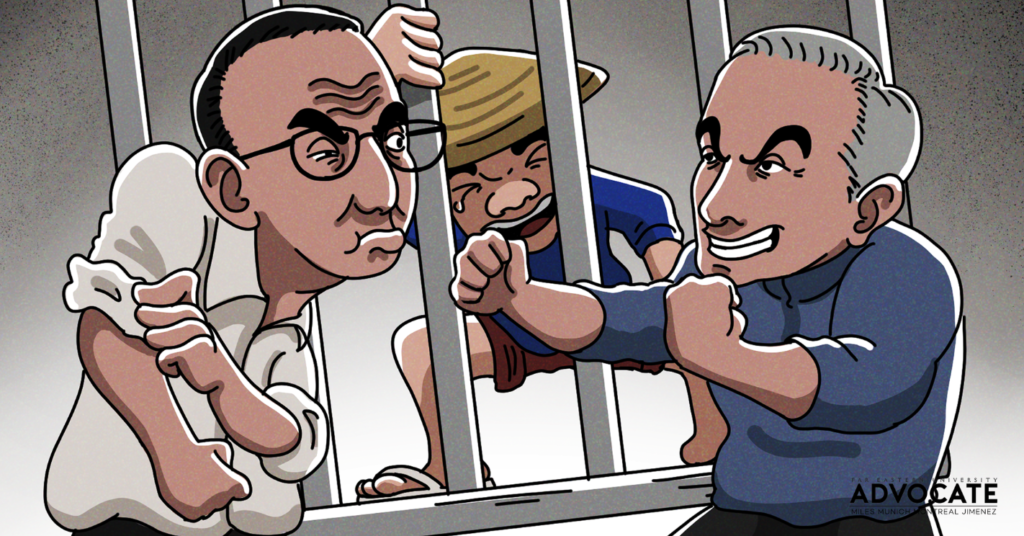
When the image of a senator using the legislature not as a venue for public service but as a stage for factional power arises, the perceptions of institutional incompetence and misplaced priorities further deepen. It also reinforces long-standing concerns about unequal access to justice, wherein ordinary citizens face swift consequences for minor infractions while influential figures can rely on political connections and the protection of their peers.
In an interview with FEU Advocate, Far Eastern University (FEU) second-year political science student Alexia Marie Manabat described watching the Senate's escalating dysfunction as something that cuts deeper than frustration.
"Watching every session of the Senate makes me feel like the true essence of serving the Filipinos is being ignored, especially that lawmakers were put in a position by the votes of the people to convene sessions over constitutional, legal, and political fractures — so why has the Senate become so paralyzed in legislative work?" she asked.
Tensions escalated further on the night of May 13 when gunshots were heard inside the Senate building, coinciding with the transmission of the articles of impeachment against Vice President Duterte to the Senate in the presence of the media, putting the building under temporary lockdown.
The incident prompted criticism from opposition groups, which subsequently filed complaints for obstruction of justice against senators who allegedly aided dela Rosa in evading arrest.
The Senate's turmoil invites a deeper reflection on the state of the country's sovereignty. Independence was meant to secure not only freedom from foreign rule but also the capacity for accountable self-governance — an ideal tested when political institutions struggle to prioritize the welfare of the people over narrow political interests.
The bills buried beneath the noise
But while the public’s attention is fixed on this cycle of unrest, the work that the government is supposed to fulfill slips into the background. Every hour spent on procedural deadlocks is an hour unused for deliberating measures that directly affect millions of Filipinos.
Tensions over Senate leadership and the institution's direction spilled into regular legislative work, resulting in two consecutive days of canceled plenary sessions after senators failed to establish a quorum.
This prompted President Marcos Jr. to publicly call on senators to ‘get back to work’ and warn that the impasse was undermining governance and halting the ‘essential business of legislation.’
The deadlock was broken last June 3, when Senator Francis ‘Chiz’ Escudero attended the session, providing the numbers needed to restore a quorum after days of legislative paralysis. His arrival allowed the proceedings to resume and enabled senators to move forward with leadership and committee reorganizations that had been stalled by the impasse.
This came at a high cost, with several priority measures endorsed by the Legislative-Executive Development Advisory Council remaining stagnant as the chamber adjourned, according to Malacañang.
Among the measures left in limbo is the Anti-Hospital Detention Bill, which seeks to end the practice of preventing patients from leaving hospitals — or withholding the bodies of deceased loved ones — because of unpaid medical bills.
The comedy of the Senate’s online meme cycle evaporates when juxtaposed with the reality of its legislative stalemate. Every hour spent clipping a senator's emotional floor breakdown into a viral TikTok clip is an hour stolen from the families currently trapped in hospitals, unable to bury their dead because the bill remains buried under political theater.
Another is the proposed Magna Carta of Barangay Health Workers, which aims to provide stronger benefits and protection to frontline health workers who often serve as the first and only point of care in underserved communities. Delays in passing the measure prolong the vulnerabilities of workers who continue to bridge gaps in the country's healthcare system with limited support and recognition.
Among those who have been watching the chamber's commotion with a specific lens is Dr. Reynold Agnes, an associate professor at FEU and current president of the Philippine Political Science Association. He traced the roots of legislative inaction not only to the country's current political crises but also to a structural problem that has remained unresolved since the ratification of the 1987 Constitution.
He also argued that the Senate's recurring dysfunction may stem from a political system that allows power to remain concentrated within the same families across generations.
"The Constitution was ratified on February 2, 1987. It's 2026 na... Up until now, there is no law yet banning political dynasties. The absence of [an] anti-political dynasty law is the cause. It is not in the interest of families controlling the two houses. Why? Because it's like political suicide on their end," he explained in a separate interview.
Agnes pointed out that the Senate's lack of action goes beyond today's political conflicts. For him, the deeper problem is a system where lawmakers from political families are less likely to support reforms that could weaken their hold on power. As a result, bills that may benefit the public often struggle to move forward because they conflict with the interests of those already in seats of power.
Similarly, Axel John Cainglet, News Editor of The Manila Collegian, pointed to two specific measures whose stagnation he traced directly to the dynastic composition of the legislature itself.
"House Bill No. 209 [An Act Defining and Prohibiting Political Dynasties] and House Bill No. 4172 [Campus Press Freedom Act] are two of the currently pending bills in the lower chamber that I hope to be enacted. However, the dynastic composition of the Congress and the self-preservation tendency of the lawmakers prevent any significant developments for the two bills," he expressed in an interview.
Delayed legislation does not simply mean postponed policy discussions; it leads to extended uncertainty for communities that depend on these meaningful reforms. For many Filipinos, especially those belonging to historically marginalized sectors, legislative inaction means waiting longer for representation, protection, and recognition from institutions meant to serve them.
In a separate interview, Mark Julius Clerigo, an FEU third-year political science student, asserted that the impact of that failure is most evident in the communities left to shoulder its burden.
"Ang daming mga Pilipino na naghihintay, mga magsasaka, mga [mangingisda], mga atleta, the LGBTQIA+ community, the solo parents, students. Ang daming representation na dapat mangyari pero [naisantabi] kasi maraming political problems and chaos ang inuna ng mga senador natin (Countless Filipinos remain waiting, such as farmers, fisherfolk, athletes, members of the LGBTQIA+ community, solo parents, and students. Countless sectors deserve representation and action, yet they have been pushed aside because many of our senators have chosen to prioritize political problems and chaos instead)," he said.
If reforms stall because they threaten the political interests of those in power, then inaction ceases to be a mere byproduct of dysfunction and becomes a reflection of institutional priorities. As measures addressing representation, accountability, and protection remain buried beneath political maneuvering, Filipinos are left to bear the cost — not only through delayed policies but also through opportunities for reform that never materialize.
The laughingstock of the nation
Political dysfunction today does not end when the gavel falls. Within minutes, heated exchanges are clipped into short videos, sarcasm becomes screenshots, and moments of tension are repackaged into memes that circulate across Facebook, TikTok, and X. Senators increasingly reach Filipinos not through legislation they authored or policies they championed, but through viral soundbites and reaction images.
A week after the shooting incident, the Senate had become a relentless wave of internet memes. Senator Pia Cayetano's breakdown on the Senate floor, in which she called out minority members for not checking on her after the shooting, was clipped and circulated online before the session ended.
For Manabat, the proliferation of memes surrounding Senate proceedings reflected a growing disconnect between public expectations and the institution itself.
"The line 'Ang hirap mahalin ng Pilipinas' (It’s hard to love the Philippines) has been echoing throughout every corner of the streets because while the Filipinos are truly great people, the nation has become more of a circus rather than a sanctuary. It is disappointing, heartbreaking, at last, that the Senate proceedings turned into memes because it strips away the real essence of their job and exposes the raw, absurd nature of the people's so-called leaders," she shared.
Nonetheless, beneath the humor and frustration is a growing sense of political awareness. Many young Filipinos are no longer content to accept political spectacle as normal, instead questioning the disconnect between democratic ideals and realities. The memes surrounding Senate proceedings may reflect disappointment, but they also signal a generation that can recognize dysfunction when it unfolds before them.
This growing political consciousness challenges a status quo sustained by generations of public tolerance and disengagement. More than expressing frustration, the youth's reactions suggest a refusal to accept that political theater should come at the expense of public service.
Clerigo acknowledged that while the instinct to laugh is a natural first response, it cannot be where the reaction ends. He distinguished the humor that surfaces in the moment and the deeper frustration that it often masks.
"Sa una, matatawa ka. You will laugh about it. You will make and share memes about it. But if you will go deeper and think more critically, maunawaan mo na ‘yung mga kasalukuyang nagaganap sa Senado ay bunga ng nagdaang desisyon ng mga Pilipino (At first, you will laugh about it. You will make memes and share them online. But if you look deeper and think more critically, you will realize that the current Senate happenings is the result of the decisions Filipinos made in the past)," he reflected.
To Cainglet, the meme cycle is not a mere distraction but something politically meaningful, a form of protest that carries real weight, even as it risks being absorbed into the very spectacle it critiques.
"Social media posts — ranging from memes, news, to critical analysis — are often a reflection of the state and a manifestation of protest from the people without exception. Apart from information dissemination, it amplifies the disgust and discontentment of the masses from the incompetence of those who hold power," he shared.
However, these political memes also direct public discourse in multiple and often conflicting directions. While they can make political issues more accessible, they may simultaneously oversimplify complex matters into shareable content designed for entertainment and engagement.
In this sense, political memes function as a double-edged sword: they provide avenues for criticism and participation, but they can also distort public understanding of events.
This pursuit of virality often comes at the expense of accuracy. Stripped of context and optimized for rapid consumption, memes can obscure nuance, circulate misleading narratives, and amplify misinformation. Rather than merely reflecting political realities, they can actively shape perceptions of them.
Instances of fabricated quote cards attributed to fictional characters such as Annalise Keating and Saul Goodman from popular television series ‘How to Get Away with Murder’ and ‘Better Call Saul,’ respectively, further illustrate how entertainment culture intersects with political discourse online.
Presented in familiar visual formats that mimic legitimate media content, these posts often circulate widely despite lacking credible sources. Their popularity underscores how easily misinformation can gain traction when packaged in engaging and emotionally resonant forms.
Moreover, an analysis by FULCRUM noted that the 2016 Presidential Election, which former President Rodrigo Duterte won, is now considered the country's "first social media election," a turning point after which politicians learned that provocation and virality could substitute a legislative record. In the years since, political discourse has increasingly been shaped by the logic of online engagement, where moments that provoke strong reactions often travel farther than the issues themselves.
This can also be seen with the contractors and officials involved in the Blue Ribbon Committee hearings on the flood control corruption scandal, which became the subject of viral memes. Slowly, the line between political accountability and online entertainment grew increasingly blurred when public hearings became punchlines, and the weight of the issues they seek to address risks being lost amid the laughter.
With political conversations increasingly shaped by social media, the role of entertainment in civic engagement has become harder to ignore. While memes and viral moments can draw people into political discussions, they may also reduce complex policy issues to fleeting online content.
Independence, on whose terms?
The Senate's ongoing instability casts a different light on this year's Independence Day observance. When the nation's legislative chamber becomes defined by political feuds and legislative limbo, it raises an even deeper question: What does sovereignty mean if the institutions meant to uphold it struggle to serve those they represent?
Manabat traced the meaning of independence not through historical narrative but through the texture of daily life — through the specific ways ordinary Filipinos experience or are denied what the state owes them. For her, independence is not an abstraction commemorated once a year but a standard measured against how the country is actually governed.
"Independence Day was more than the fragments of rebellions that the Filipinos stood for. It is a freedom out of resistance — rationed by the love for the people, by the people, [and] from the people. It is a non-tangible product that the Philippines once valued its countrymen over some rotting dominance — a breathing struggle forged by the people," she reflected.
That standard, measured against the current Senate, exposes an uneasy reality: Do young Filipinos feel heard by the institutions that claim to represent them? Do they see their concerns reflected in legislative priorities? Do they believe the government is capable of responding to the problems that shape their futures?
Cainglet answered the questions from a vantage point shaped by journalism and activism. For him, true independence carries a specific and demanding definition, one that goes far beyond ceremony and cuts directly to the conditions under which a free press and a free people can actually exist.
"True independence, in my view, is the freedom to write and expose the societal inequalities that are free from state censorship and foreign manipulation," he stated.
As for Clerigo, he emphasized that democracy is not exhausted by the act of voting and that young Filipinos carry more political agency than they are often given credit for. He pushed back against the tendency to dismiss youth voices, issuing a pointed reminder to those who would silence them out of age alone.
"You are not too young to be involved; you are too old to be ignorant," he declared.
Dr. Agnes shared that same conviction, grounding it not with idealism but in the concrete mechanisms through which citizens have historically held power accountable. He pointed to the collective force of civic engagement as the most direct instrument available to ordinary Filipinos watching their institutions falter.
"In the Philippines, we have repeatedly witnessed [the] effectiveness of civil society, most notably during the EDSA People Power Revolution. So this event was remarkable. It resulted in the peaceful removal of a dictator without bloodshed. So that's the power of civil society," he said.
Clerigo concluded with a line that cut to the heart of what Independence Day demands from every Filipino — a reminder that liberation is not only historical but conditional.
"Hindi tunay na malaya ang bayang ipinagtatanggol ang manlulupig nito (A nation is not truly free when it defends those who oppress it)," the student asserted.
As another Independence Day commemoration passes amid Senate boycotts, stalled legislation, and a political landscape increasingly reduced to spectacle, the gap between what independence promised and what governance delivers grows harder to ignore. The ceremonies will proceed, but freedom means more than the absence of foreign rule — it also requires confronting the systems that continue to silence, constrain, and deny Filipinos the quality of life they deserve in their own country. The question remains: are Filipinos truly free, or have the chains simply grown familiar enough to go unquestioned?
(Illustration by Miles Munich Montreal Jimenez/FEU Advocate)