





By Ishia Eleanor F. Marquez
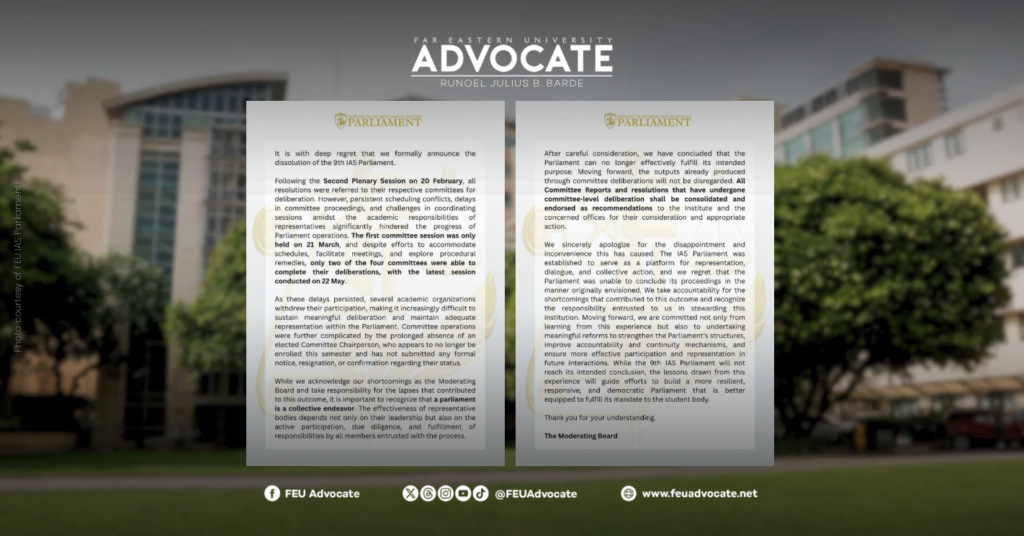
Far Eastern University (FEU) 9th Institute of Arts and Sciences (IAS) Parliament announced its dissolution after the withdrawal of several academic organizations, citing procedural difficulties in a statement released last May 31.
Composed of nine academic organizations, the IAS Parliament serves as the Institute’s presiding legislative body, which aims to propose resolutions to address the IAS student body’s academic concerns.
The 9th Parliament officially convened last November 20. However, only two plenary sessions followed, specifically held last February 4 and 20.
In a statement posted on Facebook, the FEU IAS Parliament explained that the proposed resolutions by the legislators during those sessions were subjected to deliberations in their respective committees. However, the legislative body faced various setbacks that hindered further parliament sessions from convening.
“Persistent scheduling conflicts, delays in committee proceedings, and challenges in coordinating sessions amidst the academic responsibilities of representatives significantly hindered the progress of Parliament operations,” it read.
In an online interview with FEU Advocate, presiding officer and Moderating Board member Irish Francine Alarilla shared that the board asked the member organizations to assess their capability to continue participating despite the challenges.
“We encouraged each organization to assess its capacity to continue participating in light of the operational challenges, time constraints, and other commitments faced by its representatives. We respected these decisions as legitimate exercises of their judgment and autonomy within the Parliament,” she explained.
With only two out of nine academic organizations expressing their intention to continue, the Moderating Board concluded that the Parliament can no longer effectively perform its duties in serving the students, prompting its dissolution.
Parliament criticisms, challenges
As one of the academic organizations that withdrew, the Political Science Society (PSS) emphasized the legislative body’s role in being an avenue for proper student representation in a statement released last May 30.
“The purpose of the Parliament is to serve as a space where students' interests are shared and discussed… To be the voice of our stakeholders is the foremost duty of each representative,” the organization noted.
In contrast, PSS noted that the 9th IAS Parliament failed to uphold its purpose of addressing student concerns due to its representatives’ ‘incompetence.’
Additionally, the academic organization shared that the Moderating Board requested the Parliament representatives to hold a session on May 25 despite the academic year’s conclusion, an ‘option’ that they claimed was only proposed due to the legislative body’s inefficiency.
They further denounced the Parliament for depriving the Tamaraws of the representation they deserve, hoping that the next legislative body will serve with urgency and accountability.
“When delays become frequent, schedules remain in disarray, and sessions are reduced to mere compliance instead of genuine representation, the essence of what the Parliament stands for erodes,” the PSS emphasized.
Moreover, the Moderating Board stated that the prolonged absence of the committee chairperson also added to the parliament’s operational conflict, as they reportedly did not submit any notice regarding their status to the board.
The committee chairperson spearheads the parliament sessions and is responsible for scheduling meetings, managing deliberations, and coordinating among the committee members.
Furthermore, Alarilla noted that the chairperson’s absence contributed to the issues they faced in succeeding sessions, resulting in the Moderating Board turning to other measures.
“Without active leadership in several committees, coordination became more difficult, and procedural timelines were affected. The absence also created uncertainty regarding the committees' direction and continuity, requiring the Moderating Board to explore alternative arrangements while preserving the integrity of the parliamentary process,” she shared.
Acknowledging their lapses, the Moderating Board apologized and affirmed their commitment to collectively providing meaningful representation to the students despite the incident.
“The IAS Parliament was established to serve as a platform for representation, dialogue, and collective action, and we regret that the Parliament was unable to conclude its proceedings in the manner originally envisioned… We take accountability for the shortcomings that contributed to this outcome,” the statement read.
Additionally, the presiding officer shared that the board is currently proposing reforms, including capacity-building programs, a timetable ahead of the proceedings, better coordination, and other amendments to the House of Rules regarding attendance and accountability.
In a separate post, the 9th IAS Parliament shared ten resolutions that managed to undergo committee deliberations, which will be further evaluated by the Dean’s office and other relevant offices.
These include House Resolution (HR) No. 2 by the PSS, which aims to promote the usage of Generative Artificial Intelligence (GenAI) in student assessments through tutorial videos in collaboration with the concerned offices.
Meanwhile, the FEU English Language Circle proposed HR No. 13, seeking to modify the guidelines for the grading system of outputs that utilize GenAI.
(Photo courtesy of FEU IAS Parliament)