






By Ishia Eleanor F. Marquez
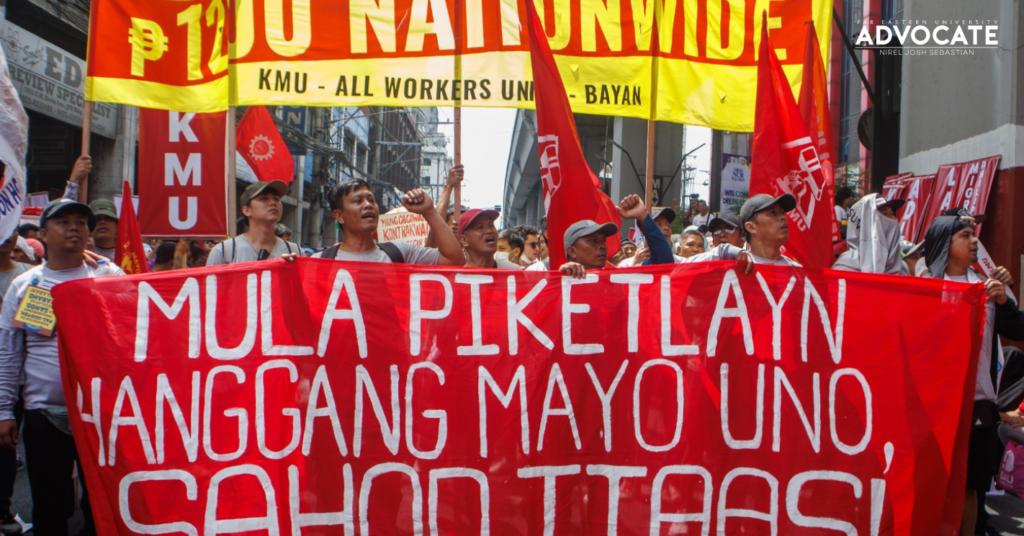
Despite the ₱85 adjustment on the Metro Manila daily minimum wage, labor groups and workers continue to push for a higher national living wage amid the country’s poor economic conditions and rising prices of goods under the Marcos Jr. administration.
Under Wage Order No. NCR-27, Department of Labor and Employment (DOLE) Secretary Francis Tolentino announced last June 30 that labor workers across the National Capital Region (NCR) will receive an ₱85 increase on their daily minimum wage to be implemented in two tranches: ₱60 on July 19 and ₱25 on January 20 next year.
For the non-agricultural sector, the daily minimum wage is expected to increase from ₱695 a day to ₱780 on its second tranche, while the agricultural workers’ wages will rise from ₱658 to ₱743 after the second tranche.
Claiming the increase as ‘historic,’ Tolentino said that the new order would benefit over 1.1 million minimum wage earners in the country.
This is higher than the ₱50 increase on Metro Manila workers’ wage issued by the National Wages and Productivity Commission under Wage Order No. NCR-26 last July 2025.
Prior to the announcement of the wage increase, IBON Foundation deemed the ₱510 national average minimum wage insufficient for a family of five, noting that it is only half of the ₱1,305 estimated national living wage needed per day due to the high inflation rates.
This was backed by labor groups as they asserted the need for a higher minimum wage, stating that the ₱85 increase remains inadequate amid rising prices of basic necessities.
Labor groups slam ₱85 wage hike
In an online interview with FEU Advocate, Kilusang Mayo Uno (KMU) Secretary General Mary Ann Castillo said that the salary hike is insufficient due to government-mandated deductions incurred by workers.
“Tumaas ‘yung inflation rate mula nung May at June. Talagang mataas ang bilihin at mababa ‘yung hupay talaga ng sahod… Last year din noong 2025 January tumaas ang government-mandated deductions ng SSS [Social Security System], talagang maliit ang inuuwing take-home pay ng manggagawa bukod sa mataas na income tax (The inflation rate increased from May and June. The prices of goods are high while wages remain low. Last January 2025, the government-mandated deductions increased for SSS, resulting to workers taking home even less pay aside from the already high income tax),” she stated.
Despite the Philippine Statistics Authority recording a lower inflation rate of 6.8 percent in May and 6.4 percent in June, food prices continue to rise during the second half of last month.
Meanwhile, the SSS implemented a one-percent contribution rate increase for private sector workers, including business owners and workers, household employers and employees, voluntary and non-working spouse workers, and land-based Overseas Filipino Workers last January 2025.
Additionally, Castillo criticized the government’s decision to implement the salary increase into two tranches despite its already ‘meager’ amount, further questioning the basis for the ₱85 wage hike.
“₱85 na nga [lang] siya, tapos ‘di pa siya ‘yung across the board na lahat makikinabang tapos ginawa niya pa ‘yung dalawang hati… Maliit na nga, hinati pa niya. Sana binuo na lang niya… [At] wala kami makita na [naging] basis bakit ₱85 at dalawang tranche pa ito (The increase is only ₱85 and would not even be implemented across regional wage boards to benefit everyone, further splitting it into two tranches. It was already small to begin with yet they divided it into two. They should have just given the full amount. We also did not see any basis why the increase was ₱85 and why it was implemented in two tranches),” she stressed.
In response to the minimum wage, the KMU secretary general revealed that she, along with other labor workers, pushed for a ₱200 wage increase and ₱1,200 national daily minimum wage prior to the announcement of the ₱85 wage hike by DOLE.
House Bill No. 202 was filed by ACT Teachers Partylist Representative Antonio Tinio and Kabataan Partylist Representative Renee Louise Co, seeking to implement a ₱1,200 national living wage for private sector workers while addressing salary disparities between regions.
The lack of a unified national wage in the country is prompted by the Republic Act No. 6727, or the Wage Rationalization Act of 1989, which is supposedly meant to equalize the exchange between businesses and workforces through varied wages based on the cost of living across regions.
However, labor groups continue to condemn the said law, arguing that the prices of goods continue to rise regardless of area, which does not justify the low wage in rural areas.
In relation to this, Castillo denounced DOLE’s discretion to implement the wage increase in NCR only despite having the authority to increase salaries across the nation.
“Kaya naman pala niya mag desisyon bilang Secretary ng Department of Labor [para] sa lahat. Kumbaga nakahain na ang wage [petitions] sa regional wage boards, talagang hinayaan niya na lang ‘yung [ibang] wage board ‘yung pagbibigay niya ng dagdag sahod [at sa] NCR niya lang ginawa ‘yung ganun [utos] (It turns out that he is capable to decide as Secretary of the Department of Labor for everyone. Wage petitions have already been filed before the regional wage boards, yet he still left the wage increase decision to other regional wage boards while implementing this order in NCR only),” she said.
The KMU secretary general also expressed dismay over the disparity in wages among agricultural and non-agricultural sectors, noting that farmers perform much more labor yet receive lower pay. Thus, she emphasized the need to unify salary rates.
Despite the Philippines being recently recognized as an upper-middle-income country by the World Bank, Filipino farmers’ wages fail to reflect the recognition, with their earnings reaching up to only ₱300 a day, which is significantly lower than the estimated national living wage.
Pointing to the administration’s lack of initiative, Castillo criticized President Ferdinand ‘Bongbong’ Marcos Jr. for failing to heed the calls of labor groups for the implementation of a national wage increase.
“Hindi kulang [ang aksiyon] niya, kundi wala [talaga] siyang tugon… Ilang beses na nanawagan sa pagtaas ng sahod, pero talagang wala siya ginagawa… Wala siyang iniisip para sa kapakanan ng nasasakupan ng mga mamamayang Pilipino (He did not fall short in his actions because he did not respond at all. Despite the repeated calls for higher wages, he has done nothing. He has shown no regard towards the welfare of the Filipinos),” she stated.
Workers’ wage predicament amid poor living conditions
As the inflation rate went up to 2.4 percent last February, Filipinos have faced difficulties with employment amid the country’s worsening economic condition and rising cost of living.
While acknowledging the looming wage hike as a significant step, for high school teacher John Dem Santos, the salary increase remains inadequate as it fails to keep up with the continuous rise in commodity prices.
“Sa isang banda, malaking hakbang ito at maganda na merong pagtaas ng sahod, subalit sa kabilang banda, hindi naman ito sapat… Hindi pa rin tayo satisfied, dahil hindi naman nakakahabol ‘yung pagtataas ng sahod sa pagtataas ng presyo ng bilihin. Magtataas ka ng sahod ₱85, tapos bilihin tataas ng ₱100, paano ka naman makaka-survive niyan? (On one hand, this is a significant step and it is good that there has been a wage increase. On the other hand, however, it is still not enough. We are still not satisfied because the wage increase is failing to keep up with the rising prices of goods. If wages go up by ₱85 then the cost of goods increases by ₱100, how are people supposed to survive?),” he stressed.
According to the Department of Trade and Industry last May, the prices of some basic goods will increase due to the ongoing conflict in West Asia; however, secretary Maria Cristina Roque assured that it is expected to remain below 10 percent of prewar prices.
Even with the financial support of his father’s pension, Santos continues to struggle to budget his income despite having only himself and his father to sustain.
“Mahirap mag-allocate ng budget kahit sabihin mong ako o dalawa lang kami ng tatay ko… ‘Pag sabihin natin wala na siyang pension, paano na? Kahit natatanggap ko ‘yung supplement ng pension, hindi pa rin kasya… Kahit anong pagtitipid gawin ko, ‘di pa rin kasya (It is difficult to allocate my budget even if there are only two of us, me and my father. But, if for instance, he no longer has his pension, what would happen then? Even if I receive his pension as a supplement, it is still not enough. No matter how much I try to save expenses, it is still not enough),” he said.
As Santos deemed his current minimum wage inadequate to cover the basic needs of two people alone, he stressed that the budgeting situation could be worse for larger families.
Similarly, Castillo underlined that the increase is disproportionate to the country’s actual cost of living, citing the mounting expenses faced by jeepney drivers and other workers.
“Malayo ang ₱85 sa daily cost of living [na] mataas na… Ang hirap pagkasyahin ng minimum wage… ‘Yung sahod nanatili ng mababa tapos tumaas na ‘yung gasolina, presyo ng krudo, nakikita talaga natin kung paano nahirapan ang drivers at tsuper… ‘Yung mga bilihin, bayarin, pati ‘yung sa kuryente mataas [at sa] tubig mataas (The ₱85 increase is far from the already high daily cost of living. It is difficult to meet daily needs with the minimum wage. While wages have remained low, gasoline and fuel prices have continued to rise, and we have clearly seen how this has burdened the drivers and jeepney operators. The prices of basic goods and household expenses also increased, including electricity and water bills),” she stated.
Last June, Meralco announced a ₱0.1488-per-kilowatt-hour (kWh) increase in the electricity rate, bringing the total rate from ₱14.3354 per kWh last May to ₱14.4833 per kWh in June.
As the West Asia conflict persists, fuel prices are set to increase starting July 7, with diesel prices rising by ₱1.57 to ₱3.57 per liter and kerosene prices at ₱1.70 to ₱3.70 per liter.
In light of such conditions, Castillo and Santos stressed that the government’s short-term cash assistance or ayuda is insufficient, especially to those in the marginalized communities, pressing the administration to implement long-term solutions that would ensure livable wages for workers.
“Kaysa kabibigay-kabibigay ng ayuda, pagtuunan nila pansin kung papaano nilang mabibigyan ng tamang sahod… Maayos at ‘yung totoong sapat na sahod (Instead of repeatedly distributing cash assistance, the government should focus on ensuring that workers receive fair wages, an actual proper and sufficient salary),” Santos emphasized.
Ahead of the upcoming State of the Nation Address (SONA), Castillo expressed her hope for the President to listen to the labor sector’s calls on higher wages, lower prices of basic goods, and accountability for those involved in state corruption.
President Marcos Jr. is set to deliver his fifth SONA on July 27, where he will provide updates on the country’s development over the past year and outline plans for the administration's succeeding years.
(Photo by Nirel Josh Sebastian/FEU Advocate)