





Pride is being stripped of its history and is being sold back to us. What emerged from collective resistance against state violence and social exclusion has, over decades of neoliberal restructuring, been recast as a marketable identity — one that corporations, institutions, and even governments can readily incorporate into their public image.
When liberation becomes a negotiation, identity turns into a commodity. Pride is welcomed only when it is profitable, queerness is celebrated only when it is consumable. In this exchange, resistance is traded for respectability, politics for branding, and solidarity for spectacle.
Each June, rainbow logos proliferate across advertising campaigns and commercial spaces, contradictory to their unfavorable labor arrangements that perpetuate economic precarity, environmental degradation, and widening inequality.
The commercialization of Pride reflects more than mere corporate hypocrisy. It demonstrates the capacity of neoliberal capitalism to absorb movements that once challenged structures of power, repackaging them into symbols that ultimately leave those very structures intact.
In a conservative country where queer identities continue to be stigmatized, the endorsement of mainstream institutions may arguably foster greater social acceptance where Pride can be celebrated more openly than ever.
But acceptance is not synonymous with liberation. Visibility, while meaningful and may soften prejudice, cannot, on its own, dismantle exploitation and structural exclusion.
Now what remains is a version of Pride that is colorful enough for advertisements, respectable enough for boardrooms, and profitable enough for corporations, yet too carefully sanitized to threaten the inequalities that gave birth to it.
Queer politics is thus reshaped so that it no longer questions dominant heterosexist institutions, social, and economic norms, but seeks recognition within them. The danger in this logic is that Pride recognizes only those queer lives that can be accommodated by the market, leaving behind the struggles of those who do not fit the margin of being marketable.
This can clearly be seen every time society ends up rewarding the urban, cis-passing, consumer-oriented queer identities whose aspirations mirror the ideals of homonormative standards while abandoning those who do not fit the mold.
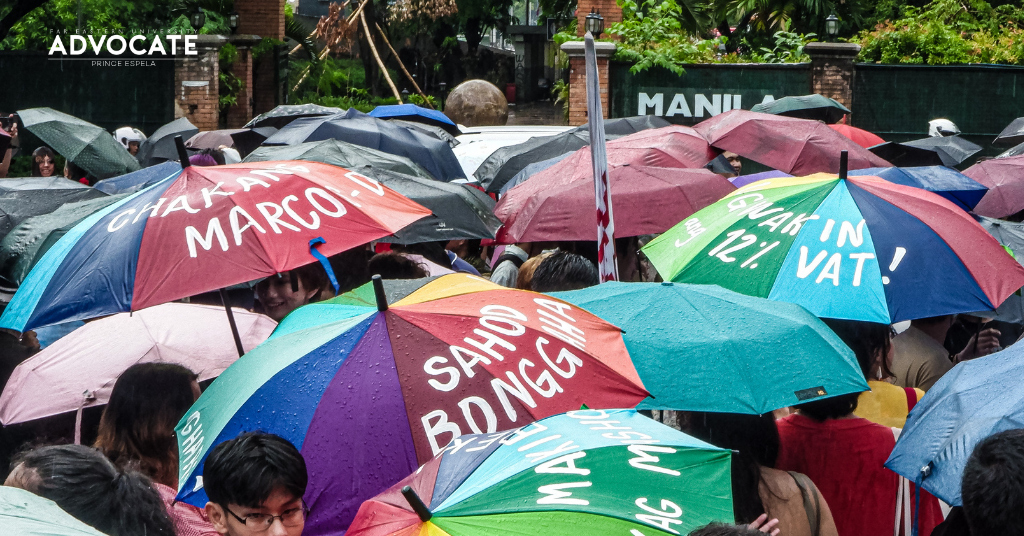
The irony becomes particularly evident in contemporary Pride celebrations, such as this year’s LoveLaban Pride PH. The event occupies a unique place in the Philippine queer movement. Last year's march drew more than 250,000 participants, with organizers expecting an even larger turnout this year, cementing its place among the largest Pride demonstrations in Asia.
Yet its growing reach comes with an uncomfortable contradiction. The larger its audience, the more valuable it becomes to corporations and state institutions seeking to capitalize on the movement's credibility.
Giving a platform to sponsors such as Aboitiz Power and state-linked institutions such as the National Youth Commission increasingly mediates Pride through corporate and governmental legitimacy.
The former’s development projects displaced marginalized communities and contested lands — from Lima Land's development of 200-hectare land cultivated by Hacienda Luisita farmers last year, to the recent Olongapo Solar Power Project that violated the Free, Prior, and Informed Consent of the Indigenous Peoples’ Rights Act of 1997, particularly of the Aeta people.
Meanwhile, the latter reproduces state narratives that delegitimize and criminalize dissent through counterinsurgency discourse, as reflected in their statement on the Toboso 19 case, which engaged in red-tagging remarks and openly expressed support for the National Task Force to End Local Communist Armed Conflict.
What’s supposed to be an emancipatory space becomes entangled with actors who have broader histories of land dispossession, environmental conflict, and state violence.
Queer liberation, however, should not be reduced to visibility. It is not merely the capacity to be represented by systems that have historically produced queer marginalization, but the struggle to transform the conditions that render queer lives precarious in the first place. This way, real queer liberation is inseparable from broader struggles against labor exploitation, state violence, and structural inequality.
Long before Pride became a spectacle of rainbows, the struggle for queer liberation has always been rooted in the grit to confront institutions that criminalized, excluded, and brutalized the community. The Stonewall uprising in 1969, sparked by resistance to police brutality, remains a defining moment of modern queer politics precisely because it transformed survival into organized defiance.
That same spirit reached the Philippines in the 1994 Stonewall Manila March, where LGBTQIA+ Filipinos gathered in the streets to challenge state harassment, discrimination, and social exclusion. To remember this history is not merely to be sentimental; it reminds the very people today that Pride was born out of a thrown brick, not popped confetti.
When we replace history with narratives of branding, it narrows down the queer imagination itself. As long as we reduce queer politics primarily to representations within existing political, economic, and cultural institutions, those institutions continue to reproduce inequality.
This narrative cannot account for the everyday realities of many queer Filipinos, whose experiences in discrimination are beyond interpersonal prejudice and are embedded in unequal access to employment, housing, healthcare, education, and economic security.
It is precisely the reason why the community’s calls to acknowledge the lived names of gender-fluid individuals, to affirm that trans women are women, and to advance long-overdue legal protections against discrimination are not symbolic concessions but essential assertions of dignity and personhood.
The Philippines is its own witness to how queer struggles intersect with broader questions of militarization and imperialism. The killing of Jennifer Laude in 2014 became not only a landmark case of anti-trans violence, but also a symbol of the unequal power relations surrounding the continued presence of foreign military forces in the country.
More than two decades after it was first filed in Congress, the Sexual Orientation, Gender Identity, Gender Expression, and Sex Characteristics (SOGIESC) Equality Bill — which seeks to prohibit discrimination based on their desired SOGIESC — remains trapped in a legislative limbo.
Yet this is hardly an isolated case, as time and again, measures advancing LGBTQIA+ rights filed with promise of progress are only left languishing in committees and repeatedly deferred or quietly pushed down. This results in a political pattern that treats queer lives as perpetually negotiable, leaving LGBTQIA+ Filipinos without comprehensive nationwide protection against discrimination in workplaces, schools, healthcare institutions, and public accommodations.
For queer Filipinos relentlessly denied employment and subjected to discrimination because of their gender expression, queer youth displaced from their homes, and transwomen barred from entering restrooms that affirms their gender, exclusion is experienced not merely as a social stigma but as material deprivation. Within this condition, liberation cannot be reduced to mere symbolic recognition or legal visibility.
These realities demonstrate that queer oppression cannot be understood through sexuality alone. Rather, sexuality intersects with class, labor, geography, and political power to determine whose lives remain most vulnerable.
It is therefore insufficient to imagine queer liberation as separate from broader struggles against exploitation, militarization, and imperial domination. Nor can Pride fulfill its historical purpose if it is confined to annual displays of corporate inclusivity while remaining silent on the conditions that continue to deny dignity to workers, peasants, Indigenous peoples, and other marginalized communities — including queer individuals within them.
A society cannot claim to have liberated its queer communities while workers remain exploited, peasants remain dispossessed, Indigenous people remain displaced, democratic freedoms continue to shrink, and those at the margins are told that representation is enough.
Reclaiming Pride demands more than an annual celebration that asks nothing of those in power. It means standing with workers fighting exploitation, peasants defending their land, Indigenous communities protecting their ancestral domains, and every sector whose struggle reveals that being queer has never been separate from the broader fight for social justice.
Pride ceases to be a protest the moment it becomes comfortable with the very systems it was born to resist. The task, then, is to not make Pride marketable but to make it political again — to fill the streets with rainbows until no one will ever have to negotiate their dignity for acceptance, their identity for survival, or their freedom for inclusion.