








By Julienne G. Tan
In the tragic aftermath of the recent school shooting in Tacloban, gaming found itself at the center of a very different kind of conversation. Reports that a suspect had allegedly played the sandbox game GoreBox quickly sparked a debate, revealing deep societal anxieties over gaming. This reaction shows how public discourse after a tragedy often gravitates toward these highly visible, simple explanations while the complex conditions behind youth violence remain difficult to confront.
Yet even as these conversations gained momentum, experts urged the public to resist drawing conclusions too quickly. They cautioned that no established scientific evidence supports a direct relationship between violent video games and acts of mass violence, warning that reducing these complex tragedies to a single factor risks overlooking the broader social, psychological, and environmental conditions that precede them.
The debate that followed the Tacloban shooting now raises questions that extend beyond one game or incident. Why do violent video games so often become part of the subject matter after such tragedies, and how does the media shape the narratives people come to believe?
When one factor takes the blame
Last June 22, a shooting incident at San Jose National High School in Tacloban City, Leyte, left three students dead and 13 others wounded. Both alleged suspects, minors aged 14 and 15, were in police custody within hours.
GoreBox quickly entered the spotlight when early investigative reports revealed that one of the suspects had allegedly played it.
Developed by independent studio F2Games, GoreBox is a physics-driven, sandbox-style video game that emphasizes user-generated environments and graphic destruction.
More than a week after the shooting, Cybercrime Investigation and Coordinating Center (CICC) Executive Director Renato Paraiso told ANC that the ban on GoreBox risked becoming permanent. This followed a Senate hearing on July 1 wherein the game's German-based developer declined an invitation to explain its safety measures.
Paraiso clarified that the CICC was not pursuing an outright ban on games with graphic themes as a standard regulation, but that developers would only face restrictions if they refused to meet government standards for age verification and safety controls. The government previously set these same conditions for Roblox during an earlier Senate probe into digital platforms as vectors for extremist content among Filipino youth.
As violent video games have repeatedly entered public discourse for decades after acts of mass violence, a familiar pattern emerges, particularly those involving young perpetrators.
Cases of school violence such as the 1999 Columbine High School massacre in Colorado and the 2012 Sandy Hook Elementary School shooting incident in Connecticut, United States of America, prompted debates on the linkage of games such as Doom and Call of Duty to youth violence.
While these incidents are already frequently blown out of proportion, sensational headlines further distort public perception, underscoring the critical need for responsible journalism when covering sensitive issues.
In tackling these complex, emotionally heavy tragedies, ethical journalism calls for prioritizing truth with precision over sensationalized framing, which ensures that narratives do not imply direct causation before investigation reaches evidence-based conclusions.
Media that leans on empathy in storytelling helps minimize harm and invites the public to look deeper at the systemic, real-world struggles that directly affect the youth.
The recurring debate also reflects a clear generational divide. While gaming has become an ordinary part of young people's lives, many adults continue to view it with suspicion.
From concerns over screen time and attention spans to fears about violent content, gaming has frequently been portrayed as a source of anxiety whenever young people become involved in troubling incidents.
In an online interview with FEU Advocate, Ethan Josh Victoria, an incoming second-year psychology student at Mapúa University, stated that what stood out most to him was not the reported gaming activity itself, but how quickly it dominated public discussion.
“To portray the situation as 'a suspect who committed violence also played a violent video game' and immediately conclude that the game is the issue is not only a hasty generalization of the situation but also a disservice because it ignores many of the core issues that could explain why the suspect committed such acts,” the psychology student expressed.
Victoria believes that the way information spreads today makes it easier to form such conclusions. With many people encountering tragedies primarily through headlines, short videos, and curated feeds, individual details can become detached from the larger context in which they were originally reported.
“When we see information that we believe is right, at times we don't second-guess it. Viral posts and online discussions can shape public opinion, even when the issue itself is far more nuanced,” he said.
What the student described points directly to a growing challenge of the digital era — as news coverage, online discourse, and social media algorithms do more than distribute information, they also influence which details remain in public memory.
Just as one aspect of a developing story repeatedly receives attention, it can gradually come to define the narrative itself, even as preventative measures continue against premature conclusions.
The discussions surrounding the Tacloban shooting, therefore, become more than just about one video game. It raises another question about how public understanding is shaped after tragedy, and why certain narratives become far more persuasive than others.
Looking past the headlines
For decades, studies have examined whether violent video games influence behavior, and the findings complicate any link between gaming and violence.
Dr. Alicor Panao, an associate professor at the University of the Philippines (UP) and data scientist for Inquirer, analyzed academic research on the link between video games and aggression.
Across every genre examined, the majority of research found no meaningful relationship between the two. Among studies on action and combat games, 68.16 percent found no evidence of a link, while only 18.51 percent indicated a direct correlation.
Even in genres closer to GoreBox, studies on simulation, strategy, and sandbox games showed the strongest consensus against a link, with 80.41 percent finding no meaningful relationship and 12.65 percent reporting a straightforward link.
His findings echo those of the Psychological Association of the Philippines, which noted that school violence cannot be explained by a single factor alone and that serious acts of violence among children and adolescents rarely arise in isolation. The organization said such acts emerge through the interaction of developmental, social environments, and broader digital and cultural influences.
Similarly, Far Eastern University (FEU) General Education instructor Nickko John Samson emphasizes that referring to these studies instead of reducing the discussion merely to video games helps reinforce a more fundamental idea of the environment in which young people grow and develop.
“Hindi naman gagalaw ang isang bata na meron lang isang variable na nakaapekto sa kaniya… Maaaring makaapekto ang video games, pero hindi iyon ang pinaka-primary reason bakit gagalaw ang bata with violence (A child will not act based on just a single variable affecting them. Video games might have an effect, but that is not the primary reason why a child will act with violence),” he explained in a separate online interview.
Instead, Samson argues that children's behaviors are shaped by the cultural environment that surrounds them. As they grow older, young people continuously absorb values, beliefs, and behaviors from institutions that collectively influence how they understand the world.
“Habang lumalaki ang isang bata, meron din siyang kinukuhang kultura sa paligid niya. Nagiging parte iyon ng kaniyang identidad, [at] kailangan din nating tanungin kung ano ba ang pinoportray ng kultura natin pagdating sa violence (As a child grows up, they also absorb the culture around them. That becomes part of their identity, and we also need to ask what our culture portrays when it comes to violence),” the educator said.
His perspective touches on the complex nature of childhood experiences, where events of bullying, mental health struggles, dysfunctional family relationships, exposure to harmful online communities, and lack of access to support systems affect a child’s fundamental phase, where they are most vulnerable and susceptible to harm.
Victoria also echoed that understanding this complexity requires a strict distinction between correlation and causation, which is precisely why public discussions must remain careful and evidence-based while also being critical of every aspect of the situation.
“This incident cannot be directly blamed on only looking at one source of the problem, rather, we should look at the different factors that led up to the incident itself. With a situation so nuanced, it is imperative not to be hasty in drawing a conclusion,” he rationalized.
Every hour spent debating over a game is an hour not spent asking deeper questions. Somewhere amid all this sits an empty counselor's office, a missed warning sign, and a student who needed intervention long before he needed judgment.
Researchers have named these gaps as the real architecture of prevention. Mental health services, anti-bullying programs, family support, and early intervention rarely make headlines the way a game deemed violent does.
This is what the video game discourse conceals without meaning to. Rather than delving into what game a student played, understanding violence involves seeking answers on what a student lived through and who was there to notice.
A tragedy this complex cannot be resolved by criticizing one detail from a young person's life. It asks something much bigger of everyone involved — to look past the screen and toward the child itself.
It takes a village to raise a child
The policy discussions that followed the Tacloban shooting reflected the urgency to respond to a tragedy that deeply unsettled the public.
Shortly after reports linked one of the suspects to GoreBox, the game was temporarily restricted in the Philippines while lawmakers and government agencies reviewed its accessibility to minors.
At the same time, proposals emerged calling for stricter age verification measures and tighter regulation of violent video games, reigniting a debate that has surfaced repeatedly along with the recurrence of youth violence.
Yet not all policymakers viewed prohibition as the answer. Senator Bam Aquino opposed the blanket ban on violent video games, arguing that the focus should be on strengthening safeguards that prevent young users from accessing age-inappropriate content.
Instead of an outright ban, Aquino emphasized the need to enforce age restrictions, raise parental awareness, and base future policies on evidence rather than public panic — especially since the country lacks its own rating agency like North America’s Entertainment Software Rating Board.
For incoming second-year psychology Tamaraw Adriene Patricia dela Cruz, rather than the game, what bothered her the most was the other factors that could’ve largely contributed to this tragedy.
“One of the most alarming factors is the suspects' impermissible access to firearms. Not to mention the possible link of their exposure to online influences, family circumstances, and various aspects of their mental health,” she said.
Meanwhile, as an educator, Samson adds that protecting young people means prioritizing prevention long before violence occurs. While acknowledging the responsibility of game developers to implement clearer age ratings and restrictions, he stressed that safeguarding the youth cannot rest on one industry alone.
“Hindi rin natin puwedeng tanggalin ang responsibilidad ng mga game developers, dapat age-appropriate ang mga laro at malinaw ang restrictions. Pero kailangan din ng malinaw na batas para magabayan sila (We also cannot remove the responsibility from game developers; games must be age-appropriate and restrictions should be clear. But we also need a clear law to guide them),” he argued.
The educator likewise emphasized that parents remain central in helping children navigate both digital spaces and the information they consume online.
While Samson pointed to schools and educators as another crucial line of prevention, effective interventions require institutional support through policies, curricula, and learning outcomes that intentionally cultivate empathy, critical thinking, and responsible media consumption among students.
“Kailangan ding i-revisit ng DepEd [Department of Education] at CHED [Commission on Higher Education] kung ano ang nilalaman ng ating pinag-aaralan… Baka matagal na palang problema ito at ngayon lang lumalabas (DepEd and CHED also need to revisit the contents of what we are studying... This might have been a problem for a long time, and it is only surfacing now),” the educator underscored
Additionally, dela Cruz argued that effective prevention also needs to manifest in school hallways, where these tragedies often take place, to make it a safer space for the entire school community.
“Even though the incident is considered to be an exceptionally rare occurrence in the Philippines compared to other countries, it does not hide the fact that our schools lack reputable security measures… We should no longer be concerned about safety in our schools because it is meant to be a place that nurtures, not a breeding ground for tragic murders,” she emphasized.
Further, Victoria believes that prevention requires investing in environments where young people develop, rather than focusing solely on what they consume for entertainment.
“Many of these issues come from neglect — whether familial, educational, or environmental. The most meaningful steps forward are not by banning video games with blood on the screen, but by molding and shaping the way the youth thinks,” he said.
These perspectives echo recommendations from psychologists and child development experts who have consistently identified accessible mental health services, early intervention, stronger anti-bullying initiatives, and safe school environments as critical components of violence prevention.
The conversations that follow a tragedy shape how we choose to protect the next generation. While quick policy reactions seem like immediate action, meaningful prevention starts far earlier by raising children within supportive, healthy environments.
Youth violence does not merely stem from a single influence, and resolving it requires more than quick fixes. It demands a sustained commitment to improving the spaces where children grow and nurture, even after the headlines fade and the hardest questions remain.
Beyond immediate answers
When tragedy strikes, the search for answers often begins immediately, but the first explanation to emerge is not always the one that best explains what happened.
The recent debates surrounding violent video games also revealed many things about how society responds to tragedy, as they do about gaming itself.
dela Cruz stressed how social media has amplified discourse surrounding the tragedy, revealing how easily assumptions can spread alongside facts. She believes that such discussions carry a responsibility not only to share information, but also to question how conclusions are formed.
“Above all else, these conversations must be approached not only with profound understanding but also grounded in evidence rather than assumptions… We must focus on how to prevent future tragic incidents and, most importantly, ensure a safe and healthy environment for the learners,” she said.
In an era driven by algorithms, public focus easily suffers from tunnel vision. A single detail becomes the entire story, leaving the systemic realities of bullying, mental health struggles, and failed interventions completely ignored.
These realities rarely generate the same public attention. They are more difficult to measure, more uncomfortable to confront, and far less likely to fit into a headline.
But such circumstances are also where researchers, educators, psychologists, and policymakers consistently point to when discussing how violence can be prevented before it reaches irreversible consequences.
Perhaps that is the lesson this tragedy leaves behind. Before deciding which deserves blame, society must first do something far more essential: pause before allowing one headline to dictate the whole story. Only then would the questions that matter most finally come into view — raising not what game a child played, but what pain went unnoticed, what support never arrived, and what kind of community could have stepped in before violence took root.
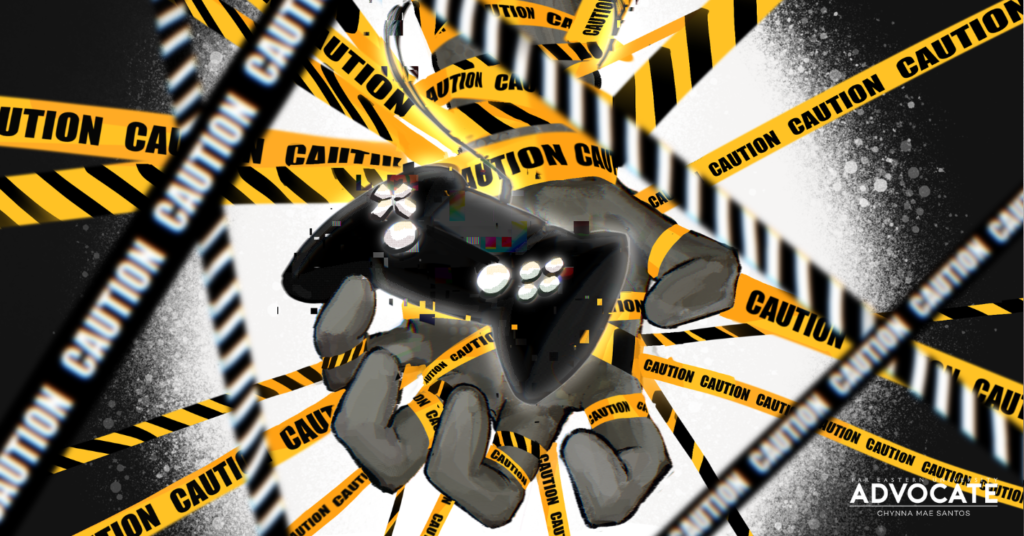
(Element by Chynna Mae Santos/FEU Advocate)