







By Dave Louie Blas
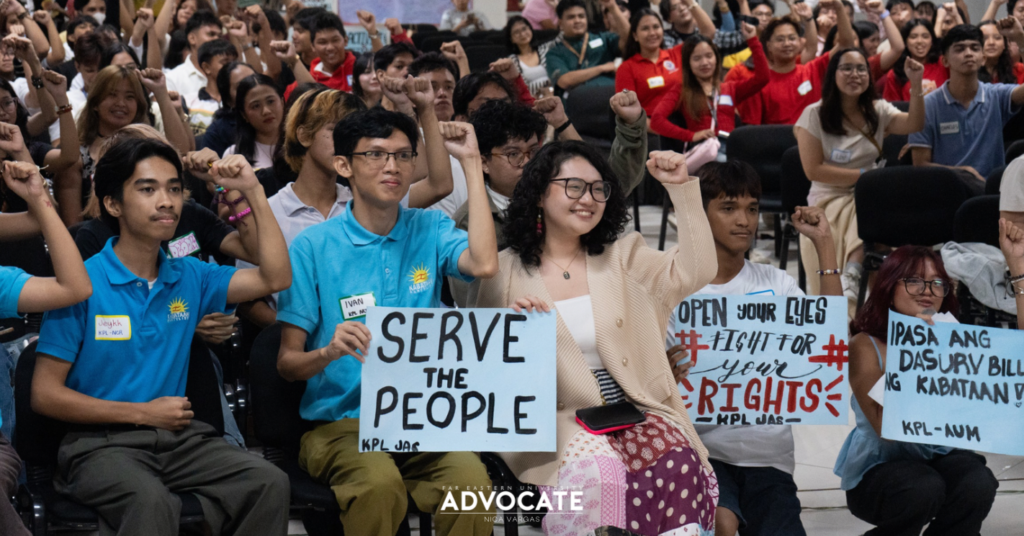
Youth organizations across the National Capital Region (NCR) criticized President Ferdinand ‘Bongbong’ Marcos Jr. for his neglect of the persistent education problem and corrupt practices under his administration during the State of the Youth Address (SOYA) at the IFI Conference Center in Manila City last July 26.
Specifically, progressive youth organizations led by Kabataan Partylist NCR asserted that Filipino youth still suffer from the lack of access to quality basic and tertiary education after four years of Marcos Jr.’s presidency.
The groups also rallied behind the call to hold all personalities involved in government corruption accountable, citing the flood control scandal and the ongoing impeachment trial against his ally-turned-foe Vice President Sara Duterte.
Enduring education crisis
During last year’s State of the Nation Address (SONA), Marcos Jr. admitted that there is an education crisis in the country, vowing to resolve the issue.
A year after the president’s promise, Marcos Jr. bragged about the promotion of 80,000 educators and the creation of 30,000 new teaching positions, alongside new instructional tools and equipment during his fifth SONA yesterday, July 27.
However, Kabataan Partylist NCR Chairperson Ivan Punzalan underscored in his presentation how the education crisis remains prevalent as caused by several issues including classroom shortages and the growing population of out-of-school youth who either struggle financially or have lost interest in studying at all.
“Sa sampung kabataan, walo lang ‘yung nakakatapos ng primary education… Mula doon sa walo, tatlo lang ‘yung nag-aral sa high school. Tapos sa tatlong nag-aral sa high school, dalawa lang ‘yung nakapagtapos ng college (Among the 10 youths, only eight were able to finish primary education. From those eight, only three went to high school. Then, from those three, only two finished college),” he shared.
According to a study cited by United Nations Foundation Chief Akihiro Fushimi, 90 percent of Filipino children in fifth grade cannot read at their expected level while 83 percent have low proficiency in basic mathematics, exhibiting a huge learning gap among Filipino youth.
Additionally, Punzalan emphasized that in NCR alone, over ₱30 billion of budget deficiency has been recorded among state universities and colleges.
“Danas pa rin nating mga kabataan ‘yung kakulangan talaga sa badyet sa edukasyon… Ngunit ang ginagawa ng gobyerno, komersiyalisasyon ng edukasyon (The youth is still struggling with the lack of budget for education. However, the government is commercializing education instead),” he stated.
Accordingly, IBON Foundation found that a budget increase in education does not guarantee better education as it merely prioritizes scholarships for selected students instead of expanding Free Higher Education access for all.
Specifically, it cited the Commission on Higher Education (CHED) two-billion-peso Tulong Dunong Program cash grants, where eligibility relies partly on a barangay-issued certificate of indigency that is prone to political patronage.
Furthermore, Punzalan also criticized the Strengthened Senior High School Curriculum that is being rolled out this year, which extends work immersion hours from 80 to 320 hours.
“More chances ito ng free labor… Kasi maraming private companies ngayon na konti na lang ‘yung empleyado nila, kasi malaking range ng mga nagtatrabaho sa kanila [ay] mga galing sa work immersion na ‘di naman nila binabayaran… Tine-train talaga tayong maging alipin ng kapitalismo (This means more chances of free labor. Because many private companies nowadays have few employees left since a large range of their employees comes from work immersion programs whom they don’t even pay. We are really being trained to be slaves of capitalism),” he emphasized.
The chairperson also called out the proposed General Education (GE) Reform by CHED that will reduce GE units from 32 to 18, removing subjects such as Readings in Philippine History, Ethics, Art Appreciation, and other GE courses from the curriculum.
“Bilang mga kabataan, nandito tayo para pag-aralan ang lipunan, pag-aralan ang kalagayan, [at pag-aralan] din ang kasaysayan… gagawin ng education system [GE Reform] natin na maging bulag tayo sa ano ‘yung totoong lagay natin ngayon (As youth, we are here to study the society, conditions, and the history as well. That is why if the GE Reform will be passed, our education system will make us blind to our social realities),” he asserted.
Meanwhile, in an interview with FEU Advocate, League of Filipino Students - Far Eastern University (FEU) Chairperson Jham Evangelista encouraged Tamaraws to be involved in the call for ‘zero tuition fee increase’ in the University for the upcoming school year.
“Hindi tayo puwedeng magpakampante na hindi tayo madadamay sa tuition fee increase… Dapat napapaingay na ito sa social media at napag-uusapan sa loob ng bawat circle natin, sa mga kaibigan natin, sa mga institute, at sa mga academic organizations natin (We cannot afford to be complacent, thinking that we won’t be affected by the tuition fee increase.We should start raising awareness on social media and discussing it within our circles, friends, institutes, and academic organizations),” she urged.
This call comes after reports of observed tuition fee increases flagged by students across different schools along the University Belt.
While the tuition fee increase in FEU has yet to be confirmed, Evangelista said that they are working alongside FEU Central Student Organization to bring and clarify the matter to the administration.
Calls for accountability
The forum also discussed the rampant corruption issues in the country that intensified following Marcos Jr.’s “mahiya naman kayo” statement in his SONA last year.
In line with this, Evangelista expressed her disappointment on the failed promises by the Marcos Jr. administration in addressing the flood control scandal.
“Hindi rin masyadong natugunan ‘yung isyu ng flood control scam kasi naitayo nga ‘yung ICI [Independent Commission on Infrastructure] pero hindi rin naisapubliko, tapos ‘yung findings hindi pa rin umuusad… Lahat ito may domino effect sa ating mga kabataan (The flood control scam was also not addressed because despite the establishment of the ICI, it was not made public, and the findings are not making any progress. All of this has a domino effect on us, the youth,” she observed.
Likewise, in a separate interview, Kabataan Partylist Representative Renee Co insisted that the fight against corruption is significant to the youth and the next generations.
“It is our generation’s fight. Ang pananagutan hindi lang ‘yan sa pagkamal ng kita, pero pa’no ba nila hinawakan ‘yung kapangyarihan nila para magparatsada ng mga polisiya na nakadulot ng pinsala sa atin, whether that’s Marcos Jr.’s Pax Silica or VP [Vice President] Sara Duterte’s confidential intelligence funds (It is our generation’s fight. Accountability is not just about amassing funds, but about how they used their power to push policies that caused us damage, whether that’s Marcos Jr.’s Pax Silica or VP Sara Duterte’s confidential intelligence funds),” she affirmed.
Pax Silica is a United States (U.S.)-led project on Philippine soil that will establish a 1,620-hectare industrial hub in New Clark City in Tarlac focusing on AI and the semiconductor industry with an initial investment of 10-billion U.S. dollars.
However, several groups warned that if the project is to push through, the country’s ancestral lands and natural minerals will be vulnerable, while more tensions will arise due to the current geopolitical climate between China and the U.S., inevitably endangering local communities.
Co also urged the youth to rally behind the fight for accountability, highlighting the importance of youth participation in the ongoing impeachment trial of Sara Duterte.
“Dapat tuloy-tuloy ‘yung paghatid ng edukasyon ng pananagutan sa mamamayan, lalo na sa kabataan… Things will be done to delay these proceedings to confuse the people, so kailangan meron tayong efforts para i-educate ang isa’t isa (We should continuously deliver education on accountability to the citizens, especially to the youth. Things will be done to delay these proceedings to confuse the people, so we need to make efforts to educate one another),” she encouraged.
In addition to the education crisis and corruption, several local youth leaders who attended the event also criticized their own local government units and educational institutions over oppressive policies and campus militarization.
Some student leaders also expressed concerns about the lack of free campus press in some state universities, rampant red-tagging, and the issuance of show-cause orders among student activists that their universities impose as a form of disciplinary action.
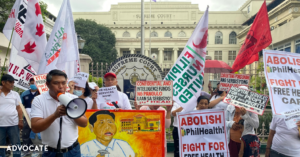
The program concluded with a protest along Pedro Gil Street calling on the government to address the country’s real current condition.
SOYA is an annual youth conference led by the Kabataan Partylist NCR aimed at presenting the realities faced by the Filipino youth before the president’s SONA.
(Photo by Nica Vargas/FEU Advocate)