



By Shayne Elizabeth T. Flores
As part of the major provisions mandated for the Far Eastern University (FEU) Elections 2026, the FEU Commission on Elections (COMELEC) has introduced campaign expenditure caps in the revised Omnibus Election Code (OEC) to prevent resource inequality among candidates and political parties.
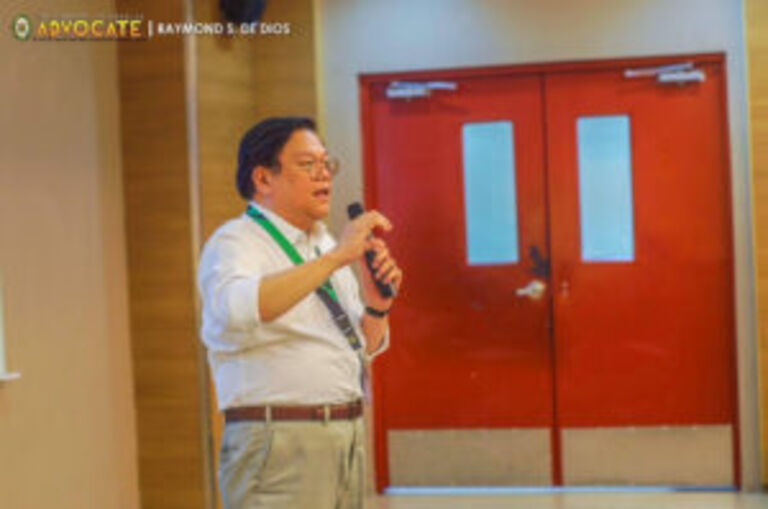
In an interview with FEU Advocate, FEU COMELEC Chairperson Roderick Evans Bartolome said that this mandate is the first time the OEC has underlined a specific campaign spending limit in contrast to the previous versions of the election code, which were ‘relatively vague’ on the matter.
“I think it’s the first time that it was introduced. We introduced campaign expenditure caps. Before, wala ‘yan [yata] (I think there was none)… Before, silent ‘yung OEC about how much the political parties and individual candidates can spend,” he claimed.
Aside from discouraging lavish expenditures, the provision primarily intends to equalize the opportunities between independent candidates and those under established political parties equipped with more resources.
“The goal is bigyan ng (to give) equal chances [to] both candidates coming from political parties as well as independent candidates, kasi kumbaga, siyempre iba ‘yung may makinarya [ng] political party (as political parties have machinery). They have more resources. So kapag may cap, kayang humabol o kayang lumaban nung mga independent candidates (if there is a cap, independent candidates can keep up with them),” he explained.
Per the Implementing Rules and Regulations (IRR) of the 2026 OEC, political parties as a whole have a budget cap for campaign paraphernalia expenses of ₱225,000, while candidates under their wing may individually spend up to ₱5,000 only.
Meanwhile, independent candidates have a bigger spending cap of ₱35,000.
The FEU COMELEC chair further noted that the provided price caps are not arbitrary, but are in proportion to the cost of the allowed number of paraphernalia.
Revised candidate qualifications to ‘widen participation’
Although the 2025 OEC was still used as the basis for this year’s election code, Bartolome noted that revisions and new provisions were applied to address the gaps observed in the previous version.
This includes Article III Candidacy Section 1.2a under Academic Qualifications, requiring candidates to “not have incurred a failing grade in the two (2) semesters immediately preceding the elections, except in highly meritorious cases as determined through a formal review by the Department Chair and the Dean.”
According to the FEU COMELEC chair, the specification of ‘two semesters’ is intended to clarify the extent of the ‘no-failing-grade’ rule that the previous OEC upheld in order to ease the academic standards expected of candidates and to widen the selection of students qualified to run.
“Kasi nakita namin dun sa previous OEC, no failing grade period. So parang ibig sabihin… ‘pag first year [na] PATHFIT [Physical Activity Towards Health and Fitness] or WRP [Wellness and Recreation Program], may bagsak ka, hindi ka na puwedeng tumakbo. So we clarified, sige, the COMELEC members still wanted to maintain a sort of good academic standing so we clarified the provision that kung puwede, at least two semesters kang walang failing grade,” he noted.
Similarly, the qualifications for vice president have also been relaxed, in contrast to the previous OEC, which laid out the same set of requirements for the president and vice president positions.
Per Article III Section 2.b., candidates may run for vice president if they are an incumbent officer of the FEU Central Student Organization (FEUCSO), Student Councils (SC), Academic Organizations (AO), or University-wide Organizations, or if they are “an incumbent member of the Central Board or Board of Directors (BoD) during the school year preceding the elections.”
“Before kasi, they had the same qualifications as the president. Kailangan required na appointed or elected sa executive board. So ‘yung vice president, we allowed them to be an incumbent member of a central board or BoD… Ibig sabihin medyo mas na-widen ‘yung field. Mas maraming puwede sumali, at least for the vice president (The playing field has been widened with more people qualified to run as vice president),” Bartolome explained.
On the other hand, candidates for treasurer must now have prior experience as treasurer or other similar financial positions as specified by Section 2.c. Meanwhile, external experience may be considered for first-year students, provided that it is vouched for by credible authority.
Compared to last year, the OEC now requires Certificate of Attendance to at least one seminar or activity organized by the Office of Student Involvement (OSI) instead of two.
Candidates are also required to submit only one recommendation letter from their respective Department Chair for AO candidacy or Dean for SC or FEUCSO candidacy.
Grounds for disqualification
In the 2025 OEC, the provisions highlighting affiliation with external political parties as grounds for disqualification were focused on individual candidates as they are prohibited from receiving financial support and influence from such external organizations.
However, in the 2026 OEC, the clause was removed from Article III Section 3 and is now specified in Section 6 under Disqualification of Accreditation of Student Political Parties, forbidding the “receipt of endorsement from, or financial, material, or logistical support by, any political party or political organization outside the University” for political parties as a whole.
Moreover, the revised Section 3.c better outlines what constitutes as 'political bullying,' stipulating that candidates can be disqualified if they “[engage] in any act of bullying, harassment, intimidation, coercion, or undue pressure against another current or potential candidate, whether verbal, physical, or through digital or electronic means, which has the purpose or effect of undermining the integrity of the electoral process or the free participation of candidates.”
Although these provisions intended to oversee the conduct of candidates, Bartolome emphasized that he wants FEU COMELEC to remain impartial instead of proactively policing students.
“Ayoko talagang mag-function si COMELEC na parang pulis… Kasi para sa’kin, hindi proactive ‘yung role, nagre-react lang si COMELEC doon sa ginagawa. Ang sa’kin, mabuti pang i-lay down na natin ‘yung provision, maliwanag at nakikita ng mga candidate, aware sila. Therefore… ‘yung election, hindi personality-based, [but] issue-based. Ano ba ‘yung platform mo?... What’s your track record? (I don’t want COMELEC to function as a police because for me, our role is to not be proactive, but to merely react. It’s better that we lay down the provision, where candidates can see it clearly. Therefore, the election would be issue-based, rather than personality-based. What is your platform? What is your track record?)” the FEU COMELEC chairperson said.
More students, less bureaucracy
Another major amendment in the 2026 OEC is the addition of Article X Deputization, which mandates FEU COMELEC’s capacity to deputize nonpartisan organizations or individuals to assist in the student elections.
The clauses specifying the roles of the FEU Manila - Junior Philippine Institute of Accountants (JPIA) and TAMang Boto in the elections were omitted as COMELEC intends to foster inclusivity for other nonpartisan organizations.
“Kasi ang naging concernko… bakit naka-mention sina JPIA at TAMang Boto? Parang ang dating sila [lang] ‘yung puwede tapos ‘yung ibang organizations,hindi na. So sabi ko, okay ba sa inyo na alisin natin ‘yung name ng organization and then maglagay tayo ng specific provision that allows for deputization (My concern was why were JPIA and TAMang Boto mentioned specifically? It may seem that they’re the only organizations we can work with. That’s why I asked if it’s okay to omit the organization names and add a specific provision for deputization)… It would allow COMELEC to be a lot more inclusive when it comes to working with nonpartisan organizations,” Bartolome remarked.
Additionally, this year’s FEU COMELEC co-chairperson position is held by a student representative, in contrast to last year when the role was held by a faculty member.
According to Bartolome, this has been a practice in FEU COMELEC even in the previous terms in line with the commission's goal to be led by students themselves in the future.
“Actually it’s not the first time, nung first run ko as COMELEC chair, galing na rin sa estudyante (it came from students also)… Ang direction namin even before was actually gradually gawing student-led ang COMELEC. Since it involves student elections, ang nagpapatakbo dapat estudyante na. Kayo na dapat ‘yan (it should be run by students themselves),” he clarified.
The FEU COMELEC chair also expressed that in the future, he wants the faculty’s role in the FEU COMELEC to be limited to the adviser position only, while the organization would be primarily composed of students.
As such, in his term as chairperson this year, Bartolome plans to make the FEU COMELEC student representatives more visible in his stead.
“I think this will be the last time that I will be visible. I’d want the student representatives to be a lot more visible in the coming activities. Para maramdaman ng mga estudyante na eleksiyon namin ‘to kaya ang nagpapatakbo, kapuwa namin estudyante (So students can feel that this is their election because it is handled by their fellow students),” he noted.
Furthermore, to reduce bureaucracy, the 2026 OEC has waived the last elections’ independent committee, which was previously formed by the Vice President for Academic Services (VPAS) to investigate disputes.
“The previous OEC even goes up to the VPAS, which is masyado nang bureaucratic… bumabagal ‘yung proseso, samantalang ang involved naman talaga sa mga estudyante primarily ay ‘yung COMELEC and the Office of Student Involvement. Kaya lahat ng appeals actually ay nilagay na lang namin sa level ng OSI para mabilis din ‘yung desisyon (It was too bureaucratic that it slows the process, when in fact the COMELEC and OSI are the ones that are primarily involved with students. That’s why we have placed the appeals entirely on OSI to quicken the decision-making),” Bartolome explained.
Rather than merely running the student elections in an administrative approach, the FEU COMELEC chairperson highlighted increasing last year’s 24.27-percent voter turnout as their primary goal.
After opening last April 6, the filing of Certificates of Candidacy has been extended to April 13. Meanwhile, qualified candidates are expected to be proclaimed on April 15.
- With reports from Ishia Eleanor F. Marquez
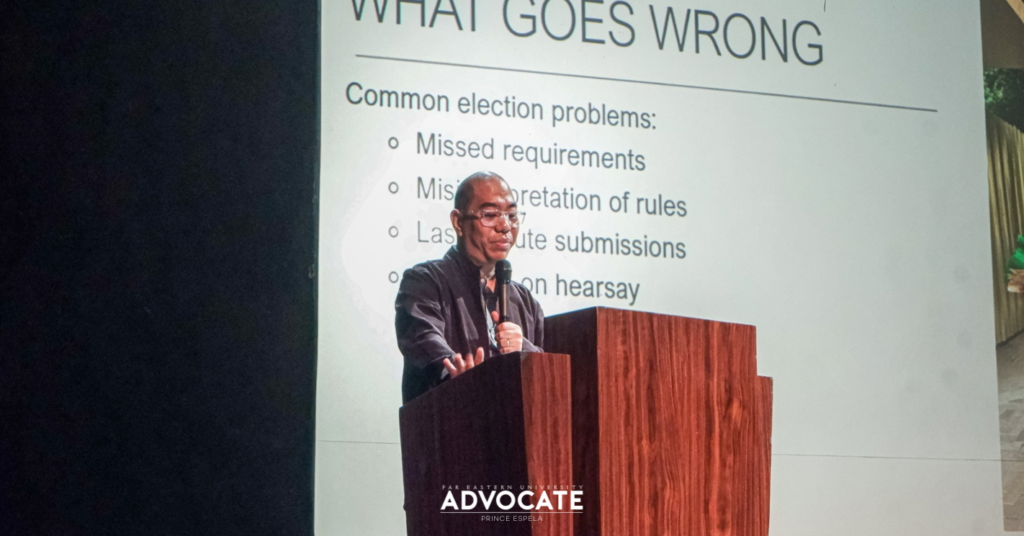
(Photo by Prince Espela/FEU Advocate)