


By Eunhice Corpuz and Sean Clifford M. Malinao
For a jeepney driver, every journey begins with passengers to pick up, destinations to reach, and a day’s earnings to bring home. The road demands patience, and the weight of making a living rarely disappears when the engine stops. For Elmer Cordero, fondly known as ‘Tatay Elmer,’ the road stretched far beyond his driver’s seat, leading him to stand alongside those with whom he shared his fight for a dignified livelihood.
Tatay Elmer died on October 7 at age 78, nine days after suffering a heart attack while participating in a transport strike in Monumento, Caloocan City. He was rushed to the Caloocan City Medical Center, where he remained hospitalized in critical condition until his death.
From his wife who shared his joys and understood his convictions to the fellow drivers and young people who looked up to him, Tatay Elmer’s story lives on through the people who stood beside him and the lives he touched along the way.
A Tatay beyond home
To those whose journeys crossed paths with Tatay Elmer’s, may it be along the streets he navigated to the struggles he fought, he was not just the driver and activist others came to recognize. He was a husband, a companion, and a father figure whose presence extended beyond the family he built at home.
In an interview with FEU Advocate, his wife, Elvie Cordero, described Tatay Elmer as a husband whose patience often outlasted their disagreements. Like any married couple, they had their share of arguments, but where disagreements might have lingered, Tatay Elmer’s patience made room for reconciliation.
“Mabait si Tatay Elmer, ako mabunganga ako dahil hindi [naman] maiwasan sa mag-asawa ang nag-aaway pero imposibleng hindi kami nagbabati [dahil] mahaba ang pasensya niya (Tatay Elmer was kind. I can be quite outspoken, and arguments between married couples are inevitable, but it was impossible for us not to make up because he was very patient),” she stated.
In Nanay Elvie’s recollection, Tatay Elmer’s patience became part of the life they built together, a quiet assurance that even when they did not see each other eye-to-eye, they would eventually make amends.
One memory, in particular, captures the particular kind of happiness they shared. Despite not having children of their own, she recalled how they would joke about their circumstances, finding contentment in the companionship they had.
“[Iyong] nagbibiruan kami na kahit wala kaming anak, masaya [kami]... Siguro kaya siya sumasama sa mga protesta, nagkakasundo kami sa gusto niyang mangyari sa gawain niya. Maligaya rin naman kami basta’t nagkakaintindihan kami (We would joke with each other that even though we did not have children, we were happy. Perhaps that was why he joined protests. We understood and agreed with what he wanted to pursue through his work. We were happy as long as we understood each other),” Nanay Elvie reminisced.
This understanding extended to a part of Tatay Elmer’s life that reached past their home. Nanay Elvie understood that the protests mattered to him, and their shared happiness included the freedom to pursue the causes he believed in.
His convictions, as Nanay Elvie understood them, were grounded in solidarity with ordinary workers. The people he stood alongside were not distant beneficiaries of his activism; they were fellow drivers who shared the realities of his livelihood.
“Isa iyan sa ipinaglalaban niya, siyempre ipinaglalaban niya [iyong] para sa karamihan na kagaya niyang driver lang, doon siya nagkakaroon ng lakas ng loob na lumaban talaga (That was one of the things he fought for. Of course, he was fighting for the many others who, like him, were just drivers. That was where he drew the courage to keep fighting),” she emphasized.
Yet the most melancholic part of Nanay Elvie’s recollection is how she spoke of the young people who came to embrace her husband as their Tatay. Although they had no children of their own, Tatay Elmer found genuine happiness in the affection of students who welcomed him into their lives.
Nanay Elvie, in turn, found joy in witnessing the love they gave him, recognizing how much their presence meant to the person she once hoped to build a family with.
“Inspirasyon para sa kaniya [ang mga kabataan]. Kahit wala kaming anak, [kapag] nakikita niyang mahal na mahal ninyo siya, maligayang-maligaya rin ako para sa kaniya (I know how happy he was whenever he saw student organizations, especially when they embraced him. The youth were an inspiration to him. Even though we do not have children, whenever he sees how much you young people loved him, I was very happy for him too),” she reflected.
For her, loving Tatay Elmer was never difficult. Beneath the struggles he carried on the streets and the causes he fought for was a man whose kindness made him easy to love, a presence that turned the ordinary days of their life together into something worth holding on to.
“Kasi ang asawa ko hindi naman mahirap mahalin ‘yan, kasi napakabait niyan (My husband was not difficult to love because he was such a kind person),” Nanay Elvie added.
These recollections may be simple, shared in the quiet sincerity of those who continue to carry Tatay Elmer’s memory with them, but coming from Nanay Elvie who knew him as a spouse, it carries the weight of a shared life — the patience that outlasted their arguments, the understanding that allowed them to support each other’s pursuits, and the happiness they found in the people who came to love him.
‘Ganiyan si Tatay Elmer’
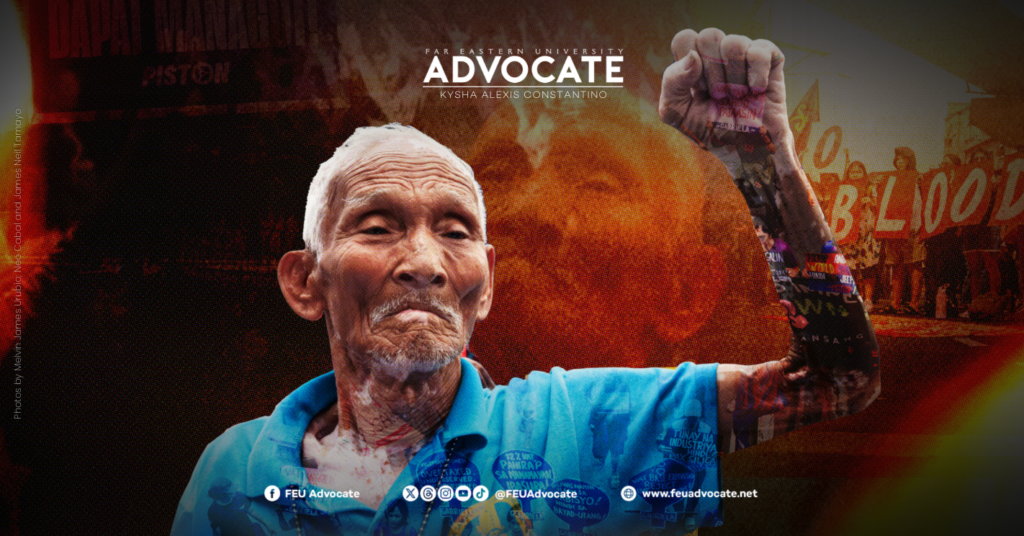
In nearly every rally and transport strike, Tatay Elmer stands at the forefront of the transport group PISTON. His presence and persistence in raising his fist have become a symbol of resistance and solidarity for every jeepney driver and operator.
But long before becoming a fixture in these nationwide movements, Tatay Elmer faced an immense adversity. He was one of the ‘PISTON 6’ protesters who were arrested after staging a peaceful mobilization during the COVID-19 pandemic in 2020.
During the Grand Parangal held on the final night of Tatay Elmer’s wake, one of the PISTON 6 and the transport group’s Deputy Secretary General Ruben Baylon looked back on the day of their protest.
“Noong time na ‘yun 62 na ako at si Tatay Elmer 74 at ‘yung isa 60, ‘yung isa 58 at 57 [taong gulang]. Talagang mga senior na kami at kami lang ang lumalabas n’un para manawagan para sa balik-pasada (At the time, I was 62, Tatay Elmer was 74, one was 60, one was 58, and another was 57 years old. We were already seniors and we were the only ones who stepped out back then to call for the resumption of public transport operations),” he narrated.
Baylon shared that the protest was originally planned for just one day, but members from Monumento suggested extending the movement to a week to help the public understand its cause, with support from allied organizations.
“Ang rason, ‘pag isang araw lang nanlilimos na nga tayo eh. Paano pa tayo manmamalimos kung titigil pa tayo? (The reason was, even after just one day, we were already begging as it is. How much more will we have to beg if we stop completely?),” the transport leader expressed.
Baylon recalled arriving early on the frontlines, only to be commanded to be arrested by authorities by 11 o’clock in the morning.
After being held in the city jail, Baylon shared how Tatay Elmer stood firm against the injustice of their imprisonment, fiercely refusing to be locked up behind bars.
“Noong andoon na kami [city jail] ayaw niyang [Tatay Elmer] pumayag na makulong, sabi ng ibang kasama namin, ‘itali niyo na lang kami dito, ‘wag niyo na kaming isama diyan wala naman kaming kaso, wala kaming kasalanan’ (When we were already at the city jail, he refused to allow himself to be locked up. Some of our companions said, ‘Just tie us up here, don’t take us in there, we do not have a case against us and we have done nothing wrong),” he recounted.
Tatay Elmer’s devotion and defiance sparked an enduring flame — inspiring not only Baylon, but countless drivers and operators across the sector. To his very last stop, he lived out his mantra: to keep moving forward, and to never stop fighting.
Baylon also added that Tatay Elmer’s unwavering determination to fight and speak up for what is right left an unforgettable mark on their shared history.
“Sabi ni Tatay Elmer, ‘Ang ipinaglalaban namin makabalik kami sa aming hanapbuhay.’ Ganiyan si Tatay Elmer (Tatay Elmer said, ‘What we are fighting for is for us to return to our livelihood.’ That was Tatay Elmer),” he recalled.
Such resistance shown by the PISTON 6 during their detention paved the way for their acquittal after four long years. Yet those years were haunted by the injustice of being imprisoned simply for exercising their right to livelihood during the pandemic lockdowns.
When the news broke that Tatay Elmer was one of the arrested PISTON 6, widespread public attention was drawn — and from that day forward, his enduring presence anchored every transport strike and rally.
‘Makulit at pasaway na matanda’
There is no age limit in defending the rights of a sector whose livelihood and lives are at stake. This was proven by Tatay Elmer’s dedication, who, despite his old age and underlying health conditions, persisted to always be present in every fight and protest.
In a speech during Tatay Elmer’s wake, PISTON President Mody Floranda fondly described him as a ‘stubborn old man,’ sharing that for every movement they organized, they would always have a silly fight.
“Ang masasabi ko lang ay makulit na matanda, ‘yon ang ano ko sa kaniya noon. Kasi halos tatlong taon din ako sa Caloocan, nakailang welga kami at kung gaano kadaming welga ang inilunsad namin ganun din karami ang away namin (All I can say is he was a stubborn old man, that’s what I thought of him back then. Because I was in Caloocan for almost three years, we had several strikes, and however many strikes we organized, that was how many fights we had),” he said.
Floranda recalled that whenever they had discussions in organizing initiatives, Tatay Elmer would always reiterate the question if it could help to feed his family.
“Lagi’t lagi niyang sinasabi: ‘Bakit, kaya bang mapakain ang pamilya ko?’ Akala mo ang daming anak, ‘yun pala si Nanay lang (He always said, ‘Why, can that feed my family?’ You would think he had so many children, but it turned out it was just Nanay),” he playfully narrated.
Concluding his speech, Floranda thanked Tatay Elmer’s wife for allowing him to stand and fight by their side.
“Mula sa PISTON, habambuhay po kaming nagpapasalamat sa buong pamilya, lalo na kay Nanay na talagang, pinahiram ni Nanay si Tatay Elmer sa sektor hindi lamang sa transport kundi [pati] na rin sa mga mamamayan, sa maiksing panahong buhay si Tatay Elmer (From PISTON, we are eternally grateful to his entire family, especially to Nanay, who truly lent Tatay Elmer to our sector, not just to transport workers, but to the entire nation during his brief life),” the PISTON president expressed.
Beyond the causes Tatay Elmer championed was a man who could be stubborn, playful, and be unapologetically human, even in the middle of the organizing work that defined much of his life.
For Edward Soliman of Defend CAMANAVA, Tatay Elmer was one distinct presence. His stubbornness, as Soliman recalled, surfaced even in the ordinary routines of their office.
“Si Tatay Elmer pasaway talaga… kapag pumupunta siya sa office namin at [tinatanong kung] ‘Kumain ka na ba,’ sasabihin niyang ‘Hindi, busog pa ako,’ tapos makikita namin na tulog na habang nag-e-ED [educational discussion] (Tatay Elmer was really quite a handful. Whenever he came to our office and we asked him if he had eaten, he would say, ‘No, I’m still full,’ and then we would find him already asleep during an educational discussion),” he recollected.
Tatay Elmer’s place in the movement was not built solely on the gravity of his convictions. He was also a person with habits that amused the people around him, someone whose presence became part of the texture of their everyday lives.
Yet the same mischievousness took on a different meaning whenever Tatay Elmer marched into mobilizations. At strikes, where standing at the front meant making oneself visible amid the collective demand, Soliman remembered a man who did not easily yield his ground.
“'Yong mga moment na nasa welga kasi talagang siya ‘yung nangunguna. ‘Tatay Elmer, kaya mo ba ‘yan?’ [Tapos sasabihin niya,] ‘Kaya ko ‘yan, kahit ano pa ‘yan, gusto mo, ako pa mauna sa harapan,’ (During strikes, he was always the one leading the way. We would ask him, ‘Tatay Elmer, can you handle that?’ And he would say, ‘I can handle it, whatever it may be. If you want, I’ll even be the first one at the front’),” Soliman recalled.
These lighthearted stories shared by those who cherished him were among the fondest memories that stood witness to Tatay Elmer’s selflessness and earnest intention. It reflected his remarkable dedication to foster a real family in the community he fought alongside.
For Tatay Elmer, taking the lead was not simply about being the first person in the crowd. It meant standing alongside fellow drivers whose concerns extended beyond a single protest. Their calls for a dignified livelihood were tied to the realities of working in a sector where rising operating costs, uncertain earnings, and contentious government policies could threaten their ability to make a living.
These concerns have persisted amid the government’s Public Transport Modernization Program. While the administration presents modernization as a means of improving public transportation, PISTON and other progressive groups have raised concerns about the financial burden on drivers and operators stressing the importance of being part of the program’s implementation.
For drivers like Tatay Elmer, these debates are not merely questions of policy. They concerned the conditions under which they could continue to work, support themselves, and remain part of the routes that commuters depend on.
Tatay Elmer’s presence at the forefront was part of a collective struggle over who gets to shape the future of public transportation and whose livelihood must bear the cost of its transformation. When drivers take to the streets to demand that their concerns be heard, their participation reflects not only their willingness to resist but also the conditions that make resistance necessary.
To his wife, fellow drivers, and the youth who stood beside him, Tatay Elmer embodied more than the spirit of collective action — he demonstrated love in its purest, most selfless form.
Despite his shortcomings and personal struggles, he continued to navigate the rough roads of resistance and voice out the plight of the marginalized, exposing how the system continues to trample on their rights.
Though Tatay Elmer’s road has come to an end, these testimonies will remain deeply engraved along every route traveled by those who knew him. His life stands as a blatant indictment of systemic state neglect yet his fellow drivers stood firm at the frontlines — not only to defend their livelihood, but to expose a system that forces the marginalized to bear the heavy cost of its flawed transformation. Indeed, the fruits of his struggle may outlive him, but he will always remain as the father who fought back against structural oppression and proudly raised his fist for the next generation as the fight pressed on. Long live, Tatay Elmer!
- With reports from Antonio Lao
(Photo by /FEU Advocate)