






By Rhyse Cheyann Tancio
Warning: The content contains spoilers on the play's storyline.
#Refreshments: A house can hold many things — the warmth of a family, the remnants of a life, and the silence left behind by those who are gone. In their latest play ‘Moryon’ directed by Dudz Teraña, Far Eastern University (FEU) Theater Guild places the house at the center of a war that rarely needs to be shown in order to be felt.
Set during the period of Japanese occupation and Holy Week, the play draws from Guy de Maupassant’s short story ‘Mother Sauvage’ while finding its own footing in the culture and history of Marinduque.
Beyond the house walls lie soldiers, fear, and an occupied country, while within them are a mother, a son, and a faith slowly coming undone.
At the center of the play is Caridad, a mother whose life has already been marked by absence. After losing her youngest daughter and being left by her husband, she raises her son Joaquin on her own. He trekked the mountains for six months without a letter, leaving his mother only with a silent hope that he would one day come home. In a play enveloped by war, it is this quiet waiting that defined the pain in her story.
Moryon first won its audience over by making the set feel lived in. Opening with banter between Caridad and her friends, the play portrayed the rhythm of an ordinary life, made more convincing by the cast’s natural Marinduque accent.
They tease, argue, and worry about being overheard, serving as a reminder that under occupation, normalcy makes the presence of danger feel even closer. It is also within this fragile sense of normalcy where Caridad’s story begins to unfold.
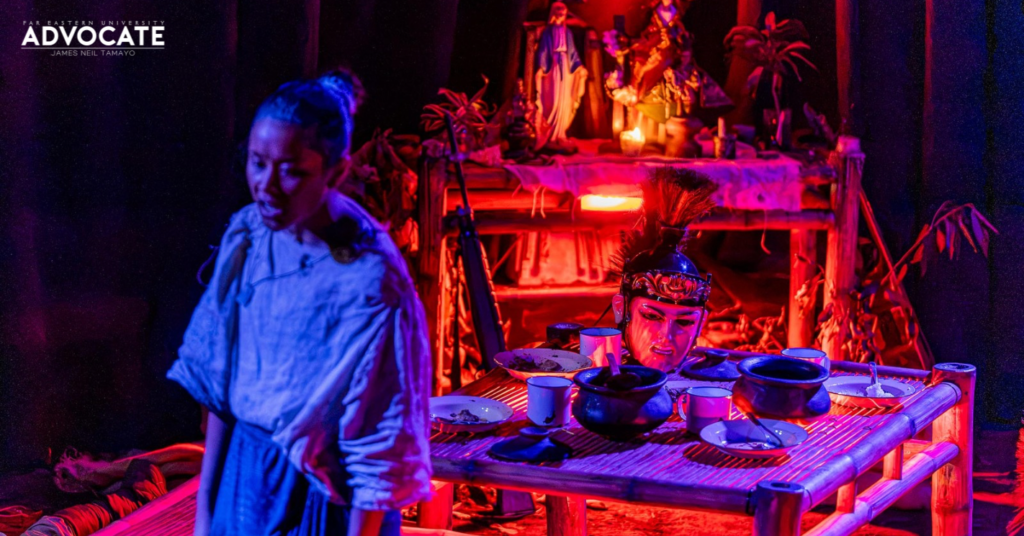
Much of that quietness is reflected in the very space she calls home — at its heart is a kitchen, which the play deliberately makes its focal point. It begins as a place of warmth, food, and familiarity, then quietly changes alongside Caridad’s circumstances.
Then came Esteban, a Filipino working as a translator for the Japanese soldiers, who knocked on Caridad’s door for a place for them to stay.
Her hatred for them is immediate, but necessity eventually brings her into their orbit as she cooks for the very men she resents. For a moment, her kitchen becomes a strange meeting place between host and occupier, where familiarity blends with the fear of the soldiers who have entered her home, creating dissonance between comfort and violence. The space that once represented her solace now becomes a place where she must confront the very people who threaten it.
But the kitchen is more than just a backdrop to Caridad’s story; rather, it is a space shaped by the traditions she carries with her. The world around her is layered with the customs and beliefs that have long been part of her life.
Marinduque’s rich religious traditions are heavily carried into the set’s visual language, specifically the Moryon masks traditionally worn during the Moriones Festival to portray Roman soldiers, adding another dimension to a story already concerned with identity.
Additionally, incorporating the act of ‘penitensya’ brings in the imagery of blood and sacrifice, echoing the suffering that runs through Caridad’s story. These elements never demanded the spotlight, but they make the world of Moryon feel more complete.
The isolation of occupation is not confined to what the audience sees; it penetrates the spaces between words, slipping into the language itself. This becomes another way to draw the audience further into its world. The characters move between Japanese and the Marinduque variety of Filipino with noticeable care. But the most effective device is what the audience is deprived of: subtitles.
When the Japanese soldiers speak, the audience is left to listen without understanding, sharing the feeling of isolation experienced by Filipinos who lived under a language they could neither control nor define.
The absence of translation turns language itself into its own kind of occupation. This deliberate choice leaves the audience with the discomfort of not knowing exactly how Filipinos were living under their regime.
And as that feeling of unease settles in, Caridad’s personal loss finally arrives at the center of the story. Esteban secretly tells her what she has long been dreading. Joaquin has been killed, accused of being a spy.
“May Diyos pa baga sa Mogpog (Is there a God left in Mogpog)?” she questioned.
With Joaquin gone, Caridad is left staring into a silence no prayer seems able to fill. The faith she once carried instinctively now sits beside her grief, no longer offering the certainty it once did.
Her question lands not as a grand declaration but as the sound of someone searching for an answer that no longer comes easily. For a woman who has spent so much of her life holding on, her doubt becomes an act of surrender.
With Caridad’s faith now shaken, the play’s religious imagery takes on a different weight. The themes of Holy Week and the Passion of Christ add another layer to this crisis. Caridad’s suffering begins to echo the religious story surrounding her, but Moryon refuses to make suffering appear neat or comforting.
Joaquin’s death does not induce redemption; it brings anger. The faith that once gave Caridad something to hold on to now has to compete with the grief that threatens to consume her.
This is where the adaptation of Mother Sauvage finds its Filipino voice. Maupassant’s story provides the bones of a grieving mother seeking revenge, but Moryon gives those bones a Marinduque home, a Catholic faith, a history of occupation, and the distinctly Filipino sense of family.
Caridad is not simply a version of Maupassant’s mother placed in another country. She is shaped by the world she inhabits, from the traditions of Marinduque to the realities of occupation, faith, and family, all of which become part of how she understands and responds to loss.
And when grief finally amplifies into action, the significance of the kitchen comes full circle. The place where Caridad once fed the soldiers becomes the setting for her reckoning with all that their presence has taken from her.
Her grief has Joaquin’s name, but it carries the weight of an entire home undone, of a life slowly stripped of both the people and peace that once filled it.
The same table that welcomes the Japanese soldiers becomes the setting for her own retaliation. The kitchen, once a place where she fed people in compliance, becomes the place where she finally fights back. It is a sleek but striking reversal: the same hands that once prepared food to keep her family alive now lay the poisoned meal that avenges the death of her son.
This is where Moryon finds its sharpest edge. It does not present war through grand battles, but through what happens when war invades a home and stays there.
Through the way the story is brought to life onstage, such intrusion feels intimate, as familiar spaces turn into reminders of loss. It takes a son and unsettles a mother’s faith. By the final moments, Caridad is no longer simply the woman we met at the beginning, and the house is no longer the home it once was.
Moryon ultimately leaves its audience with no easy answer to Caridad’s question. Somewhere in her kitchen, the answer is left simmering at the same table where she once fed the people she loved, welcomed the people she feared, and finally faced what grief had made of her. Perhaps that is the point — some wounds do not seek an answer; they simply ask what we become after them.
Moryon will officially take the stage on October 1–3, 8–10, 15–16, 22–24, 29–30, and November 5–7, 12–14, 19–21, and 26–28, every 6:30 p.m. until 8:00 p.m. at the FEU Center for the Arts Studio located on the ground floor of the FEU Engineering Building.
(Photo by James Neil Tamayo/FEU Advocate)