






I opened my eyes and was shocked to find myself in the middle of nowhere — a place that did not seem to exist, an area full of riddles. I was lost — and perhaps confused as I inspected this strange place. I saw from afar different traces of nature: gigantic boulders, scented petals, and the lush, rustling plains at every crevice.
At the very end of the junction, I saw a wooden scarecrow carrying a sign: Calle de la Escolta. The bustling masses were irritating and suffocating at first, but despite the chaotic embrace, what slowly crept in was my true purpose in these noisy streets.
My great stone arches reach outward from my facade like outstretched arms, catching the breeze coming in from the harbor. My face bears thin columns and beautiful Beaux-Arts style carvings, and the scent of old limestone, polished brass, and dried paper fills the air.
Burke, the newcomer next door, stood proudly beside me, his big arched windows framed with delicate Aztec plaster patterns, thin pilasters reaching to the thick cornice, and thin wrought iron railings that look like delicate lace frozen in time, mirroring his stern but cheerful manner.
Meanwhile, Perez, who is placed in front of me, carried highly stylized flower patterns, pointed chevrons, and geometric abstraction — all highlighting her sleek, lively, and playful attitude.
Despite our differences, I was glad I managed to find friends in this blazing, deafening street. As decades passed, we became companions and family. We enjoyed standing tall, telling each other stories, admiring the rays of sunshine, the gaze of the moonlight, and the bustling streets of Escolta.
We laughed at people running from the rain, and at cars vanishing from the streets. In other words, we loved watching the fleeting, chaotic lives of the little beings.
Then one day, my sweat dripped more than usual; the sun rays felt hotter, and the streets grew more humid. That’s when we noticed that Perez had vanished. Her sudden absence left a strange, eerie emptiness that settled over the block. In an instant, our trio was broken.
Burke and I mourned what happened. Nothing was left to do but to carry on. But grief never had the time to settle before I noticed Burke beginning to drift away. The cheerful, radiant partner I used to know began to dim, replaced by a quiet, simmering resentment.
Every night, Burke became harder to distinguish. His unique gold began to leach away; his delicate patterns faded, leaving hollow scars, while his iron railings detached one by one.
And when he finally left, the news felt heavy but not surprising.
I remembered what Perez said: structures like us don’t disappear totally; we are disassembled, cleared, and replaced by newer structures, made for a world that no longer resembles ours. I wonder if Burke endured the same fate.
Looking back, I remember how sharp we used to look, painted in the timeless, tailored styles of an era that slipped away when we weren’t looking. Now, I feel a bit out of touch, like I don’t quite belong in this generation.
As I return to the present, the quiet settles over the street once more. I carry on with my work, grateful for the memories, but forever asking the same silent questions: why did both of you have to leave me behind? And now I dread: how long will it take ‘til my own sand drifts away?
- Christian Violon
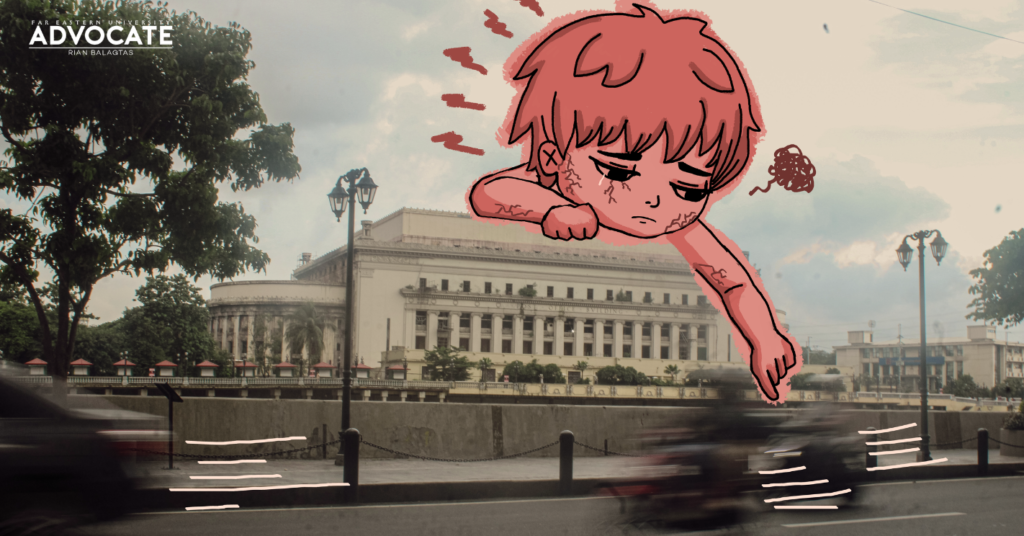
(Photo and Illustration by Rian Balagtas/FEU Advocate)