

By Kristine Aimee Millonte
Content Warning: The article mentions themes of physical torture, psychological torture, and sexual violence.
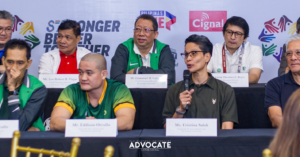
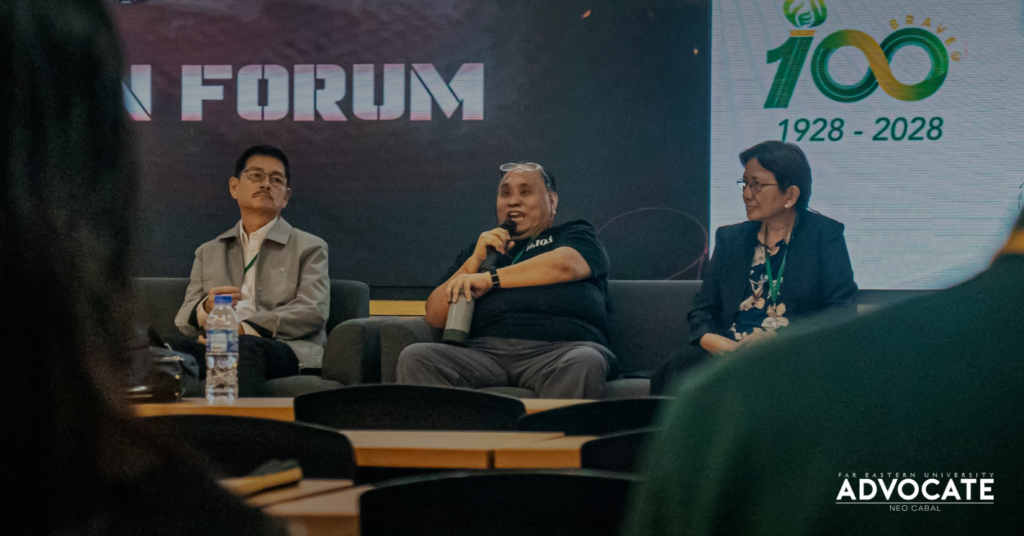
Fifty-four years after the declaration of Martial Law by late dictator Ferdinand Marcos Sr., survivors revisited the atrocities and resistance they endured in a forum led by the Institute of Arts and Sciences Student Council held at the University Conference Center last September 23.
Centered on the theme ‘Barbed Truths: A Testimonial and Political Forum on the Victims and Memory of Martial Law,’ the event featured Cristina ‘Tina’ Bawagan, Alan ‘Al’ Alegre, and Jovito Labajo — three of the 11,103 individuals officially recognized as victims of human rights violations during the Martial Law era, out of the 75,749 who filed claims under Republic Act (RA) No. 10368.
Enacted in 2013, RA 10368, or the Human Rights Victims Reparation and Recognition Act, recognized individuals who suffered unlawful imprisonment, torture, enforced disappearance, and killings under the Marcos Sr. regime from September 21, 1972, to February 25, 1986.
More than half a century later, their testimonies remain marked by the violence they endured, the repression they witnessed, and the grassroots resistance they became part of.
Behind the numbers
For then 16-year-old Jovito, Martial Law began in an unusual quiet, recalling the sudden absence of newspapers and radio broadcasts without any warning.
“Pumasok ako sa school noon, eh, parang tahimik na tahimik. Walang diyaryo, walang radyo... Ayon pala, ang unang ginawa ng mga Marcos, ‘yung mga media outlet, isinara. So, ‘yung mass communication, isang media outlet lang mapapanood, at ‘yun ay kontroladong midya (I went to school that time, and it was very quiet. There were no newspapers or radio. Turns out, the first thing that the Marcoses did was to close down media outlets. So the only means of mass communication was through one media outlet, which was state-controlled),” he narrated.
Multiple privately-owned media outlets were shut down following the declaration, while only crony-operated and state-controlled outlets such as the Philippines Daily Express were allowed to operate, which published pro-regime news promoting the ‘new society.’
Marcos Sr. then immediately issued Letter of Instruction No.1 and Letter of Instruction No. 1-A, allowing the sequestration and military takeover of private media companies such as ABS-CBN and The Manila Times. Similarly, several campus publications were forced to shut down, including FEU Advocate.
A few years younger than Jovito, Al shared he was only 11 years old when Martial Law was declared, describing how his political consciousness grew alongside the regime's expansion.
“Batang bata ako… pero ‘yung istorya ng pagmumulat ko ay istorya ng [paglarga] ng Martial Law sa lipunan (I was too young. But the story of my awakening is also the story of Martial Law’s advance in society),” he reflected.
For Tina, her earliest memory of Martial Law goes back to September 22, 1972, a day after its signing, when her friend called to inform her about her husband’s arrest.
“On the 22nd, we did not know that Martial Law had been signed. A friend of ours… called our house and she said her husband has just been arrested,” she shared.
According to the Official Gazette’s records, although Proclamation No. 1081, or the Martial Law Declaration, was signed on September 21, it was only publicly announced by Marcos Sr. through a nationwide television broadcast on September 23.
During their respective discussions, Tina and Jovito highlighted how the authoritarian regime was justified as a supposed attempt to subdue communist insurgency, growing anti-government movements, and widespread civil unrest.
They also noted how Martial Law masked the systemic propaganda of bureaucrat capitalism and imperialism through the sweeping campaign of arrests targeting political dissenters, student leaders, union organizers, and journalists without due process.
Despite the horrors experienced, the Marcoses returned to the Palace when Ferdinand ‘Bongbong’ Marcos Jr., the dictator’s son, was elected as president in 2022.
This return has coincided with continued concerns over historical revisionism and disinformation surrounding the former Marcos Sr. regime.
For the survivors who lived through the dictatorship, preserving the truth of that period remains tied to how information is produced and remembered.
Despite the restrictions imposed on the press during Martial Law, Al recalled a time when foreign information and entertainment were allowed to return to the airwaves in the form of pageantry.
In an interview with FEU Advocate, Al explained how entertainment can both occupy and distract public attention, seeing it as a broad strategy to distract people from tyrannical rule.
“Anybody in power, nakikita nila na populism works… On a deeper level, there’s a lot of distractions… So people should be aware that they are being distracted. Kailangan ng mga gigising at magmumulat sa kanila (They need those who will wake and awaken them)… Minamanufacture iyan, eh. Strategy iyan, eh. If you do not move, you do not notice your chains,” he stated.
The atrocities during the Marcos regime weren’t only about controlling what Filipinos could read, hear, and watch, but were also experienced directly by those who were arrested, detained, and tortured.
Cost of ‘bagong lipunan’
Behind Marcos Sr.’s promise of a ‘new society’ was state-perpetrated abuse against political prisoners, activists, journalists, and desaparecidos, among others.
Political prisoners were routinely subjected to physical and psychological torture inside detention cells, where many were held for weeks or months without formal charges. They endured extreme methods, such as waterboarding, electrocution, severe beatings, and solitary confinement to silence opposition.
In a separate interview, Jovito detailed the psychological aftershocks of his own captivity at Camp Crame following his time in the underground guerrilla movement.
“Sa [Camp] Crame, bartolina ako noon, eh. Mag-isa ako, solitary confinement. ‘Di ba nabanggit ko rin na ‘yung water cure.. Talagang na-trauma ako noon. Nanaginip ako... Bigla kang magigising na akala mong pinapahirapan ka. May period ako ng ganoon... Akala ko nga tapos na ako sa tinutubig ako. Noong bandang huli ‘di na ako humihinga, baka ‘di ko kayanin ‘yung pahirap (In Camp Crame, I was in an isolated cell; I was alone in solitary confinement. I mentioned the water cure earlier; I was traumatized by it. I had dreams, waking up thinking that I was being tortured. I had a period like that. I thought my life would end while being subjected to the water cure. At one point, I could no longer breathe because I might not endure the torture),” he recalled.
The water cure is a torture method first documented in the Philippines during the Philippine–American War between 1899 and 1902, where American troops would pour water into the mouth and nose of victims until they ‘swell up like toads,’ causing extreme pain.
Meanwhile, women detainees like Tina faced compounded horrors as they were subjected to sexual violence and other harassment, including rape and forced abortion.
“'Yung pompyang sa tainga, malakas, pero nakapiring ako, at saka nakagapos.... So may mga tanong sila; basically, gusto nilang malaman kung sino ang mga kasama ko at saan sila mahahanap… Nandoon ‘yung pompyang, andoon ‘yung sampal... May pinasok rin na bagay sa ari ko the next day (They would clap their hands on my ears, strongly, while I am blindfolded and my hands are tied. They had questions; basically, they wanted to know who I am with and where they can be found. There were the cymbals, there was slapping. They also inserted an object in my vagina the next day),” she narrated.
Her sister Etta Rosales, who later served as Commission on Human Rights Chairperson from 2010 to 2015, also endured the same fate, experiencing more severe torture methods and sexual molestation.
Aside from direct torture, repression also extended to the suppression of dissent, with peaceful mobilizations met with police violence and arrests.
During the 1985 Welgang Bayan, Alegre was illegally detained alongside celebrated National Artist for Film Lino Brocka and theater artist Behn Cervantes amid a rally at Cubao, Quezon City.
“Sa Cubao, peaceful rally, mga driver ng jeep, etc., ta’s bigla kaming pinagpapalo at pinagdudukot. Walang [negotiation] or anything… Hinawakan ako sa kuwelyo saka sa sinturera, [tapos] itinapon sa isang harabas (In Cubao, there was a peaceful rally with jeepney drivers and other participants. Then suddenly, we were beaten and arrested. There was no negotiation or anything. I was grabbed by the collar and belt loop, then thrown into a van),” he recounted.
Apart from illegal detention, Alegre also enumerated other forms of police brutality such as the use of tear gas, truncheons, and murky sewer waters to disperse groups.
The survivors further underlined the growing malnutrition and poverty rates during the Martial Law period as evident in the Negros famine, along with other human rights violations including massacres incited by the Philippine Constabulary forces and paramilitary units.
For Al, the dictatorship also represented the unprecedented loss of democracy and freedom.
“Maraming namatay. Namatay ang demokrasya, namatay ang katotohanan… Pero nabuhay namang muli (There were many deaths. Democracy died, the truth died… But it resurrected),” he said.
People before power
Alongside these accounts of repression, the survivors also bore witness to the various ways Filipinos organized and resisted the regime.
Notwithstanding the culture of terror, resistance persisted through ingenious acts of defiance, such as how student activists from the University of the Philippines (UP) Manila secretly coordinated lightning rallies despite military surveillance, as narrated by Tina in a separate interview.
“‘Yung ginawa namin sa UP Manila, lightning rally. Tatlo ‘yung palapag ta’s may kaniya kaniyang puwesto kami, magkakalayo... Sabay-sabay ‘yung sigaw, ‘Marcos, Hitler, diktador, tuta!’ around 10 times, then disperse (What we did in UP Manila was lightning rallies. There were three floors; we had respective positions spaced apart from one another. Then, we shouted together, ‘Marcos, Hitler, diktador, tuta!’ around 10 times before dispersing),” she detailed.
She also recounted tightly wrapping notes and leaflets in plastic, concealing them inside her underwear to bypass inspections and bodily frisking.
“Nagkaroon ng mga OP at OD, Operasyon Pinta o Paskil, at Operasyon Dikit… Kapag may balita, we would type it in very short pieces of paper, ta’s nakasulat sa ilalim ‘ipasa pagkabasa.’ So para secured… naka-fold ‘yan, naka-plastic, then we would put it in our underwear. We [would] go to the comfort room… I’d call [a] friend and then babasahin niya, and ililipat niya sa iba… (OP and OD, Operasyon Pinta o Paskil, at Operasyon Dikit emerged. Whenever there’s news, we would type it in very short pieces of paper, with the note ‘pass after reading’ at the bottom. To keep it secure, we fold it, put it in plastic, and tuck it into our underwear. We would go to the comfort room. I’d call a friend, and she would read it then pass it to others),” Tina shared.
Al and Jovito similarly detailed resistance strategies in public spaces and utility jeepneys, passing down notes of the historically significant ‘noise barrage.’
“Kapirasong papel. Sasakay ka ng jeep, and then may magpapasa sa’yo ng papel. Ganitong oras, alas nuwebe, limang minuto, mag-ingay ka kung nakakatikim ka na ng hirap… So damang-dama ko ‘yung pagkagulat… Mga ordinaryong tao, kinakalampag mga kaldero nila. Nagugutom na ‘yung mga tao (A piece of paper, you’d ride a jeepney, then someone would pass you a note. At a certain time, say nine, for five minutes, make noise if you’re already feeling the hardship. So I really felt shocked. Ordinary people were banging their pots. People were already going hungry),” Jovito shared.
Per the victims’ account, culture was also among the many forms of resistance at the time. It was embedded in the song ‘Kalayaang Pilipino’ by Ka Celso and protest songs composed by Ishmael ‘Jun’ Quimpo, Tina’s late husband.
These small acts formed a broader mass movement of mobilization across the country, culminating in the 1986 EDSA People Power Revolution, during which millions of Filipino citizens, including professionals, students, and members of the Catholic Church, flooded the streets of Epifanio de los Santos Avenue (EDSA) to peacefully dismantle the two decades of Marcos Sr.’s authoritarian rule.
Never forget, never again
After the dictatorial regime shut down spaces for dissent, the speakers emphasized that keeping history alive requires active participation from the next generation.
“Ang tao, dapat palayain ang sarili… bago palayain ang [sariling] bayan (A person must free himself before liberating his own country),” Jovito told the audience.
Echoing the same calls, especially under the current Marcos Jr. administration, Tina and Al urged the youth to reject historical distortion, defend human rights and the truth, and recognize that studying itself is a revolutionary act when tied to the service of the nation.
From handwritten notes to placards on the streets, dissent has outlived the hands that tried to suppress it.
The channels may have changed, but the political stakes surrounding information remain. As historical revisionism and disinformation campaigns continue to shape public discourse, the struggle has moved into a landscape where information is no longer only suppressed, but distorted, buried, and weaponized. And while these narratives continue to circulate, the question of how Martial Law is remembered remains inseparable from the environment in which that history is understood.
ERRATUM: FEU Advocate has corrected portions of the article following a transcription error and a gap in the context. The survivor clarified that hands were used to clap strongly against their ears, not cymbals. Furthermore, the correct chant is "Marcos, Hitler, diktador, tuta!" and not "Marcos, singilin, diktador, tuta!" The latter was inadvertently mixed into the account.
(Photo by Neo Cabal/FEU Advocate)