






By Misaki F. Koizumi
Welcome to the country of the resourceful and the endlessly enduring. Here, streets are marketplaces until clearing operations arrive as dinner tables bear witness to a thousand pesos stretched far beyond what can reasonably be afforded. In the Philippines, resilience is woven into the hands that continue to work and the feet that keep on moving forward despite the weight of everyday struggles.
For generations, Filipinos have worn resilience as a badge of honor, taking pride in their ability to withstand calamities, economic precarity, and persistent social challenges. Yet beneath this familiar narrative of strength lies a question worth confronting: when did the ability to endure become an expectation rather than a choice?
As you weather these hardships, brace yourself for the faces that greet you with smiles, each concealing stories marked by the inextricable relationship between the sweat of relentless labor and the tears of struggles endured in silence.
Livelihoods on borrowed space
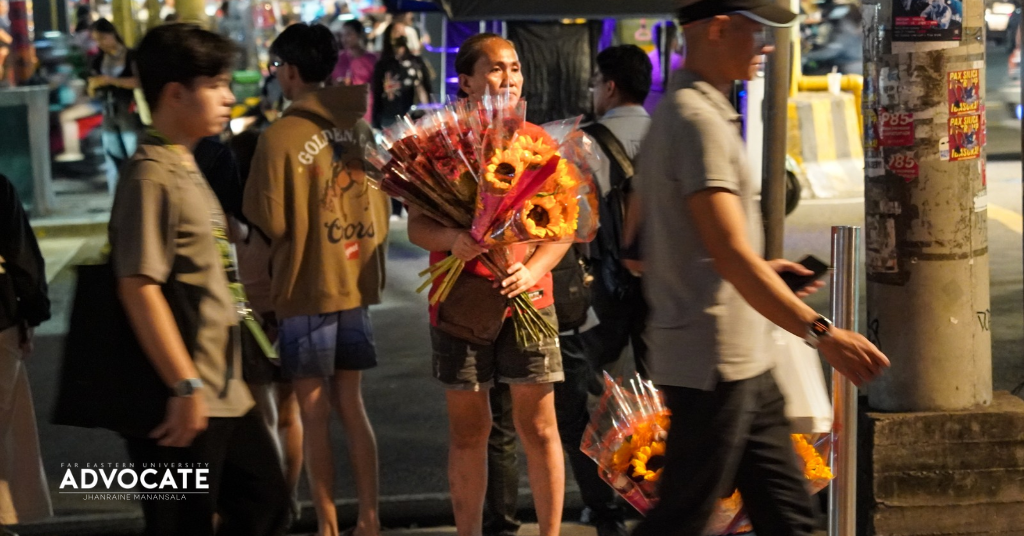
Along Quirino Avenue, the streets are more than passageways leading to another destination. For street vendors, every stretch of pavement is a place to make a living, with each sale a chance to sustain their families’ daily needs. Yet the very streets that keep their livelihoods afloat can also be taken away through space restrictions in which they are permitted to sell.
In an interview with FEU Advocate, a street vendor under the alias ‘Don J’ described the financial and mental strains of sustaining a livelihood while keeping up with the demands of household expenses.
“Laging iisipin kung saan kami kukuha ng pangkain namin sa araw-araw [at kung] paano ‘yong mga bayarin namin (We always have to think about where we will get the money for our daily meals and how we will pay our bills),” they shared.
Making ends meet is not simply a matter of working harder for vendors whose income is shaped solely by the opportunities each day brings. However, these struggles are often folded into the familiar narrative of ‘Filipino resilience,’ in which the ability to keep going is praised without enough attention to the root causes of what makes survival so difficult in the first place.
Don J’s situation became more difficult amid the clearing operations carried out in preparation for the 49th Association of Southeast Asian Nations Summit, as authorities sought to secure key roads and venues for the arrival of foreign delegates.
Behind the government’s efforts to present a clean and orderly image of the Philippines to the international community was a more uncomfortable reality: poverty remained unresolved even as the country prepared to welcome the world.
“Sa totoo lang, araw-araw ‘yong clearing operations, mula umaga hanggang gabi. At dahil nga may clearing operations ay hindi kami makapagtinda. Bali, ang ginagawa na lang namin is sa loob na lang kami nagtitinda [para] hindi sakop ng national road (To be honest, the clearing operations happen every day, from morning until evening. Because of these, we cannot sell along the road, so we resort to selling farther inside, in areas outside the national road),” the vendor explained.
Moving farther from their usual selling area did not guarantee the same foot traffic. When sales fall short, Don J and their family are left with fewer resources to sustain their livelihood.
“Kapag kaunti lang ang benta or hindi sapat is babawasan ‘yong dapat na ipupuhunan para sa bagong paninda (When sales are low or insufficient, we reduce the money that should have been used to purchase new merchandise),” the vendor shared.
When Filipinos are repeatedly expected to adjust to circumstances beyond their control, their ability to endure risks becomes an excuse for the conditions that demand such endurance. The celebrated capacity may, in reality, be a response to the absence of more sustainable opportunities and adequate protection.
According to the Department of Social Welfare and Development, 409 individuals received cash assistance to help cover their basic and immediate needs amid the disruptions caused by the summit preparations. Although financial aid was reportedly made available to vendors affected by the clearing, not everyone was guaranteed the same relief.
“Sabi may ayudang ₱10,000, pero hindi naman kami nakakuha do’n kasi pili lang ang binibigyan (We heard that there was ₱10,000 given as a financial assistance, but we did not receive any because only selected vendors were given them),” Don J claimed.
The pursuit of orderly public spaces must also consider the people whose livelihoods depend on them. Providing accessible financial assistance and designated vending spaces is essential to ensure that administrative efforts to improve urban spaces do not come at the expense of workers who rely on them to make a living.
After all, a person’s ability to stretch a meager income should never be mistaken as a reason to deprive them of more. Rather, it should reinforce the government’s responsibility to ensure that the conditions they live and work in allow them to earn a decent living.
A journey that demands more than a fare
Beyond the roadside stalls are the train stations, where commuters begin and end their days amid crowded platforms, long queues, and journeys that require more than one ride. For students and workers traveling between cities, getting from one destination to another often means spending hours on the road and a considerable portion of their daily budget on transportation.
Arianne Louise Canimo, a first-year nursing student at Chinese General Hospital Colleges, currently rents a dormitory near her school since traveling home to her province in Laguna requires taking a train, a bus, a jeepney, and two tricycle rides.
“Even though I don’t do this commute every day, it is still very tiring and inconvenient, especially kapag naaabutan ako ng rush hour (especially when I get caught in rush hour). There are times when I have to stand throughout the entire 10-station LRT [Light Rail Transit] ride because it is too crowded,” she shared.
At times, she has to wait for another train when one is already full. The wait does not end at the station either, as she sometimes spends another half-hour waiting at the bus terminal.
In the Philippines, waiting is unfortunately an inevitable part of getting from one place to another — these delays are often treated as ordinary inconveniences, leaving passengers to absorb the consequences of limited capacity and unreliable services.
Canimo tries to beat the rush hour by leaving early, but adjusting her schedule is not always possible. Academic responsibilities and other commitments leave her with limited room to rearrange her day just to secure a more comfortable ride.
“Unfortunately, I don’t really have a choice but to deal with these inconveniences. I am being forced to adjust… However, the circumstances cannot always be that way. Hindi naman sa lahat ng pagkakataon ay kaya kong baguhin ‘yong takbo ng oras o kaya ‘yong mga kailangan kong gawin para lang makasakay nang mas komportable (The opportunity for me to change my schedule or rearrange my responsibilities just to have a more comfortable commute do not come all the time),” the nursing student emphasized.
The ordeal of commuting also affects how often she gets to visit her family. Despite wanting to spend time with her grandparents, the thought of taking numerous rides and spending the majority of the day on the road often makes her reconsider going home.
Compounded expenses add another layer to the journey. Following an ₱11 increase in bus fare, the ₱200 she once allotted for a one-way trip to Laguna is no longer enough. To manage these expenses, she looks for cheaper routes, even when these entail longer travel times.
Being self-reliant has become a means of stretching what little one has for many Filipinos, whether through finding alternative courses or sacrificing convenience. Although these decisions are often praised as manifestations of adaptability, they also reveal the extent to which people are made to compensate for realities imposed upon them.
These experiences also shape Canimo’s concerns about the proposed privatization of MRT-3 [Metro Rail Transit Line 3] operations and maintenance. She questioned the decision to turn over a public transportation system built through taxpayers’ money to private entities.
“I was genuinely shocked kasi why would the government hand over something that was built using taxpayers' money? Para na ring ipinagwalang-bahala ‘yong perang pinaghirapan at ibinayad ng taumbayan (It would be as if the hard-earned money paid by the public were being disregarded),” she noted.
Rather than simply making commuters adjust to existing conditions, she hopes to see more trains, fewer breakdowns, greater passenger capacity, better air-conditioning, clearer station announcements, and a more dependable system.
Canimo’s expectations point to something that often gets lost in discourses about Filipino resilience: the right to demand for better conditions. Endurance should not silence dissatisfaction, for commuters are not imposing to be spared from every inconvenience; they are asking for a transportation system that recognizes their time, safety, and dignity as priorities.
“I manage to carry on with my daily responsibilities because, honestly, I feel like I have no choice but to endure these unfortunate conditions. Hindi naman puwedeng dahil lang napapagod ako sa pagko-commute, hindi na ako papasok o aalis… Enduring these conditions has become normalized in our society kasi wala naman talagang choice ang mga Pilipino (I cannot simply stop going to school or leaving the house just because I am tired of commuting. Enduring these conditions has become normalized in our society because Filipinos really have no choice),” she underscored.
For commuters like Canimo, transportation is not merely about reaching a destination. It also determines how much time remains for studying, resting, and spending time with loved ones. A ride home should not demand so much of a person’s energy before the day has even begun.
A thousand pesos, divided into a thousand needs
The journey eventually reaches the Filipino dining table, where the cost of everyday necessities is measured against the money available to provide them. For households managing several expenses at once, grocery shopping has become an exercise in deciding which needs must come first.
Senior collections associate Rikka Tanciangco is one of the primary budgeters in her seven-person household, standing witness to how rising prices have changed the way her family manages their income.
“Dati, kung may ₱1,000 ka sa palengke, may maiuuwi ka pang pang-ulam ng dalawang araw. Ngayon, isang araw na pamalengke pa lang, kulang na. Kailangan ko na talagang i-lista kada piso — bigas, ulam, gatas, pamasahe (Before, ₱1,000 at the market could buy enough food for two days. Now, it is barely enough for a single day’s groceries. I really have to account for every peso — rice, viands, milk, transportation),” she shared.
With seven people depending on the household’s budget, purchasing decisions have become increasingly deliberate. Instead of buying meat every day, the family opts for more affordable alternatives such as vegetables, eggs, and chicken. At times, one dish has to last throughout the day.
Making a limited budget work may demonstrate an individual's ability to adapt, but it does not make the limitations any less burdensome. When households are repeatedly expected to adjust their needs to accommodate rising prices, resourcefulness risks becoming a convenient substitute for addressing the conditions that make necessities difficult to afford.
As someone who is nearing childbirth, Tanciangco faces additional expenses for prenatal checkups and vitamins, alongside the costs already covered by her household income.
“Wala na po kaming tinatawag na luho. Ang naging diskarte na lang namin ay bumili lamang ng kung ano ang talagang kailangan… Inuuna ko talaga ang pangangailangan ng mga bata at magulang ko sa bahay bago ang sarili ko (We no longer have what we consider luxuries. Our only way of managing expenses is to buy what we truly need. I always prioritize the needs of the children and my parents at home before my own),” she explained.
For many Filipino households, putting family before oneself is regarded as an expression of love and responsibility. However, when financial limitations leave little room for personal necessities, self-sacrifice becomes more than a personal choice, but an expectation forced by circumstances. The ability to set aside one's own needs may be praised as a virtue, but it should not obscure the sacrifices breadwinners make to keep their households afloat.
Government initiatives such as the Department of Agriculture’s ‘Benteng Bigas, Meron Na!’ program seeks to make rice more affordable by offering eligible beneficiaries rice at ₱20 per kilogram. While the program has expanded its reach nationwide, access remains an important consideration for households that need such assistance.
Tanciangco has yet to avail of the subsidized rice program, as she is unfamiliar with where and how to access it. This highlights the need for the government to strengthen its information dissemination efforts, ensuring that intended beneficiaries are not only aware of these programs but also understand the steps required to avail them.
With these circumstances, the prospect of welcoming a new member to the family brings another layer of financial strain. As a mother nearing childbirth and one of her household's providers, Tanciangco admits to feeling both worry and exhaustion over the anticipated costs of milk, diapers, and hospital bills.
Despite these concerns, she continues to render overtime at work, putting in twice as much of labor to earn additional income and prepare for her child’s arrival. Even while acknowledging how physically demanding this period has become, she believes she must remain strong and find ways to provide for her family.
“Ang hiling ko lang po, sana mas maging abot-kaya ang presyo ng pagkain, lalo na ang bigas at masustansyang ulam para sa mga bata at pagbubuntis. At sana mas mapalawak at mas maging accessible ang mga programa tulad ng murang bigas at tulong pinansiyal para sa mga pamilyang tulad namin na nagsisikap araw-araw. Hindi naman po kami humihingi nang sobra, sapat lang na tulong para makaraos at mabigyan ng maayos na kinabukasan ang pamilya (My only wish is for food prices to become more affordable, especially rice and nutritious meals for children and pregnant women. I also hope that programs such as subsidized rice and financial assistance become more widespread and accessible to families like ours who work hard every day. We are not asking for too much, only enough support to help us get by and provide our families with a better future),” the breadwinner emphasized.
Tanciangco’s experience reflects a distinction often undermined when household budgeting is praised as resourcefulness: knowing how to stretch a limited income does not make it sufficient. Careful spending can help families manage their expenses, but it cannot replace affordable necessities and accessible public assistance.
The price of entering the workforce
On the far side of the dining table are the doors toward workplaces, where many young Filipinos are set to face another challenge: securing their first employment. For those entering the workforce without prior experience, finding opportunities and completing the necessary pre-employment requirements can become obstacles prior to receiving their first paycheck.
At the prospect of entering the workforce, Ataxia Aldenese, a second-year office administration student at the City University of Pasay, found herself navigating an unfamiliar process. Having little knowledge of how to obtain identification cards and other employment documents, she initially turned to her relatives for guidance on how and where to secure them.
“Sa totoo lang, ang paghahanap ng trabaho is mahirap kasi sobrang kaunti ng job opportunities para sa mga kagaya ko and, ang mga hanap ng mga employer or company is ‘yong may mga experience (To be honest, finding a job is difficult because there are very few opportunities for people like me, and employers or companies often look for applicants who already have experience),” she reflected.
The difficulties extend beyond the scarcity of employment opportunities. Printing documents and commuting to government offices further add to the costs of preparing for employment. For young Filipinos who are still financially dependent on their families, these seemingly routine expenses can become another barrier to entering the workforce.
“Isa sa [mga] nagpahirap sa’kin is ‘yong kukuha sana ako ng TIN [Taxpayer Identification Number] no’n kaso nag-down ‘yong system nila kaya ayon, nasayang lang [ang] punta ko — sayang pamasahe at napagod lang ako (One of the things that made the process difficult was when I went to get my TIN, but their system was down, so my trip was wasted. I wasted money on transportation and got tired for nothing),” Aldenese recalled.
Rather than allowing the setback to delay her other requirements, she proceeded with processing different documents the following day. For her, navigating the process meant learning to adjust whenever circumstances did not go as planned.
Aldenese's decision to redirect her efforts demonstrates her determination to make the most of her time, but it also reflects how applicants are left to assimilate the consequences of institutional shortcomings.
When a government system experiences disruptions, it is the jobseeker who bears the cost of another unsuccessful trip, from the fare paid and hours spent commuting to the energy required to return on another day. The burden of adjustment falls on those who can least afford to waste either time or money.
In recognition of the financial difficulties faced by first-time jobseekers, Republic Act No. 11261, or the First Time Jobseekers Assistance Act, was enacted to waive certain government fees and charges for eligible inexperienced job applicants obtaining employment-related documents from government agencies, provided they secure a barangay certification confirming their status. This benefit may only be availed once.
Aldeneset acknowledged that the measure helped lessen her expenses in obtaining necessary documents. However, the process continues to demand time and patience.
“Sa pagkuha ng ID [identification card], bukod sa mahirap na pag-commute at sinabayan pa ng init ng panahon, is ‘yong mahabang pila. Dapat kasing haba rin ng pasensya mo ang haba ng pila na pipilahan mo (When securing an ID, aside from the difficult commute and the heat, there are also long queues. Your patience has to be as long as the queue you have to wait in),” she shared.
Despite these challenges, her motivation to pursue employment remains rooted in both necessity and the desire for independence. Amid the rising cost of living, she hopes to help her mother shoulder household expenses while also earning enough to afford her personal wants with her own money.
“Sa hirap ng buhay at sa taas ng presyo ng mga bilihin, hindi mo gugustuhing hindi magtrabaho, eh (With how difficult life has become and how high the prices of basic goods are, you would not want to be unemployed),” she highlighted.
For many young Filipinos, employment is not merely a milestone of adulthood or an opportunity to pursue personal ambitions; it is also a means of responding to the growing demands of everyday living. But how much endurance should be expected of those who are only beginning to find their footing?
Celebrating young Filipinos for their willingness to work hard and adjust to adversity should not overshadow the conditions that make their entry into the workforce so difficult. When the ability to endure becomes a prerequisite for accessing opportunities, resilience risks being used to normalize barriers rather than challenge them.
This prolonged process has taught Aldenese the importance of patience amid systemic difficulties, but she also recognizes that persistence alone cannot address the barriers young jobseekers face. She believes that fairer employment opportunities are necessary, particularly for those who have yet to gain professional experience, such as government-funded internships to help young Filipinos build the qualifications employers often require.
“Paano makakakuha ng experience kung hindi tatanggapin? (How can we gain experience if we are not given the opportunity to be hired?)” Aldenese questioned.
The transition from education to employment should not become a cycle in which young Filipinos are denied opportunities for lacking the very experience they need to acquire. While assistance programs can ease the financial burden of securing requirements, meaningful support must also extend to creating accessible pathways into the workforce.
These different realities reveal how resilience takes on many forms, shaped by the circumstances Filipinos are forced to navigate in their daily lives. Whether through finding ways to make ends meet, adjusting to inadequate public services, or carrying on despite uncertainties, their experiences reveal a shared pattern of having to compensate for conditions beyond their control.
Across the streets, terminals, dining tables, and workplaces, Filipinos have mastered the art of making things work, even when the circumstances hardly do. Their resourcefulness and determination are worth recognizing. Yet resilience becomes a troubling measure of collective strength when it is celebrated without examining the conditions that repeatedly necessitate it. Praising people for enduring hardship must not become a substitute for addressing the predicaments that make their lives difficult in the first place. Filipinos deserve more than a country that reduces life to mere survival; they are entitled to one that gives them every reason to live.
(Photo by Jhanraine Manansala/FEU Advocate)