





By Julienne G. Tan
For many Filipinos, making ends meet is a daily exercise of deciding what can wait and what cannot. A simple dine-out might mean having less money for transportation, while a sudden school expense might put off another necessity. Yet, despite these everyday struggles, the Philippine Statistics Authority (PSA) reported that poverty incidence among individuals dropped to a record low of 9.7 percent in 2025, with the poverty threshold now set at just ₱96.22 a day.
Under the government’s poverty threshold, the average monthly income for a family of five stands at ₱14,634, equivalent to approximately ₱35,122 annually per person or ₱96.22 per day. A household is classified as poor when its income, divided by the number of members, falls below this per capita threshold, while those above it are no longer statistically counted among the poor.
While a declining poverty rate may mark progress, the more important question is whether Filipinos are finally earning sufficiently not just to survive, but to live with dignity. If crossing the poverty line only means having enough to get by, how much does a Filipino actually need to live beyond survival?
The value of bills and some change
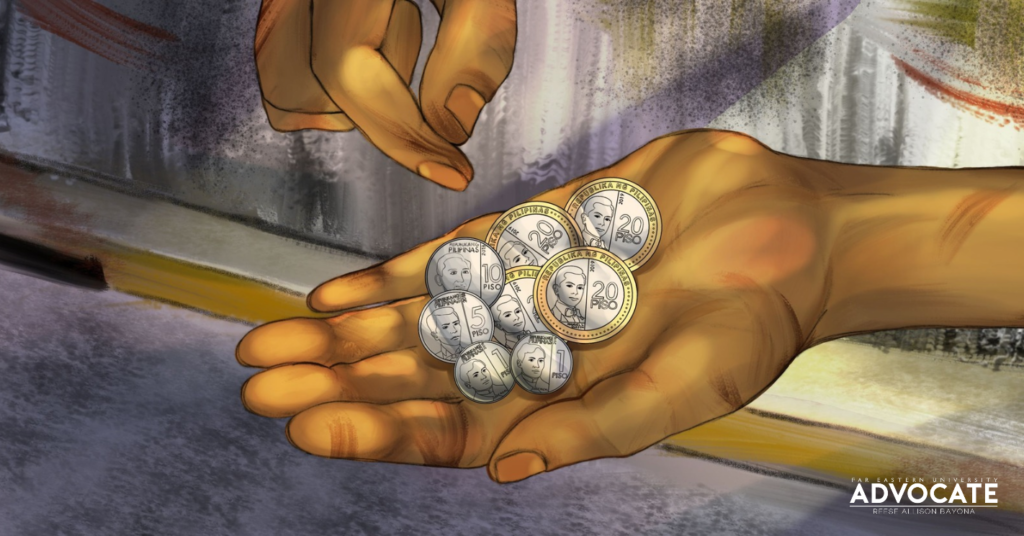
A daily budget of ₱96.22 is small enough to fit in a few bills and coins, yet somehow large enough for the government to draw a line between those considered poor and those who are not. But beyond this line lies a question that mere figures cannot answer: what happens when the amount meant to cover a person's minimum needs cannot even stretch across an ordinary day?
In an online interview with FEU Advocate, Baby Jean Tianzon, a second-year international studies major in Asian Studies student at Cavite State University, argued that the ₱96.22 figure reflects a narrow understanding of the economic conditions experienced by ordinary Filipinos. She believes that the threshold fails to account for rising commodity prices, particularly in provinces where insufficient wages and living expenses can make the amount even more difficult to sustain.
“Mini-measure nito ang kulang o hindi malawak na saklaw ng pagtingin ng gobyerno sa ating ekonomiya. Hindi nila totally napapansin ‘yong pag-inflate ng presyo ng mga bilihin lalo na sa mga lugar kung saan ay may provincial rate na hindi sasapat ang ₱96 na gastos sa pang-araw-araw na gastusin sa pagkain (This measures the government's limited or narrow perspective on our economy. They do not fully account for the inflation of commodity prices, especially in areas where the provincial rate makes ₱96 insufficient to cover a person's daily food expenses),” she explained.
Apart from the difficulty of meeting daily expenses, the threshold also poses issues about how the government defines an acceptable standard of living. For Charles Delfin, a third-year secondary education major in English student at Far Eastern University, the problem lies in how poverty is measured and the expectations imposed on those who experience it.
“By reducing basic needs to a peso-by-peso calculation, we risk normalizing a standard where Filipinos are expected merely to endure hardship rather than have opportunities to thrive. Poverty measurement is an outright insult to many Filipinos, when we should be developing policies and programs that empower and improve the quality of life that every Filipino deserves,” he explained in a separate online interview.
The limitations of an income-based measure become more apparent when household circumstances are taken into account. As Cavite State University second-year agricultural and biosystems engineering student Jan Ryser Carrasco clarified, two families earning the same amount may face vastly different financial pressures depending on the number of dependents, their capacity to earn, and the specific needs of each household member.
“The primary thing that we should consider is their lifestyle, and second is their wages and source of income, which reflects their privilege. We should also consider their family backgrounds such as how many family members they have, how many of them are dependent/independent, the dependent’s salaries, and if they have a member with special needs,” he explained in an online interview.
These realities expose the nuance between a statistical classification and the lived experiences of people living with limited resources. A household may technically earn enough to move above the poverty threshold, yet still have limited room for emergencies, personal needs, or expenses that arise without warning.
Delfin pointed to healthcare as one of the clearest examples of this vulnerability. For many middle-class families, a single hospital bill can drain years of savings and push a once financially stable family into uncertainty.
“Long hospital queues, expensive medicines, and limited access to treatment force many families to spend beyond their means simply to survive. A person may no longer be statistically poor, yet still live with constant fear of financial uncertainty in relation to health,” he explained.
These concerns are echoed by IBON Foundation in a statement released last August 22, which criticized the government’s poverty measurement for understating the cost of living. The foundation argued that the food threshold is based on a bare-minimum, least-cost basket, while non-food necessities are not directly and adequately accounted for.
As of July 2026, the foundation estimates that a family of five needs ₱1,277 daily to afford a decent standard of living, more than twice the country’s average minimum wage of ₱512. At this rate, a minimum-wage earner's daily income covers only around 40 percent of what a family needs. These figures raise questions about the accuracy of the PSA’s reported decline in poverty incidence.
While fewer Filipinos may fall below the official poverty line, IBON Foundation cautioned that moving households just above this threshold through interventions such as the Pantawid Pamilyang Pilipino Program (4Ps) inadequately addresses the structural conditions that keep families at financial vulnerability.
The poverty threshold remains an insightful statistical measure, but it does not capture the compromises families make to meet competing needs or the insecurity that persists even after crossing the poverty line. Being classified as ‘non-poor’ does not necessarily mean having enough to live securely, especially when families must still weigh which necessity they can afford to put last.
Every peso counts
A family can stretch its budget, skip unnecessary purchases, and carefully divide every peso among its expenses, but these efforts have limitations when the income itself is insufficient. For many Filipinos, financial insecurity is not simply a matter of spending wisely. It is also shaped by the societal conditions they are expected to endure: wages that struggle to keep up with rising prices, limited access to quality education, and essential services that continue to consume a significant portion of household income.
The consequences of financial insecurity also extend to education. Often regarded as a means of improving one's circumstances, education can become another financial burden. When these expenses become difficult to sustain, access to education is placed at risk, limiting opportunities that could otherwise lead to more stable employment.
Carrasco noted the role of public education in this cycle, underlining the burden of low wages and the government's responsibility to maintain accessible, quality education, particularly as state universities face budget cuts and commercialization.
“Low wages limit the students from accessing quality education and the rising cost of basic services. However, low wages are not the primary problem in education, but the budget cuts that limit the students’ access to free and quality education [are]. As the state universities slowly become commercialized, people with low wages slowly become more burdened,” the student explained.
The 2025 family poverty incidence figures show how uneven the conditions for overcoming poverty remain across the country, where the National Capital Region stood at 0.6 percent compared with 16.8 percent in Bicol, the highest among all regions. Although every region recorded improvements compared with the previous year, including BARMM, where poverty incidence fell from 26 to 12.8 percent, these gains do not erase the stark differences in the economic circumstances families face.
These disparities become particularly consequential for families trying to keep their children in school. For households supporting college students, the cost of education extends beyond tuition and school requirements to the daily expense of reaching campus. Transportation alone can take up a considerable share of a family's limited budget, leaving less for food and other necessities.
“Sa pagtaas pa lang ng transportation, kung may isang anak na nagkokolehiyo… kulang na kulang na iyon para sa pagkain at para sa iba pang babayaran. Kahit sa isang pagtaas ng presyo ng pangangailangan, malaki na agad ang epekto nito sa isang pamilyang nahihirapang ma-achieve ang amount ng pera para mabayaran ang pang-araw-araw na gastusin (Even an increase in transportation costs can already have a significant impact. If a family has a child attending college, there may no longer be enough money for food and other expenses. Even a single increase in the price of a necessity can have a major effect on a family already struggling to earn enough to cover its daily expenses),” Tianzon added.
Last March, the Land Transportation Franchising and Regulatory Board (LTFRB) approved the eight-percent minimum fare increase for jeepneys, with traditional jeepneys rising from ₱13 to ₱14 and modern jeepneys from ₱15 to ₱17. For a commuter making a round trip at the minimum fare, this means spending ₱28 to ₱34 daily on transportation alone, equivalent to about 32 percent of the ₱96.22 daily poverty threshold.
For households supporting a college student, this cost represents more than a daily deduction from their budget. It is an expense tied to access to education, one that must be met consistently regardless of whether the family can comfortably afford it.
These circumstances reveal how poverty can persist even among people who work hard and make deliberate efforts to manage their finances.
“Nagiging domino effect ang lahat ng ito at mas lalong naapektuhan ang parte ng masang hindi naabot ng gobyerno. Pero kung ang mismong gobyerno ang ugat ng problemang nararanasan natin ngayon, talagang may kailangang pagbabago (All of these become a domino effect, further affecting the sector of the masses that the government fails to reach. But if the government itself is the root of the problems we are experiencing today, then something truly needs to change),” Tianzon explained.
A more realistic understanding of poverty must therefore also account for whether workers receive sufficient wages, students can access quality education, and families can afford healthcare, transportation, and other essential services without sacrificing another necessity. Without these conditions, the responsibility of escaping poverty is placed on individuals with little control over the circumstances limiting them.
For families already spending nearly everything they earn on daily necessities, saving money becomes a privilege they cannot afford. Even the prospect of earning more is not equally accessible — better-paying jobs often require diplomas and years of experience, while professional opportunities remain easier to secure for those with greater financial means. When the path toward a more stable life is shaped by privilege, hard work alone falls short of breaking the cycle of poverty.
Understanding these conditions also puts into question the government’s definition of progress. If poverty is shaped by the opportunities people can access and the hardships they continue to endure, declining poverty figures alone do not reveal whether their lives are actually improving.
Beyond the numbers
There comes a point when hardship becomes so familiar that people begin to build their lives around it. They learn to expect less and start to make peace with possibilities that remain out of reach. What begins as a temporary compromise slowly becomes a way of living until the question is no longer what a person hopes to achieve, but what they can realistically afford to hope for.
Tianzon's perspective is shaped by her own experience of hardship, giving her a personal stake in the struggles she describes and the changes she believes are necessary.
“Since isa din ako sa mga nakakakaranas ng ganitong kahirapan, na-realize ko na talang ang hirap mamuhay kung sinasalat ka ng mismong gobyernong nasa sarili mong bansa (Since I am also someone who experiences this kind of hardship, I have realized how difficult it is to live when you are deprived by the very government of your own country),” she shared.
Her frustration points to something more consequential than the inadequacy of a single measure: the danger of allowing temporary relief to stand in for lasting change. For her, progress must be rooted in reforms that alter the conditions people have long been expected to endure, rather than simply helping them manage those conditions for a little longer.
“Nagsisimula ang pagbabago sa totoong paglubog natin sa masa at kung magbibigay tayo ng totoong pagbabago kesa sa mga band-aid solutions at pag-i-invalidate sa hirap ng masa (Change begins with genuinely immersing ourselves among the masses and providing real change rather than band-aid solutions and invalidating the hardships of the masses),” Tianzon emphasized.
This illustrates that meaningful progress requires reforms that give ordinary Filipinos a real chance to improve their lives, rather than leaving them to continually adjust to a system that demands so much while offering so little in return.
The gap between being classified as non-poor and feeling secure is crucial because progress should not mean learning to live with less or mistaking endurance for improvement. It should entail having the freedom to aspire for more without feeling the need to first calculate whether those aspirations are worth the cost.
A poverty threshold may mark the point at which a person is no longer counted among the poor. But it cannot tell us whether that person has regained the confidence to make plans, the freedom to pursue a future, or the assurance that one misfortune will not undo everything they have worked for.
Escaping poverty should mean more than earning just enough to be excluded from its statistics. It should involve no longer having to adjust an entire life around what one cannot afford. The measure of progress, then, is not only in the number of people who have crossed the poverty line but also in how many can finally look beyond it and imagine a future that entails not just simply surviving through each day.
(Illustration by Reese Allison Bayona/FEU Advocate)