








By Ishia Eleanor F. Marquez and Dave Louie M. Blas
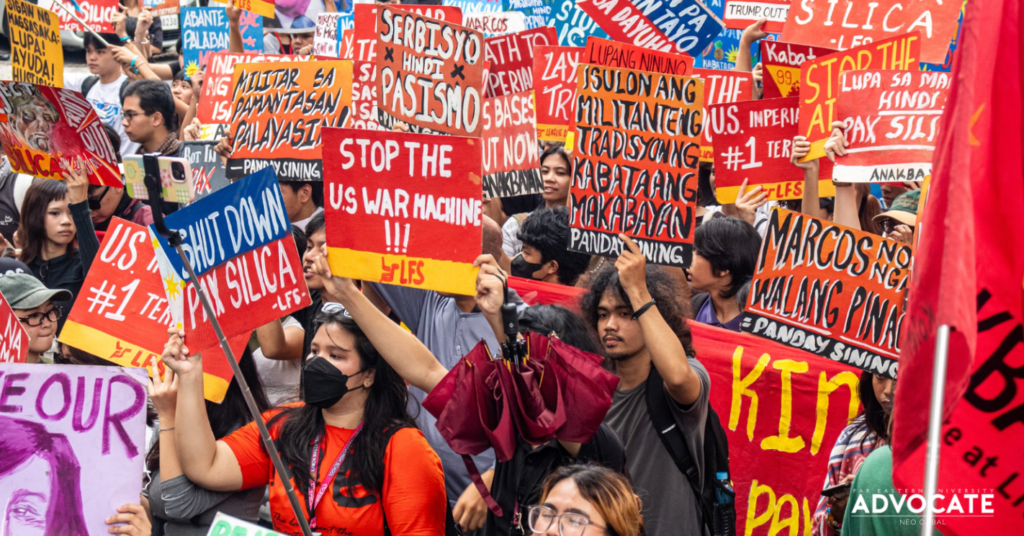
Coinciding with the four-day 49th Association Of Southeast Asian Nations (ASEAN) Summit, various progressive groups reiterated their calls against the visit of United States (U.S.) President Donald Trump and the country’s imperialist initiatives in the Philippines including Pax Silica along Recto Avenue last November 18.
With the call ‘Trump Out,’ more than 2,000 protesters denounced Trump’s participation in the summit, where he met with Philippine President Ferdinand ‘Bongbong’ Marcos Jr. and other regional leaders to discuss their economic and technological agendas during the U.S.-ASEAN Special Summit.
As thousands of Filipinos gathered to protest, among the issues condemned is the U.S.-led artificial intelligence (AI) Pax Silica initiative, which aims to manufacture semiconductors for exportations set to advance the U.S. technology and economic supply chain.
Nation against Pax Silica
Last April, the U.S. State Department announced that the Philippines designated 4,000 acres of land for an industrial hub in the Luzon Economic Corridor under the Pax Silica initiative, targeting the country's minerals such as nickel, copper, chromite, and cobalt for extraction and global supply chain use.
However, this industrialization initiative comes at the expense of around 20,000 farmers and Indigenous communities, who could potentially lose their lands and livelihoods in exchange for investments worth billions of dollars.
Prior to Trump’s arrival, speculation over the possible signing of the deal during the ASEAN Summit arose. However, Marcos Jr. and U.S. Ambassador to the Philippines Lee Lipton refuted the rumors, stating that no finalization happened during the summit.
For progressive groups, the postponement of the Pax Silica initiative is a ‘victory,’ but they emphasized that the delay does not mean it will be abandoned.
Coming all the way from San Jose del Monte, Bulacan, Sandigan ng Samahang Magsasaka member and farmer Rolan argued that the data centers would cause farmers to lose their land and livelihood, contrary to its promise of job creation.
“Ibig sabihin, paglilinlang sa aming magsasaka ‘yan. Ang mas nararapat sa amin ay ibigay sa amin ang lupain, ipamahagi ang mga lupa para mas lalong may makapagsaka… Dapat inintindi ng gobyerno sa atin ‘yong pansarili natin, kumbaga sariling likha… Kaya natin mag-produce kung susuportahan lang ng gobyerno, lalo na sa magsasaka (That means deceiving us farmers. What is more rightful for us is to grant us the lands and distribute those so more people can farm. The government should focus on our own production. We can produce if only the government will support us, especially farmers),” he stressed in an interview with FEU Advocate.
Despite its potential to bring job security to the country, progressive groups continue to condemn the project’s implementation in the Philippines, citing threats to the displacement and livelihood of individuals in rural communities.
Rolan further denounced the government’s prioritization of foreign interests over the welfare of farmers and Indigenous communities who will be affected by the proposed Pax Silica initiative.
“Malinaw dito na mas pinapaboran ng gobyerno natin ang dayuhan kaysa sa sariling atin, lalo na sa mga magsasaka, lalo na sa aming magsasaka. Ito ay kawalan sa karamihan ng mga magsasaka sa buong Pilipinas… dahil unang-una, matatandaan natin ang Pax Silica ay ang mga katutubo natin ay [ang] mawawalan ng pangkabuhayan at lupa (It is clear here that our government favors foreigners over our own, especially us farmers. This is a loss to most farmers in the Philippines, because first of all, our Indigenous people will lose their livelihoods and lands due to Pax Silica),” he said.
Despite the Bases Conversion and Development Authority’s (BCDA) estimate that the AI hub would lead to the displacement of around 200 Aeta individuals, Kalikasan People’s Network for the Environment National Coordinator and Network Opposed to Pax Silica Convener Cathleen de Guzman said that the project could affect as many as 20,000 Aetas and farmers, potentially subjecting them to long-term displacement from their lands.
After witnessing firsthand the state of the Aeta community and farmers in Capas, Tarlac, de Guzman denounced the forced relocation of residents and the meager compensation offered for their land.
“Ngayon pa lang nakikita na natin na ginagawa ito sa pamamagitan ng [BCDA], [kung saan] binibigyan nila ng papel, ng kasulatan, ‘yong mga Aeta at ‘yong mga magsasaka para palayasin sa kanilang lugar sa napakababang halaga (Even now, we are already seeing this being done through BCDA, where they give papers, documents, to the Aeta and the farmers to give up and leave their lands for a very low amount),” she stressed.
According to Human Rights Watch Chieftain Petronila-Capiz Muñoz, the BCDA verbally informed residents of Sapang Kawayan that they would be relocated to a 30-square-meter housing area three kilometers away from their current community by December.
However, the location would leave residents without access to nearby streams and agricultural land, threatening their water supply, food security, and livelihoods.
Similarly, de Guzman revealed that residents of Sitio Manabayukan rely on a gravity-fed water system that becomes insufficient during dry seasons, forcing them to turn to nearby rivers for water supply, including the Bangot River.
Sitio Manabayukan is among the several sitios in Capas, Tarlac that will be affected by the Pax Silica initiative.
However, BCDA President Joshua Bingcang said that the Bangot River is ‘enough’ to meet Pax Silica’s water supply requirement based on their initial study conducted during the dry season.
With the looming threats of Super El Niño, de Guzman underscored that the initiative may exacerbate water scarcity by further depleting the country’s reserves, which could reduce water availability for the agricultural sector that depends on rivers to sustain their daily needs and livelihoods.
“Sa usapin ng tubig dahil nga may Super El Niño at kung nababalitaan natin na napakarami na no’ng mga LGU [Local Government Unit] na nagsabi na nasa state of calamity na sila dahil sa Super El Niño. Ngayon, ganito pa ‘yong mababalitaan natin na meron Pax Silica na proyekto na hindi naman sinasang-ayunan ng mga tao at mas [nagiging] drained pa ‘yong ating rekurso sa tubig (Regarding water concerns, especially with the Super El Niño and if we hear the reports from numerous LGUs that declared a state of calamity in their area due to Super El Niño. Now, we hear that there is a Pax Silica project, which people do not even support and would drain our water supply),” she expressed.
Despite the administration’s assertion that declaring a nationwide state of calamity is unnecessary amid El Niño concerns, several LGUs, including Bohol and Iloilo, have declared states of calamity due to water shortage.
The BCDA also estimated the Pax Silica hub to consume 130 million gigawatts of water and three gigawatts of electricity daily, equivalent to 600,000 houses and three coal outputs, further straining the water and energy supply of the Philippines amid extreme weather conditions.
To meet the AI hubs’ massive electricity demands, Pambansang Lakas ng Kilusang Mamamalakaya ng Pilipinas (PAMALAKAYA) Vice Chairperson Ronnel Arambulo noted that the government is using it to justify renewable energy projects, such as offshore wind farms, which will directly disrupt their fishing grounds and threaten their livelihoods.
“Kaya may mga renewable energy project ngayon sa ating bansa para i-justify, eh ang sabi para makakalikasan, mapapagbigyan ng enerhiya, hindi nagagamit ng fossil fuels. Pero sa totoo, sa bahagi naming mga mangingisda, direktang sinisira ‘yong kalikasan kasi itinatayo ito doon sa mga lugar kung saan ay kapangisdaan at saka sa mga sa mga kabundukan (That is why there are renewable energy projects in our country to justify it — they say it is pro-environment, can provide energy, and does not use fossil fuels. But in fact, on our part as fisherfolk, it directly destroys nature because it is being built in areas of fishing grounds and in the mountains),” he claimed in an interview.
Imperialist initiatives of Trump
During the special summit, the U.S. president discussed its Comprehensive Strategic Partnership that aims to strengthen bilateral ties across sectors, including economic and technological partnerships with the Philippines.
Additionally, Trump revealed that Marcos Jr. managed to secure the ‘biggest trade deal’ for the country during the state luncheon, highlighting that it would greatly benefit both countries, particularly American farmers and workers in the energy sector.
Addressing the two countries’ persisting alliance, Makabayan Coalition President Liza Maza denounced the intensified dominance of the U.S. over the Philippines, arguing that it would bolster American influence in the Asia-Pacific region as it competes with other superpowers such as China.
“‘Yong pagdalo dito ni Trump eh meron talagang partikular na layunin na mas pahigpitin ang pang-ekonomiya, pampulitika, at militar na relasyon ng Pilipinas at saka ng Estados Unidos… Gustong ipaloob ang Pilipinas, i-integrate ang ating ekonomiya, ‘yong ating economic development, at saka ‘yong ating defense, doon sa agenda ng Estados Unidos (Trump’s attendance here really has a particular purpose to further tighten the economic, political, and military relations of the Philippines and the United States. They want to bring the Philippines in, integrate our economy, our economic development, and our defense into the agenda of the United States),” she stated in a separate interview.
Maza also emphasized the danger of being used as a pawn by the U.S. in its rivalry with China, particularly citing U.S. military presence and their exploitation of the country’s natural resources through resource-heavy production and operations in the proposed Pax Silica hub.
“Ang Pilipinas ang nasa sentro ng platapormang ito na ginagamit ng U.S. na lunsaran ng kaniyang giyera… kuhanan ng kanyang mga, pagsasamantala ng mga likas yaman natin, mga minerals (The Philippines is at the center of this platform which is used by the U.S. as a war launchpad and as a source to exploit our natural resources and minerals),” she said.
Last March, China’s foreign ministry accused the U.S. of bringing ‘conflict and the chaos of war’ to the Asia-Pacific region, following the latter’s announcement of its plan to establish an ammunition facility in the Philippines amid tensions with China over the West Philippine Sea (WPS).
The U.S. military presence is also set to intensify after Trump’s visit to the country after the White House announced $2 billion in military financing for the Philippines, $400 million of which will be utilized to boost Philippine military operations in the WPS.
With the increased militarization in the WPS, the relationship between the two nations further raised concerns regarding heightened tensions in the fishing grounds, disrupting the livelihoods of over 450,000 fisherfolk who are at risk of losing their income, which will eventually push them deeper into poverty.
Scrutinizing the possible restriction of water access for the fisherfolk within the proposed armory factory in Zambales, Arambulo argued that the project will significantly affect their livelihood and fish catch.
“‘Yong kemikal na gagamitin sa paggawa no’ng bala ay makakalason do’n sa pangisdaan, at ‘yong lugar ng ammo factory ay bawas na naman din do’n sa mga lugar pangisdaan, pangingisda ng mga mangingisda. Siyempre magkakaroon ng mga paghihigpit diyan (The chemicals that will be used in making bullets will poison the fishing grounds, and the area of the ammo factory will reduce fishing grounds. Of course, there will be restrictions there),” the PAMALAKAYA vice chairperson said.
This year, the U.S. Department of War revealed that they have been looking into the Philippines for a potential establishment of an ammunition facility for 30mm cannon rounds, particularly used for military aircraft and ground vehicles.
Trump also shared that the U.S. plans to expand its weapon production, which will help improve its capacity to supply armaments to the Philippines, including Tomahawk missiles used for deep land attack warfare.
Police aggression, mass arrests during protests
With various groups mobilizing against Trump’s visit, the deployment of police forces as ‘security measures’ led to a series of arrests and aggression against protesters.
Last November 15, members of Lakbayan ng Timog Katagalugan were set to join protesters for a broader demonstration, but were met with brute force from the police in Muntinlupa City, halting their march toward Liwasang Bonifacio.
Prior to the protest, the group also reported that two jeepneys carrying their delegation had severed brake lines and pump belts during their protest in Muntinlupa, while other protesters in Manila discovered human feces scattered across Liwasang Bonifacio.
According to the group, police units had already surrounded their kampuhan from dawn, which restricted them from going beyond the set perimeters and even buying breakfast before the start of their march.
Initially set to march toward Liwasang Bonifacio by 2 p.m., the mass-up was met with aggression from authorities, leading to a violent dispersal and the arrests of around 300 ‘Lakbayanis’ as well as student journalists from various campus publications who were covering the event.
In a separate protest in Liwasang Bonifacio on the same day, nine individuals were also arrested, who were identified as members of Kilusang Mayo Uno (KMU), Alliance of Nationalist and Genuine Labor Organization, PISTON, Alliance of Concerned Teachers, Tambisan sa Sining, and Anakbayan.
The arrested individuals were later transferred to Camp Bagong Diwa, and lawyers from the Commission on Human Rights and Gabriela Women’s Party Representative Sarah Elago were denied visitation access, which violated their right to due process.
Due to the mass arrests, the National Union of People’s Lawyers revealed in a statement that the individuals were detained for more than 18 hours without any confirmed charges filed by the Philippine National Police, calling it a breach of their constitutional rights to liberty and security.
“The police cannot indefinitely detain individuals while withholding information about their legal status, much less evade the consequences of their failure to comply with the prescribed periods,” the statement read.
Additionally, GABRIELA Secretary General Clarice Palce condemned the government’s efforts to silence Filipinos who went to the streets to express their appeals to the world stage during the ASEAN Summit.
“Itong pag-aresto nila illegally, arbitrary sa higit 200 na mga naglakbay pa mula sa Timog Katagalugan para isigaw ‘yong kanilang mga panawagan, ito ay fascism on full display. Pinapakita ng gobyerno kung gaano siya kabangis sa mga mamamayan na nanawagan ng pagbabago [at] hustisya sa ating bansa (These illegal arrests, arbitrary to over 200 individuals who traveled from Southern Tagalog to express their appeals, this is fascism on full display. The government shows how ruthless it is toward citizens calling for change and justice in our country),” she said.
Meanwhile, during the second day of the demonstration, police blocked more than 6,000 protesters in Liwasang Bonifacio from reaching the Philippine International Convention Center as Trump arrived in the country.
The following day, police once again barred the groups along Recto Avenue, preventing them from marching to Mendiola Street near Malacañang, where the bilateral meeting between Trump and Marcos Jr. was held.
As of writing, over 200 protesters have already been released, including at least 18 journalists, following the release order issued by the Muntinlupa City Prosecutor’s Office last November 18.
Among the first individuals released was Philippine Collegian Multimedia Editor Alfonzo Soliveres, who was arrested and detained together with other campus journalists and alternative media personnel, appealing to the authorities to understand the nature of media work.
“Gusto kong ipanawagan na sana po sa susunod, isaalang-alang po ang aming trabaho bilang media workers dahil hindi po kami hindi nadadawit sa mga ganitong sitwasyon, at isa po ‘to sa mga hirap at dagok na talagang nararanasan ng mga media practitioners na maaaresto kasabay ng mga pangyayari (I want to appeal that next time, our work as media workers be taken into consideration because we are always caught up in situations like these, and this is one of the hardships and challenges truly experienced by media practitioners who get arrested alongside these incidents),” he urged in an interview.
According to KMU, eight of the nine individuals arrested by the Manila Police District during the first day of the protest were released last November 20. Meanwhile, Johnvie Montante remains detained at the Manila Youth Rehabilitation Center.
ASEAN preparations
Prior to Trump’s arrival, the administration installed temporary barriers and closed several establishments as part of its ‘cleanup’ initiative along major roads to conceal polluted areas and visible poverty from the delegates.
Palce slammed the government’s effort to mask the country’s worsening conditions despite being responsible for its prevailing circumstances.
“Kahit anong pagtatago ng gobyerno ni Marcos Jr., kitang-kita naman sa kasaysayan at kalagayan ng mga mamamayan ‘yong todo-todong kahirapan, kagutuman, at ‘yong tuloy-tuloy din na pagbaha sa mga maralitang komunidad natin dito sa Pilipinas (Despite Marcos Jr. government’s attempt to hide it, extreme poverty, hunger, and continuous flooding in poor communities in the Philippines are clearly evident in history and condition of the people),” she said.
With over 1,400 vendors affected by the temporary closure of businesses during the summit, the Department of Social Welfare and Development distributed ₱10,000 and food relief packs to help alleviate their financial burdens.
However, concerns remain over the delayed distribution of the financial assistance, with vendors worrying that they may not receive the promised monetary aid.
KADAMAY Secretary-General Mimi Doringo also criticized the government’s clearing operations, emphasizing the livelihood concerns of local vendors after the temporary closure of establishments near the summit venues.
“Walang ibang pagkakakitaan ang mga inagawan ng kabuhayan ni Marcos [Jr.]. Sa taas ng presyo ng krudo, at ng mga bilihin at bayarin — ang pansamantalang pagkawala ng kabuhayan ay lilikha ng mas matinding pagdurusa sa kanila at kanilang mga pamilya (The livelihoods taken away by Marcos Jr. would have no other means of earning income. With the rising prices of fuel and basic commodities and bills — the temporary loss of livelihoods will cause suffering for them and their families),” she emphasized in a statement.
Furthermore, as preparation for the summit, the government designated a lane for ASEAN delegates along Roxas Boulevard in Pasay City.
In observance of Bonifacio Day, progressive groups are set to hold a demonstration condemning the Pax Silica initiative on November 30.
(Photo by Neo Cabal/FEU Advocate)