








By Julienne G. Tan
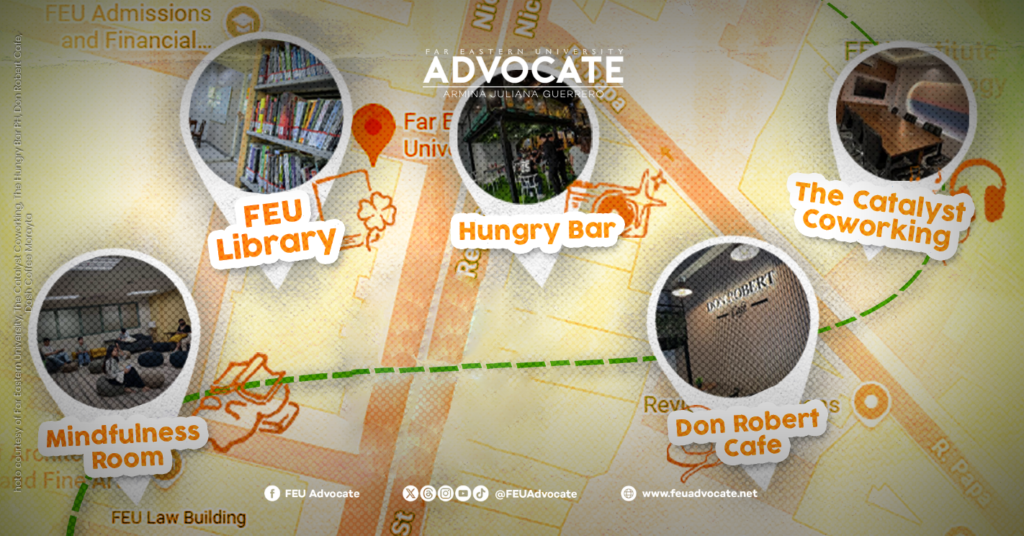
For many students, college is a season of constant becoming — learning, growing, and striving toward the future. In the rush to keep up, there will be moments when what Tamaraws need is not another task to accomplish, but simply somewhere to pause. Across and beyond Far Eastern University (FEU) exist spaces designed for rest and reflection, offering students a chance to step back from the demands of the day and return when they are ready.
With the rise of ‘third places,’ spaces between home and school have become part of how students navigate college life. A library corner, a familiar cafe, or a cozy study hub can offer more than a place to study or sip coffee.
Along the streets of Morayta, these third places can be found in different corners across the campus, each serving a different need. Whether to focus or simply breathe, these spaces remind Tamaraws that stepping away from the demands of college is different from falling behind.
1. Comforting third places inside FEU
Sometimes, the spaces students need most are already woven into their everyday routines — just beyond the classroom doors or down a crowded hallway. At FEU, Tamaraws are given a space to pause, refocus, and breathe amid the demands of college life.

The FEU Library at Nicanor Reyes Hall has grown into a place beyond borrowing books or preparing for examinations. Its comforting corners and study areas create an environment where concentration comes naturally, offering a quiet escape from the grind that often comes with campus life.
In an online interview with FEU Advocate, second-year nursing student Ashley Ainna Waje shared that the library has become an important part of her study routine, especially on days when she needs to focus.
“Kapag gusto kong magpahinga from classes or kailangan ko talagang mag-focus, naghahanap ako ng place na tahimik at comfortable because hindi talaga ako nakakapag-focus nang maayos when at home. Madalas akong pumunta sa FEU Library kasi less distractions at mas nakakagana mag-aral (When I want to take a break from classes or I really need to focus, I look for a place that is quiet and comfortable because I really can’t focus well when I’m at home. I often go to the FEU Library because there are fewer distractions and it makes me more motivated to study),” she shared.
For Waje, changing her surroundings helps her become more productive. Staying at the library to finish requirements or review notes helps draw a clearer boundary between school and home life, making it easier to balance academics with rest.
On the other hand, second-year nursing student Andrei Santos discovered the library out of necessity. With back-to-back classes and online sessions in between, returning home was often impractical. Eventually, the place became an essential part of how he managed his day.
“What started as a practical decision eventually became part of my routine. It’s a place where I can switch from one class to another without feeling rushed, and it gives me a moment to recharge before the next part of my day,” he expressed in a separate interview.
Despite having different routines, both students find that a familiar yet calming environment helpful in creating a healthier rhythm between productivity and rest. For them, the library became a space that made demanding schedules feel more manageable.
Beyond providing a place to focus, the library also fosters a sense of community — while conversations are kept to a minimum, seeing fellow students immersed in their own work creates an uplifting atmosphere as everyone shares the same goal of learning continuously.
Waje especially feels this sense of togetherness during examination week, when she and her classmates spent hours studying together in the library.
“Noong exam week, halos buong araw kaming nasa library ng classmates ko... Kahit stressful ‘yung exams, naging memorable siya kasi sabay-sabay kaming nagtutulungan. Doon ko na-realize na it’s not just a place to study, but also a place to build memories (During exam week, my classmates and I spent almost the whole day in the library... Even though the exams were stressful, it became memorable because we were helping each other out. That’s when I realized that it’s not just a place to study, but also a place to build memories),” she reminisced.
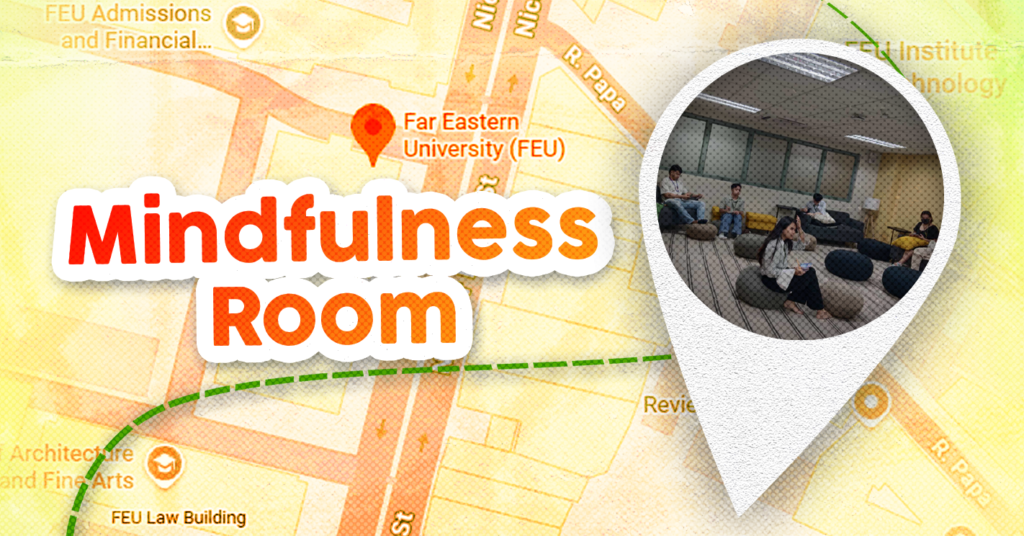
While the library encourages focus and productivity, another third place invites students to simply slow down. Just a few steps away, the Mindfulness Room in the Arts Building Room 110 offers a different kind of sanctuary.
Designed to be calming and welcoming, the room offers Tamaraws a dedicated space to breathe, reflect, or take a moment for themselves before returning to the demands of the day.
“It’s more than just a place to study; it’s a space where I can shift my mindset, find my flow, and separate the stress of school from my personal time. This balance is a lifesaver, helping me feel less overwhelmed and much more capable of tackling my daily tasks with a refreshed and focused perspective,” incoming second-year nursing student Eulyssis Salazar shared in a separate interview.
In a college culture where students are constantly expected to jump from one responsibility to another, spaces within the University serve as reminders for Tamaraws that success is defined not solely by how much they accomplish, but also by how well they care for themselves along the way.
2. Soul-filling cafes outside FEU
Yet for some, taking a break means stepping outside the campus grounds, even if only for a few minutes. Just beyond the FEU gates, Don Robert Cafe and The Hungry Bar are just two of the cafes that have become extensions of Tamaraws’ campus life, welcoming them with affordable meals, quiet corners, and even familiar faces.
These cafes have become trusted third places where students can recharge, reconnect, and return to their responsibilities with renewed focus.

Located along Loyola Street, long-time hidden gem Don Robert Cafe has built its reputation on delicious meals, generous servings, and a homey atmosphere that welcomes students anytime they want a break from the bustle of campus.
For Salazar, these kinds of spaces have changed the way he approaches both studying and self-care. Whenever academic responsibilities begin to feel overwhelming, he intentionally looks for places that allow him to step away from the classroom to reset.
“When I need a breather or a quiet corner to really focus, I’m always drawn to spaces that feel like a sanctuary from the hectic pace of campus life. They offer a kind of comfort that a classroom just can’t provide,” he stated.

Another cafe that positively impacted him was ‘The Hungry Bar’ situated along Padre Noval Street, where the space itself shapes the conversations that take place within it.
“It is a sanctuary where my friendships, my [return demonstration] buddies, and my [health assessment] group have deepened and our bonds have grown stronger… It was never just about the food or the drinks; it is about the genuine human connection and the beautiful memories we cherish in that place, which have made it an irreplaceable part of my life,” Salazar reminisced.
He added that these places are motivating because of the people who fill them. Watching other students study or work fosters a sense of purpose which encourages him to focus.
“People keep coming back to these places because they’re more than just somewhere to eat or study. They become a constant in the middle of a college life that's always changing,” the nursing student stated.
Amid the seasons of college life where schedules constantly shift and semesters quickly come and go, familiar cafes become strong anchors for students braving through it all.
After the coffee has gone cold and the laptops have been packed away, what remains is not the memory of what was accomplished that afternoon, but the feeling of having found a place where, even for a little while, the demands of college seemed lighter to carry.
3. Coworking third places that are worth your buck
As academic strains continue to grow, more students are looking for spaces beyond libraries and cafes that better support long hours of studying. Coworking spaces have emerged as another option, with an environment built for concentration while also creating opportunities for collaboration.
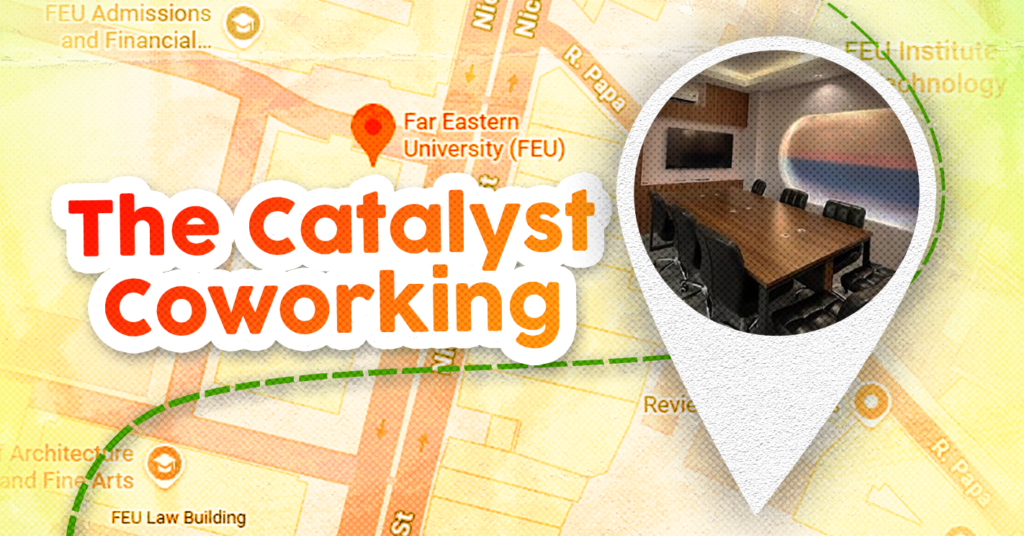
Just a few minutes from Thy Happy Halls, The Catalyst Coworking, located in St. Thomas Square along Padre Campa Street, has become a shared workspace for students seeking a dedicated environment for productivity. Though it comes with an hourly rate, many Tamaraws see it as an investment for uninterrupted focus.
For Waje, what makes these spaces meaningful is not only their ability to help students accomplish their work, but also the relationships they nurture along the way.
“Big help siya kasi dito madalas kami nagmi-meet ng classmates para sa group work o review sessions… Dahil doon, mas naging close kami at mas comfortable makipag-collaborate sa isa’t isa (It’s a big help because this is usually where my classmates and I meet up for group work or review sessions. Because of that, we’ve become closer and more comfortable collaborating with one another),” she shared.
Waje reflected on how shared spaces can become extensions of the classroom, where learning continues through collaboration, encouragement, and everyday conversations.
For many Tamaraws, coworking spaces have become more than places to work. Working side by side allows students to exchange ideas, celebrate small wins, and remind one another that difficult days are easier to manage together.
Contrary to the notion that learning is solely defined by one’s own progress, places like The Catalyst prove that growth can also happen collectively — one shared table, one conversation, and one connection at a time.
4. Sometimes, what we’re looking for is a place to belong
With college life’s overwhelming pace, slowing down does not always mean stepping away from productivity. Third places offer a space for students to keep up with their responsibilities while still leaving room to rest, reset, and a moment to breathe.
“Malaking bagay ‘yung third places kasi nagbibigay sila ng space para mag-aral, magpahinga, o makipagkuwentuhan sandali. Nakakatulong sila sa academics pati sa mental well-being ng students... The student can feel very productive in a cafeor sa library, then rest na lang pagdating sa house (Third places are very helpful because they provide a space to study, rest, or chat for a bit. They help with academics as well as students’ mental well-being. The student can feel very productive in a cafe or in the library, and then just rest upon arriving home),” Waje stated.
This balance is also what keeps students returning to these spaces.
“I think students return because these places offer something that’s hard to find during a busy school day, a sense of balance. A good third place isn’t just quiet; it makes you feel comfortable enough to stay, focus, and even take a break without feeling guilty… Sometimes, simply having a place where you can breathe between responsibilities makes a huge difference,” Santos emphasized.
Yet these spaces are not equally accessible for every student — library seats fill quickly during examination weeks, coworking spaces operate on hourly rates, and cafes require a purchase to stay for longer stays.
For students with limited time or budget, even finding somewhere to sit, study, or simply take a break can become another burden in an already demanding day. This inaccessibility makes third places’ value more apparent — students need spaces to pause, but not everyone has the same opportunity to find one.
Still, for Tamaraws fortunate to find a third place, these spaces can become part of the rhythm of college life. They stand as familiar corners where students can catch their breath between one demand and the next.
Perhaps that is what makes third places worth occupying. They do not remove the pressures of college, nor do they make the demands disappear. They simply give students a place to step away from them for a little while.
And when accessible spaces to rest, work, and connect remain limited, their existence becomes more than a convenience. It becomes a reminder that amid a college life which requires constantly moving forward, students still need places where they are allowed to take a breather.
Years from now, many Tamaraws will forget the deadlines that once felt impossible or the lectures they hurried to every morning. Instead, what will remain are the memories of places where they found the motivation to keep going, the people who shared those moments with them, and the realization that some of the most meaningful parts of college happened in the spaces between home and the classroom.
(Photo courtesy of Far Eastern University, The Catalyst Coworking, The Hungry Bar PH, Don Robert Cafe, Dash Coffee Morayta; Layout by Armina Juliana Guerrero/FEU Advocate)