



By Jiann Delumen
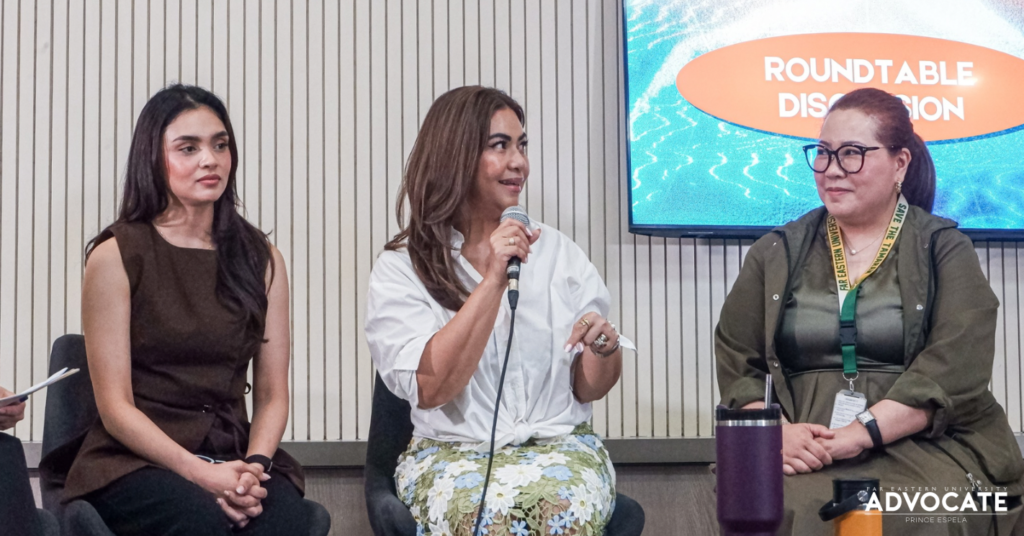
Filipina media practitioners underscored journalism as a form of public service anchored in truth, accountability, and human-centered storytelling during Far Eastern University (FEU) Communication Society (CommSoc)’s ‘Alagad ng Midya Summit 2026’ at The Huddle last April 16.
With the theme ‘Tinig ng Katotohanan, Pintig ng Midya,’ the summit centered on the responsibility of journalists to inform while remaining grounded in the realities of the communities they cover.
FEU alumna and broadcast journalist Ganiel Krishnan emphasized the need to move beyond surface-level reporting, pointing out the weight carried by stories encountered in the field.
“As a journalist, you're there not just to report… but to remind people that behind every headline is a human being,” Krishnan recalled, reflecting on her coverage on killings during the height of the drug war under former President Rodrigo Duterte.
She explained that her shift from sports to police beats and eventually to entertainment reporting reinforced a consistent principle that stories, regardless of platform, must be told with context and respect.
“Hindi lahat ng istorya ay madali. May mga araw na mabigat pero kailangan mo pa ring maipakita (Not all stories are easy. There are days when they are heavy, but you still have to carry them through)… because that's when the story needs you the most… Not everything is worth telling, but the right stories can create impact,” she added, pointing to the emotional weight and responsibility that come with covering difficult stories.
The alumna also highlighted the fundamentals of the craft — curiosity, listening, and clarity in storytelling — stressing that journalists are called to show up even when it’s hard, as the work ultimately serves the public, not the individual.
Meanwhile, documentary filmmaker Baby Ruth Villarama framed storytelling as both representation and intervention, particularly for communities often left unheard.
“Film, at its best, can be more than entertainment. It can be funny, entertaining, even strange — but at the heart of it, there is a voice… He (Jazz) is an ordinary Filipino, and if no lens gives focus to him, he can simply disappear, and no one will notice his struggle,” she shared, referring to her first documentary, ‘Jazz in Love.’
The film follows Jazz, a gay Filipino man, who dreams of getting married despite the absence of same-sex marriage in the Philippines, eventually leaving the country to pursue that possibility abroad.
Villarama noted that the project helped open opportunities for documentaries in festival circuits while also extending its reach through collaborations with LGBTQIA+ groups, contributing to conversations on the proposed SOGIE Equality Bill and broader calls for equality.
She further highlighted the importance of immersion in communities, pointing to her documentary ‘Food Delivery: Fresh from the West Philippine Sea,’ where stories were shaped through close engagement with fisherfolk in the West Philippine Sea, uncovering what she described as ‘golden nuggets of hope’ in overlooked lives.
Moreover, for ABS-CBN News Channel’s senior presenter Karmina Constantino-Torres, journalism ultimately returns to purpose, rooted in service to both nation and people, framing the work as one that extends beyond the individual and into the lives it impacts.
“It should never be about you… it is about the country and its people… When I talk about country, I mean family,” she stressed, underscoring that her work is driven by the responsibility to contribute to a better present and future for the next generation.
The senior presenter explained that the role of journalists is not only to expose wrongdoings but also to ensure that the public is equipped with accurate information, allowing citizens to form their own judgments in an increasingly complex media landscape.
Known for her direct and probing interviews on ANC’s Dateline Philippines, Constantino-Torres has drawn widespread attention online for her firm line of questioning — often described by audiences as fearless — highlighting the continuing role of journalists in holding power to account.
She acknowledged that public reception to her assertiveness has evolved, with some labeling her as stern while others praised her candor, at one point framing her visibility as a form of ‘reverse discrimination,’ though she maintained that such perceptions were never central to her approach.
“What you saw… is a mom, just doing what she can for the country and the people she loves,” the Dateline Philippines’ anchor reflected, situating her work within a personal sense of responsibility rather than public approval.
Constantino-Torres added that this sense of purpose is grounded in what she described as a ‘superpower of love,’ which continues to guide her work in seeking truth and holding institutions accountable.
Across the discussion, the speakers also confronted the personal and professional costs of truth-telling, particularly for women in media — from threats and professional risks to external pressures that challenge both safety and visibility — revealing the stakes that often come with pursuing difficult stories.
“Storytellers, we remain grounded, and we listen,” Villarama concluded, echoing a shared stance among the panel on responsibility and accountability in the craft.
The Alagad ng Midya Summit is an annual initiative of FEU CommSoc, with previous editions held in 2023 and 2024, as part of its continuing engagement with media practitioners and students.
(Photo by Prince Espela/FEU Advocate)