




By Misaki F. Koizumi and Georzea Akeisha R. Santos
Stories are often immortalized in archival records, but some survive only in the memories of those who were there. During the repressive regime of the late dictator Ferdinand Marcos Sr., countless Filipinos lived through a period marked by red — a series of arrests, violence, and censorship. Among them were students who dared to question authority and journalists who continued to pursue their work despite being placed under surveillance.
Liliosa Hilao and Archimedes Trajano were students whose lives were cut short after speaking against the regime, while Ping Galang and Jose Burgos Jr. confronted restrictions imposed upon the press. Their stories offer a closer look at how Martial Law reached beyond government offices and political institutions into classrooms and newsrooms.
More than five decades after the declaration of Martial Law in 1972, these stories remain part of the country’s historical record. To understand Martial Law is not only to remember what happened, but to remember the people who lived through it.
Beyond remembrance lies the responsibility to heed its warnings, especially in a country that once endured dictatorship, yet continues to see students and journalists face reprisals for speaking against those in power.
A lesson in speaking up
For students like Liliosa and Archimedes, political awareness was not confined to textbooks or classroom discussions. Under Martial Law, speaking against the government could place a name on a list, a body in a cell, or a life in peril.
Considered as the first reported case of a political prisoner’s death under Martial Law, Liliosa ‘Lilli’ Hilao was a communication arts student at Pamantasan ng Lungsod ng Maynila. She was set to graduate cum laude and was an editor of Hasik, the university’s student publication at the time. Through her writing, Liliosa sought to awaken the public to the brutality of the Marcos Sr. regime, joining other young Filipino journalists who used their campus publications beyond school politics — utilizing them as spaces to expose the lies and cruelty of the dictator.
On April 4, 1973, less than a year after Martial Law was declared, drunken soldiers from the Constabulary Anti-Narcotics Unit came barging into Liliosa’s home, looking for her brother. She could have stepped aside. Instead, she stood her ground and asked for a search warrant, insisting on the law even in the face of those with power who could violate it.
But the warrant never came; what followed was violence. The soldiers beat and took Liliosa away, escalating her simple demand for due process into a confrontation with the very authorities who had the power to deny it. At that moment, she came face-to-face with the cruelty of a system that had given its authorities unchecked power to enter homes, silence voices, and threaten those who dared to ask why.
State officials claimed that Liliosa had taken her own life by drinking muriatic acid, declaring the case closed — or at least, that was how they wanted the story to end. But the body never lies. The cigarette burns, injection marks, and widespread bruising bore witness to a brutality that could not be erased by the official account. In the aftermath, the Hilao family was kept under close surveillance, with several members compelled to leave their home to avoid arrest.
Two weeks after Liliosa’s death, her university held its graduation ceremonies and posthumously conferred her degree with honors. Her classmates crossed the stage one by one, carrying the futures they had worked toward while Liliosa’s seat remained empty among them.
Her name was honored, her degree was given, but the person who should have stood to receive it was gone — leaving behind a silence no ceremony could fill.
Four years later, another student would ask a question that would come at a devastating cost.
Archimedes Trajano was a student at Mapúa Institute of Technology. He was 21 when he attended a 1977 forum featuring Imee Marcos, then head of a Kabataang Barangay, a youth organization that purportedly aimed to empower young Filipinos to take part in nation-building. The student questioned her appointment and raised the records of human-rights violations by her father, Ferdinand Marcos Sr., causing him to be forcibly taken from the forum.
Two days later, his mother, Agapita, found his body in a morgue. His parents were reportedly told that their son had been caught in a dormitory brawl. Yet the witnesses remember last seeing him somewhere else.
Archimedes’ parents received one account, and witnesses offered another. Between these versions of his final moments, certainty began to slip away. The truth, meanwhile, was already being buried.
For a mother like Agapita, the search for accountability would outlast the regime itself. In 1986, following the fall of the Marcos Sr. government, she filed a civil case in Hawaii against the Marcoses.
Imee did not appear in the proceedings, and a default judgment was rendered against her. Yet even with a ruling in their favor, the Trajano family’s pursuit of justice revealed how unequal the fight had always been: one side had the weight of power behind it, while the other was left to cross borders and traverse years just to be heard.
In 1991, the United States (U.S.) district court finally put into words what had been hidden for years: Archimedes had endured prolonged physical abuse before his death, and Imee was named responsible. And in the next year, the ruling was affirmed by the U.S. Court of Appeals for the Ninth Circuit.
His death was no longer simply a name attached to a case file. Behind the legal language was a young life cut short after violence was inflicted upon him — and a family that had spent years seeking acknowledgment of what happened.
The ruling brought an answer, but it came when time could no longer be recovered. Between Archimedes’ death and the court ruling lay a different kind of loss. His life ended in 1977, yet for his mother, the question of what happened to him remained long after, carrying it through the fall of a dictatorship and across borders into another country’s courtroom.
Liliosa Hilao wrote for a campus publication, while Archimedes Trajano stood before a gathering to raise a question. Neither act seemed to carry the weight of political power, yet both became enough to draw the attention of those who held it, showing how dissent could be treated as a threat even when it came from places as ordinary as a student newsroom or a university forum.
Fifty-four years later, universities remain places where young people question not only what to do with their knowledge, but whether they are still free to speak at all.
Last May 2026, University of Santo Tomas (UST) students Raven Racelis, Ray Manuel, and Kerby Calizar faced disciplinary proceedings following a complaint by UST professor Marlon Villarin against student activists who had protested the presence of military and National Task Force to End Local Communist Armed Conflict personnel on campus.
The circumstances are not the same as Liliosa’s and Archimedes’ — no disciplinary proceeding can be equated with the violence that brought Liliosa’s story to an end, nor with the brutality that cut Archimedes’ life short. But the warning bell rings the same tone. A university should nurture questions, and professors should cultivate young minds, not instill a fear of asking them.
More than five decades later, Raven, Ray, and Kerby reflect the plight of students who continue to find the courage to speak against deceptive propaganda. Though their experiences may be a different shade of red, they show how easily the boundaries of what young people are allowed to say can still be drawn around them.
PRESS-ed into silence
Beyond student spaces, fear also reached newsrooms. The press has taken different forms over the decades, moving from the dark-ink mimeograph sheets of the past to the cold metal of a live studio microphone, yet the price of speaking out remains the same.
Under Martial Law, journalists were not only reporting on a country losing its freedom; they were doing so inside a press whose voice was being squeezed shut.
The decree did not take long to reach the newsroom where Ping Galang worked as a reporter for Business Day. Before the ink on the proclamation had even dried, restrictions were already tightening around the press.
Within the first week of the new regime, he was summoned to the Defense Ministry as the military screened media workers, placing journalists under the gaze of those who hold the power to decide whose voices could remain and which stories could reach the public.
Ping was later told that he could no longer officially work for the newspaper, yet his editor found a way for him to continue writing, quietly preserving a place for his voice in a paper that was still willing to carry it. But there was a bitter catch: while his stories could still be published, his name could not appear alongside them.
During those months, Ping was also required to report regularly to a military officer, where he was questioned about his activities, whereabouts, and associations. Though his stories appeared prominently in the newspaper, the byline that would have identified him as their author was absent.
It was a quiet kind of erasure. The words remained, but the person behind them had been stripped from the page. It showed how the consequences of having a voice could reach beyond the words themselves, extending to the identity of the person who dared to speak.
Jose Burgos Jr., however, encountered the same pressure differently. If Ping found himself writing within suffocating borders, Jose challenged those restrictions through the publication he helped build.
Within the pages of WE Forum, Jose and his colleagues did more than publish searing reports on the Marcos administration. They also led an investigation that sought to uncover just how legitimate the dictator’s wartime medals and military records truly were.
The publication became part of an independent press that persisted to question the regime even as the government tightened its grip on what Filipinos could read. In 1982, that defiance finally reached the newsroom’s doorstep. WE Forum’s office was raided, its newsroom thrown into disarray as Jose and members of his staff were arrested.
It is a jarring image when placed against what a newsroom is meant to be. The desks should have been crowded with papers, the typewriters paused with unfinished stories, the room alive with the ordinary urgency of journalists chasing the truth. Instead, the newsroom became a place of silence as the people behind those stories were taken away.
The work of reporting had become inseparable from the risks of being the person doing it.
For Ping, the cost was having his name erased from his own words. For Jose, it meant facing arrest for refusing to let those words be silenced. Their experiences differed, but both reveal the same danger: when a voice challenges power, the consequences can reach the person behind it.
The newsroom may have taken different forms, but the weight carried by a voice on the radio or ink on a newspaper has not. Under Ferdinand Marcos Jr., journalists continue to work in an environment where reporting can still carry drastic consequences beyond the story itself.
In May 2023, radio host Cresenciano ‘Cris’ Bundoquin of DWXR 101.7 Kalahi FM was shot dead in Calapan City, Oriental Mindoro. On air, he was known for being critical of local politics and illegal gambling, issues that investigators later noted as possible motives behind his killing.
The National Union of Journalists of the Philippines (NUJP) documented 84 attacks against the media during Marcos Jr.’s first year in office, including the killings of three journalists. As more cases of media killings emerged, the NUJP called on the Marcos administration and the Presidential Task Force on Media Security to end the impunity surrounding attacks on journalists and hold those who harass, attack, and kill media workers accountable.
Cris’ death was not the same as what happened to Ping or Jose. The mechanisms of pressure have changed, yet the fear they instill is familiar.
Decades apart, the stories of Ping and Jose show how the pressures faced by journalists can take different forms, from censorship and surveillance to violence. Cris’ death, though shaped by a different set of circumstances, unveils the risks of reporting the truth did not end with Martial Law.
As more names continue to surface in the long history of journalists killed for their work, one question lingers: How freely can journalists write when the names beneath their words can become the target?
The long echoes of absence
Beyond newsroom raids and courtroom dockets, the heavy hand of a dictatorship takes root in the rhythm of everyday life. History books often measure authoritarian rule through official decrees, military figures, and economic charts — impersonal metrics that make state violence feel like something contained strictly within government walls.
Yet long before an arrest ever reaches an official record, political fear redefines the home. It manifests in doors locked earlier than usual, conversations reduced to whispers over dinner, and dining rooms where an extra plate was set night after night for loved ones who never returned, quietly turning private grief into a sustained act of political defiance.
State power rarely ends at physical control; it actively seeks the authority to rewrite its own story. As political landscapes shift and years pass, official institutions routinely rely on time and silence to soften the past, which reduces acts of state brutality into distant historical noise.
Preserving what actually happened cannot be left to the very government offices designed to protect state power. It depends entirely on a public that refuses to let lived reality be replaced by political convenience.
In the face of enforced silence, remembering is neither passive nor neutral — it is an active civic defense.
As the shadows of historical revisionism persist today, the responsibility of record-keeping shifts once more to the present. To write, to speak, and to remember are not merely acts of reflection; they are active resistance against the return of silence. For as long as names are spoken, papers are printed in the dark, and missing children are carried in memory, the truth remains alive between the lines.
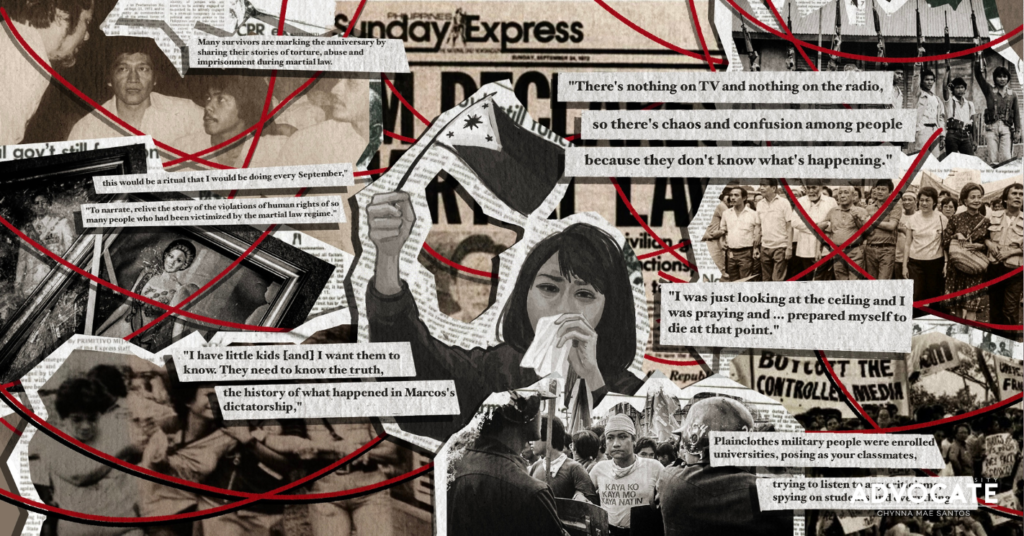
(Illustration by Chynna Mae Santos/FEU Advocate)