








Astravore
By Gerielle Anne Afos, Junior Literary Writer
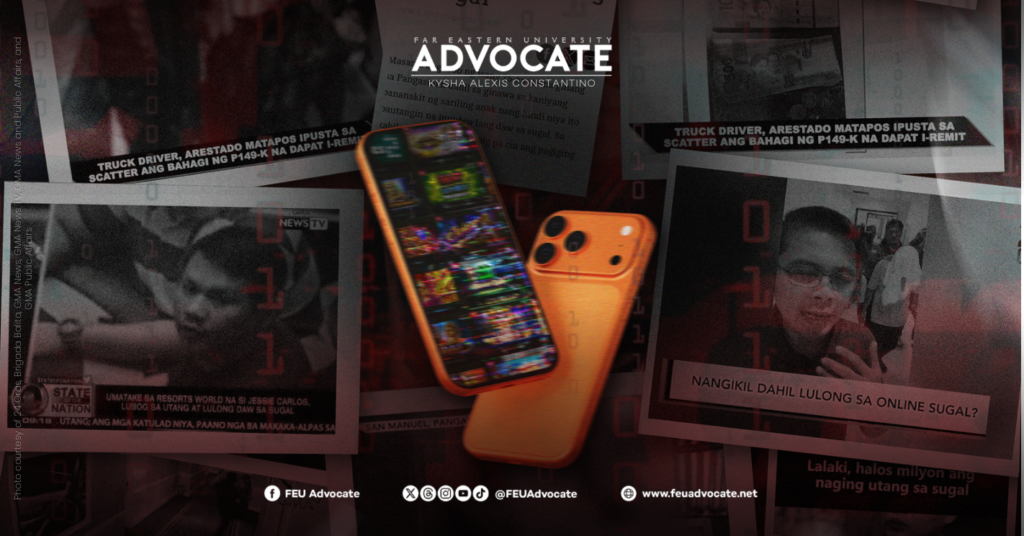
Ivana Alawi recently sparked controversy after announcing she would be giving away 100 iPhones. Millions of people flocked to the post, participating in the hopes of becoming one of the lucky winners. At first glance, the giveaway appeared to be nothing more than providing free gadgets grounded in generosity. But the initiative was actually a front for a gambling platform to lure people in. Upon closer look at the intention behind it, the campaign reveals itself as something else entirely: a modern-day Trojan horse.
The rules of the giveaway suggest its true agenda. Rather than simply rewarding fans, participants were required to follow not only Ivana but also Casino Plus — one of the country's largest online gambling platforms.
But among many celebrity ambassadors of Casino Plus, why was Ivana the perfect choice for this campaign?
Most of Ivana’s content revolves around helping less privileged Filipinos and establishing a public persona of generosity and compassion. For instance, in one viral video, the celebrity disguised herself as a pregnant beggar to solicit money, rewarding the one who helped her with much larger financial gifts.
But even if these acts may look well-intentioned, such content has drawn criticism for resembling poverty porn as the struggles of the marginalized are reduced to content for mass consumption.
The very audience that has long associated Ivana with financial assistance and charitable acts is the same audience most likely to chase the promise of winning a free iPhone. And since the giveaway is explicitly in partnership with a gambling company, it defeats the principle of being a genuine act of generosity.
With Casino Plus reporting over ₱1 billion in payouts in the second quarter alone, the cost of giving away 100 iPhones appears to be a relatively small marketing expense compared to the potential revenue the campaign could generate. Beyond the surface of being a good deed, the giveaway is a calculated marketing strategy, an emerging ploy where gambling platforms leverage content creators' influence to entice thousands of people to join.
As one of the most-followed celebrities on Facebook, with an audience of 51 million, Ivana's influence widely extends to the Filipino masses. With a single post, countless people participated in the giveaway and followed the online gambling page, many of whom were minors who admired her.
While the participants' motivations may differ — some driven by parasocial attachment, others by the hope of winning an iPhone — they all ended up following the giveaway's instructions without hesitation, suggesting the strategy’s effectiveness.
In an economy where many Filipinos struggle to earn enough for daily needs, a promotion that promises a chance to own an iPhone for nothing more than a simple follow is likely to attract low-income individuals. As a result, those who joined may also be drawn into gambling, especially if they begin to view it as another chance to win.
However, for the giveaway’s participants, gambling does not merely involve risking disposable income, but rather putting one’s intended money for daily necessities, bills, or savings at stake. Therefore, the financial consequences fall disproportionately on those who can least afford them.
Given the power of influence, using one’s platform to promote an industry that is already notorious for draining people’s money is not just financially crippling, but also puts people’s futures at risk. Such promotion is extremely threatening as gambling in the Philippines has become increasingly accessible over the years.
One no longer has to step inside a luxurious casino or travel to a hotel to place a bet. Now, it is just one tap and a cash-in away through e-wallets — a convenience that is exactly what makes it dangerous.
The more people chase after their losses, the more these companies earn. And with those profits, they can afford to pay more public figures to influence even larger audiences.
That is why the 100 iPhones are not just prizes. It serves as fuel for their machine designed to attract new users.
By highlighting gambling as ‘neutral,’ many people argue that such platforms are generally harmless and inaccessible to minors given the age restrictions in place, or that participation is simply a matter of personal choice. But this claim overlooks the psychological tactics these platforms employ to keep users betting.
Gambling apps are notorious for offering occasional wins to trigger a dopamine rush, making people hopeful that success is just one more bet away. However, in reality, they lose far more than they ever win. Such a ploy forces players to chase their losses, and this is exactly how these platforms profit — by keeping users hooked on the rigged system.
Thus, Ivana’s promotion does more than advertise a giveaway; it normalizes and amplifies gambling. Every interaction — whether people are mocking the post, commenting to join the giveaway, or sharing it for laughs — helps the platform gain more visibility.
On the surface, people are simply engaging for a chance to win a free iPhone. But on a deeper level, they are helping to expand a campaign that intends to invite thousands of people to a platform designed to exploit socioeconomic and psychological vulnerabilities.
With every iPhone given away comes at the expense of another person being introduced to gambling. It could be a parent desperate to provide for their family, someone hoping that one lucky bet could change their life, or an ordinary person chasing the dream of having financial freedom.
Lucrative as it may be, promoting gambling platforms for financial gain should never be normalized. But accountability alone should not rest on content creators. As media consumers, people must also learn to look beyond the prize and discern the true purpose behind these campaigns.
Creators and promoters of gambling platforms are likewise responsible for the consequences of the campaigns they endorse. As stakeholders, the general public has the power to hold parties accountable.
The true cost of those 100 iPhones is not the millions of pesos spent on them. It is the lives that gambling destroys, the families it tears apart, and the futures it places in jeopardy. It was never about just giving away phones, but deluding one’s hope and turning it into profit. By choosing not to engage in such campaigns, the traction that widens its reach to even more people can be halted. Real compassion begins with having integrity, and a better future starts when we stop enabling these promotions to compromise more lives.
(Layout by Kysha Alexis Constantino/FEU Advocate; Photo courtesy of 24 Oras, Brigada Balita, GMA News, GMA News TV, GMA News and Public Affairs, and GMA Public Affairs)