






By Sean Clifford M. Malinao
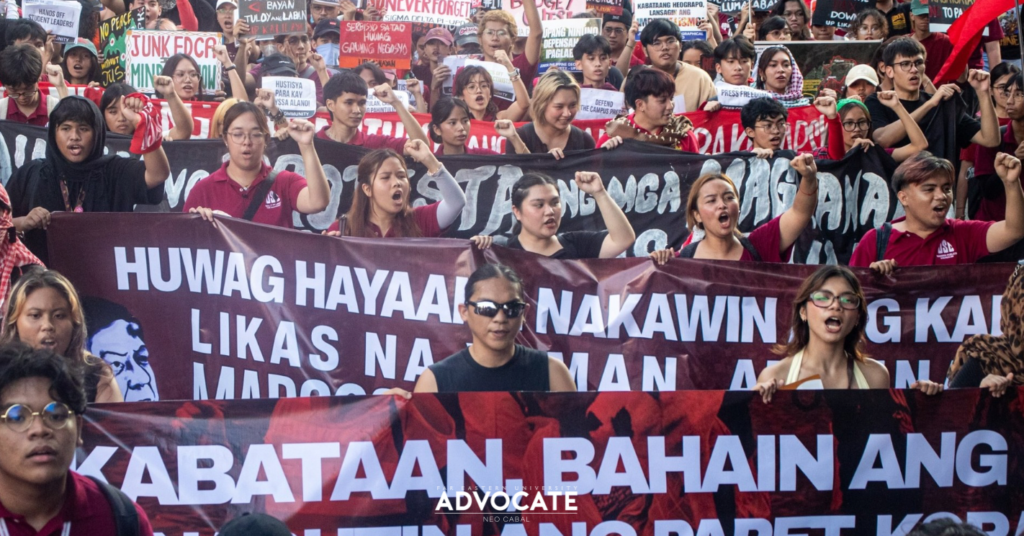
As the Philippines marked the 54th anniversary of the Martial Law declaration, various student organizations and progressive groups amplified concerns over corruption, government accountability, and other national issues in mobilizations staged across Manila City last September 21.
The protests merged at Liwasang Bonifacio for the main demonstration, eventually concluding along Recto Avenue.
Students from various youth mass organization chapters mounted separate mobilizations across the University Belt, such as the protests along Padre Noval Street in España Boulevard, and along Taft Avenue.
Youth’s sentiments
In an interview with FEU Advocate, Kabataan Partylist - National Capital Region Chairperson Ivan Lance Punzalan highlighted the importance of holding the current administration accountable for the persisting anomalies and corruption.
“Matatandaan natin last year 2025, sa araw rin na ito ay binaha ng protesta ang EDSA, Luneta, hanggang Mendiola, at nakita rin natin talaga ‘yung galit ng mga mamamayan lalo na ng mga kabataan (We can recall that last year, in 2025, on this same day, protests flooded EDSA, Luneta, and Mendiola, and we saw the anger of the people, especially the youth),” he stated.
Several youth participated in last year’s anti-corruption and 53rd Martial Law commemoration protests, which were marked by warrantless and violent apprehensions of protestors and civilians.
Highlighting students’ active participation then, Punzalan asserted that the youth movement continues to respond to emerging issues until now, including the Philippines’ involvement in the Pax Silica initiative.
“Mas mabigat ‘yung dahilan ng mga kabataan ngayon para kumilos dahil nandito ang pagtindig natin laban sa Pax Silica… Hamon natin sa lahat ng kabataan na mas maraming dahilan para lumahok kaya dapat sama-sama tayong kumilos (The reasons for young people to take action are even more pressing now, as we stand against Pax Silica. We are challenging the youth to recognize the reasons to participate and act together),” he expressed.
Meanwhile, citing issues faced by the education sector, Far Eastern University Institute of Education Student Council President Charles Delfin underlined the Martial Law commemoration as a reminder of the sector’s role during periods of political unrest.
“Ang education sector ay hindi neutral, lalo na sa panahon na ito… Dapat nasa lansangan din ang mga guro, hindi lamang sa mga classroom, kasi bahagi kami ng pambansang kamalayan. Kapag nandito kami, nakikita nilang credible ‘yung ginagawang organisasyon since may tiwala sa atin ang taumbayan gamitin natin ang platapormang iyon sa tama (The education sector is not neutral, especially during times like this. Teachers should be out in the streets, not just in classrooms, because we are part of shaping the national consciousness. When we are here, people see that the act of organizing is credible because we have the public’s trust and we use our platform for what is right),” he emphasized in a separate interview.
Delfin also criticized the Marcos Jr. administration’s decision not to declare the occasion as a national holiday, attributing it to historical revisionism and the diminishing space for political engagement.
“Isa itong hindi lang pag-iwas nila, pero isa rin sa mga tactic nila na pilitin tayong mga nasa laylayan na mawalan ng oras sa pansarili nating pagninilay… Napipilitan tayong huwag na lang mag-isip at mawalan ng oras sa mga ganitong bagay (It is not only a way for them to avoid the issue, but also a tactic to force those from the margins to lose the time to reflect on our circumstances. We are forced not to think and reflect due to lack of time),” he shared.
Youth-led calls for accountability were further echoed by Youth Rage Against Corruption National Convenor Joaquin Buenaflor, who demanded an end to systematic corruption.
He highlighted issues including the misuse of confidential funds, emerging foreign control, and the government’s failure to uphold human rights, arguing that these reflect broader problems beyond individual cases of corruption.
“When we say systematic corruption, ito ‘yung nagpapatuloy mula noon hanggang ngayon. Pagnanakaw siya sa kaban ng bayan… at pagnanakaw sa kinabukasan ng mga kabataan sa pamamagitan ng hindi binibigay sa atin ang mga karapatan natin (When we say systematic corruption, it is something that persists until now. It is stealing from public funds and the youth’s future by denying us our own rights),” Buenaflor emphasized.
Nation in protest
The larger mobilization in Liwasang Bonifacio was organized by Bagong Alyansang Makabayan and Kilusang Bayan Kontra Kurakot, drawing participants from various sectors including civil society organizations apart from youth-led groups.
Among those who joined was 64-year-old Monica Santero, who called for politicians involved in corruption to face trial and be held accountable.
“Kailangan lahat ng mga sangkot ay makukulong; lahat sila’y mananagot. Lahat ng mga [tiwaling] opisyal natin, lalo na mula sa Kongreso, ay dapat sagutin nila ang mga tao, hindi ‘yung mga sarili nila ang iniisip nila (Everyone involved must be jailed, and all of them must be held accountable. All of our corrupt officials, especially those in Congress, must answer to the people, instead of thinking only of themselves),” she asserted.
Santero additionally underscored the role of young people in sustaining the movement, urging them to unite and continue the struggle as the generation that will carry the country’s future.
“Dapat ang mga kabataan ngayon ay nakikiisa… Kami dapat ang tularan nila [at] sumunod sa yapak namin kung bakit kami lumalaban. Dapat kayong mga kabataan ang manindigan kasi kung wala na [kayo], paano na lang ang ating bayan? (The youth today should stand with us. They should follow our example and understand why we continue to fight. The youth must stand up because if you are no longer here, what will happen to our country?),” she raised.
The main program featured representatives of various sectors, who echoed concerns over corruption, government accountability, rising prices, human rights, and other sectoral issues.
Among the protesters’ common calls was their opposition to the Pax Silica initiative, a United States-led project which threatens to occupy Philippine ancestral lands and displace the Aeta community in New Clark City.
Following the program, the mass-up marched toward Mendiola but were halted by police barricades on the way, prompting negotiations between organizers and authorities.
After discussing the terms of a peaceful mobilization, protesters reached an agreement with authorities, enabling them to continue the program along Recto Avenue instead of Mendiola.
The Philippine National Police maintained a heightened presence around protest areas throughout the day, claiming it would observe maximum tolerance while responding to violence and property destruction.
Among the reported cases include the apprehension of two protestors along Recto Avenue over spray-painting a concrete barrier.
They were later released following discussions between police and group leaders, with an agreement to prevent similar incidents from recurring.
With an estimated crowd of 5,800, according to the Manila Public Information Office, the program concluded peacefully.
(Photo by Neo Cabal/FEU Advocate)