



Censorship does not always arrive with a gag order. For journalists, it is disguised as policies, enforced through bureaucracy, and justified by rules that appear impartial but selectively silence dissent. A press need not be shut down to be oppressed; it only needs to be stripped of its capacity to question, expose, and challenge those who wield power. When journalism is obstructed from pursuing uncomfortable truths, the consequences extend far beyond the newsroom.
The persistence of media attacks and publication censorship reveals a continuing struggle over the freedom to report and the power to control public narratives. From direct intimidation and harassment to institutional restrictions that constrain editorial independence, these attacks take different forms but share a common consequence: they weaken the press as a watchdog and obstruct its obligation to hold those in power accountable.
Oppression never takes a single, final form. It penetrates institutions, distorting the truth presented to the public. It operates through repressive policies, ineffective bureaucratic procedures that delay journalists long enough until their stories disappear, and the imposition of boundaries that restrict what the field truly entails. From there, it creeps in and slowly changes the story to fit bureaucratic narratives.
Journalism was never meant to be an instrument of those already in power. It does not echo official statements, preserve institutional reputations, or manufacture public consent. It must amplify the voices routinely excluded from dominant narratives: communities resisting displacement, students challenging institutional failures, and citizens confronting the consequences of political decisions.
Yet media oppression persists precisely because a free press threatens those who benefit from an uninformed or disengaged public. Stories that expose misconduct disrupt carefully managed reputations; investigations that uncover systemic failures challenge official narratives; and critical reporting makes it harder for those in authority to evade accountability.
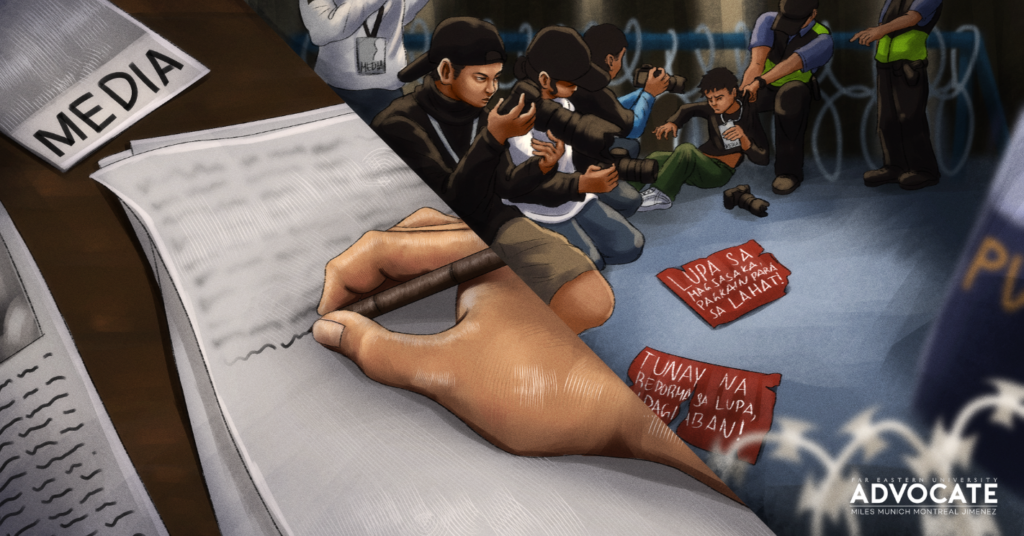
Last October 19, Bulatlat reporter Aaron Ernest Cruz was among the media workers covering a farmers’ protest for Peasant Month when police personnel used excessive force against protesters, with journalists caught up in the dispersal.
He was restrained and dragged by members of the Quezon City Police District during coverage. Footage uploaded by the College Editors Guild of the Philippines showed Cruz displaying his press identification and asserting his rights, yet the officers continued to drag him away.
Similarly, Tudla Publications correspondent and Far Eastern University first-year communication student Robie Matias was caught in a standoff between armed authorities and farmers. Video footage then revealed policemen stepping on him after he fell to the ground, despite witnesses shouting that he was part of the media.
Beyond the incidents that make headlines, the public might remain unaware of many violations without journalists physically documenting them to write and deliver stories. Without their firsthand accounts and recordings, many instances of intimidation, excessive force, and restrictions would likely remain obscured from public scrutiny.
Although physical violence against journalists and bureaucratic restrictions on publications manifest in different forms, both impede the press’s capacity to fulfill its public mandate. This was not the first time journalists faced obstruction while documenting public demonstrations; it is a recurring concern that is shrugged under the rug by the public.
On July 22, photojournalist Bullit Marquez reported that police tried to restrain and handcuff him during his protest coverage in Pasay City, held in connection with the Association of Southeast Asian Nations Foreign Ministers’ Meeting and the visit of United States Secretary of State Marco Rubio.
According to Marquez, officers tried to stop him from photographing a protester’s arrest, damaging his camera during the confrontation. The National Union of Journalists of the Philippines also reported that police harassed fellow photojournalist Rene Dilan and attempted to confiscate his camera.
This kind of violence intimidates and silences the media. The threat of arrest, harassment, or physical harm discourages media workers from covering demonstrations and other contentious public events, creating a harrowing effect on newsgathering. The chilling effects of actions by authorities may leave fewer journalists willing to report on the ground. When the state’s watchdogs are reduced in number, the public is left with fewer independent sources and a diminished capability to scrutinize those in power.
But the erosion of press freedom does not always occur within mainstream or professional media outlets. Within universities, the same struggle over who gets to report, question, and criticize can unfold through administrative requirements and the withdrawal of institutional support.
In January 2025, Today’s Carolinian staff discovered through a notice posted on their office door that their remaining workspace at the University of San Carlos’s (USC) Downtown Campus had been reassigned to the Alumni Affairs Office, effective January 15.
The publication had been operating without university funding since 2019, following its coverage of tuition and other fee increases and campus policies affecting students. It has attributed its difficulties to its critical reporting and refusal to undergo accreditation through USC’s Office of Student Formation and Activities (OSFA).
USC’s policy requires student organizations and publications to register with OSFA to access funding, office space, and other institutional resources. Today’s Carolinian, however, has resisted the accreditation requirement over concerns about its implications for editorial independence.
The administration has defended the office reassignment as a practical response to limited campus space and the needs of its Alumni Affairs Office.
Furthermore, The Torch Publication of Philippine Normal University Manila faced similar pressure from its administration. After reporting on the academic grievances raised by graduating values education students last August 10, the administration issued a demand letter and directed the publication to submit an explanation letter.
Instead of addressing the concerns tackled in the said article, scrutiny was directed at the student journalists for their critical reportage. They were asked to review their social media guidelines and send their editorial board to a mandatory Journalism Ethics Seminar, framing the problem as one within the publication and not the system.
This shows the harsh realities that campus journalists face and the endless struggle against oppressive policies and controlling systems that deem mere truth-telling is something that needs to be corrected.
The press does not exist as a promotional tool for its institutions. Journalists do not write to gain favor from the system; rather, they write for genuine representation — to uncover narratives that people are too scared to echo and to be part of that change through principled advocacy.
When the media is stripped of its resources and the access necessary to fulfill its role, the consequences are borne not only by student journalists but by the wider student body whose experiences and concerns are meant to be represented.
Persistent questioning of student journalists about their credentials, intentions, and reasons for coverage functions less as a routine inquiry and more as a form of pressure that discourages critical reportage.
While oppression within universities does not appear as blatant or violent as oppression in the national media, it does not eradicate the existence of such control.
It may not cause physical harm, but it still destroys veracious reportage through the processes that allow it to function. From delayed and tight budgeting, scarce resources, to lack of support for skills expansion — media repression attacks through the flesh until the press ceases to exist.
However, this intimidation does not stand in the way of the bravery exemplified by the journalists. Neither violence nor coercion could impede the discovery of truth. Journalists are not to be confined to a camp or institution, nor should they be reduced to flattering those in power. Narratives are not isolated; thus, there is a need to engage with the masses and counter dominant narratives to reach a collective truth.
The media has persisted through dictators, revolutions, and widespread problems that worsened people’s living conditions. It continued to report amid adverse weather conditions and rains of bullets despite conflict and war, withstanding intimidation and attacks. Amid it all, reportage will remain alive as long as stories exist.
For journalists, the streets are their battlefield, and the truth is their weapon. They know no comfort — rather, they thrive despite the persistent issues that hold people down. And in censorship, they find more courage to capture and write, resisting control to end the systematic failure. As threats against the press continue, society must demand accountability from those who obstruct journalistic work. Only then can the watchdogs break free from the tight leash of oppression.
(Illustration by Miles Munich Montreal Jimenez/FEU Advocate)