
By Lana Laurel
Far Eastern University (FEU) College Y Club (CYC) with Biological Society (BioSoc) and the Office of Student Involvement (OSI) concluded its ‘Circularity Masterclass' on circular economy and waste segregation at the University Conference Center last April 15.
CYC is also in collaboration with external partners 3ZERO House Philippines and the Agency for Technical Cooperation and Development.
By introducing proper distinguishable factors on waste management and statistical data on its effectiveness and progression, University of the Philippines Integrated School Assistant Professor Maria Ronelli Espina reinforced the idea of waste segregation during times of conflict and how this tests our capabilities in creating environmentally friendly solutions.
“It may be how wisely we use resources and how little we waste, especially at a time when global conflicts, such as the ongoing tensions involving the United States and Iran, are disrupting energy supplies, driving up fuel costs, and straining economies worldwide… Resources are not infinite, and how we use them has far-reaching consequences. Maybe it will be about being better, smarter, and more responsible [with] use of what we already have,” she said.
Additionally, Espina identified that one of the main benefits of a circular economy is to create a solution for the clear lack of initiative circulating plastic and properly separating other plastic-types.
“We tend to view plastic through a single limiting lens, no matter its type… So every bottle and sachet tells a story of both innovation and neglect — and this is where the idea of circular economy comes in,” the speaker elaborated.
Espina expounded that a circular economy enforces a process where no material is wasted and is redefined as an asset, contrary to previous societal notions.
“Materials are designed to stay in use longer, repaired, refilled, reused, and recycled instead of thrown away. So this idea is simple, but it's transformative, and it challenges producers to rethink design and packaging, encourages consumers to make more mindful choices, and shifts how society sees waste, not as an end, but a resource,” the assistant professor explained.
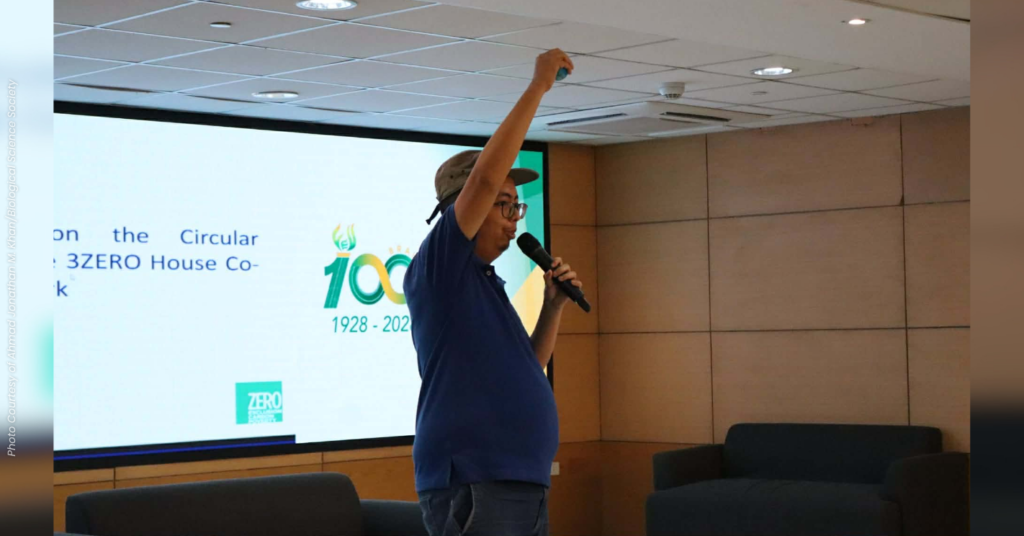
This is further explored by 3ZERO House Coordinator Patrick Tiongson in his workshop named ‘Basics of Circular Economy and the 3ZERO Framework.’
During his keynote address, he led an activity in which a small globe was passed among the participants, strengthening the narrative of circular economy. He then detailed the ‘Butterfly Model’ which separates two kinds of material based on their process of decomposing.
“This butterfly model… we are talking about two kinds of materials here, which is the biological material and technical material… This is focusing on the materials in the economy that naturally decompose [and] that biologically decompose… So the right side of [the] circular economy is the technical cycle, they [these materials] cannot naturally decompose,” he explained.
Furthermore, Tiongson expanded the discourse by briefly mentioning other methods within the circular economy framework, like the ‘Circularity of Economy’ or the ‘Circularity Approach’ from the United Nations, as well as the ‘Sustainable Development Goals.’
Concluding the event, Marielle Clarisse de Lima from the Ayala Foundation conducted the masterclass’ second workshop titled ‘Leadership in Sustainability and Resource Transformation.’
FEU CYC hosted their first Circulatory Masterclass online last April 10.
(Photo courtesy of Ahmad Jonathan M. Khan/Biological Science Society)