


By Ishia Eleanor F. Marquez
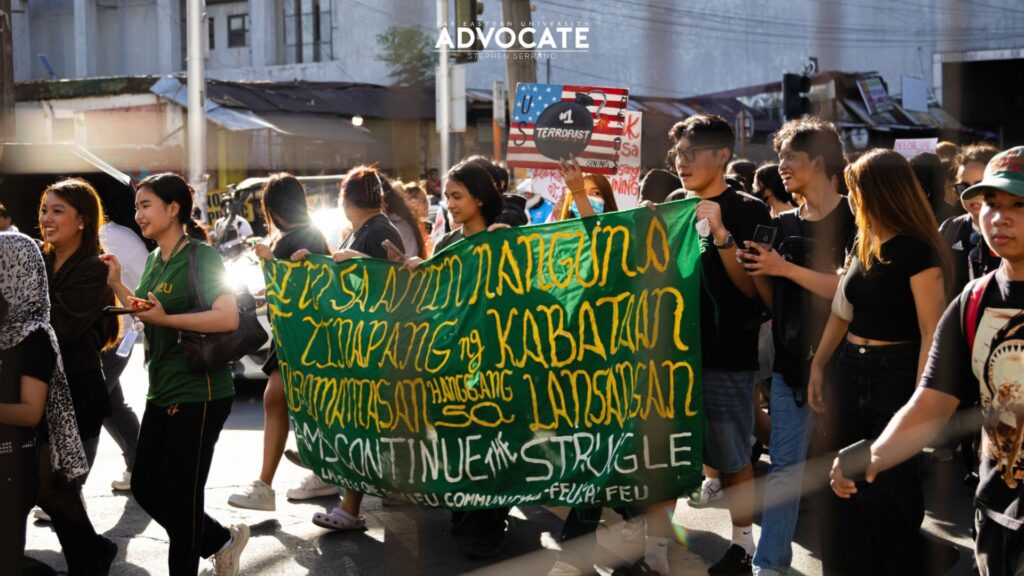
As part of the National Youth Day of Action, Far Eastern University (FEU) students condemned the upcoming visit of United States (U.S.) President Donald Trump and the Pax Silica initiative during a walkout protest in front of FEU Gate 4 last November 13.
With the theme ‘Walkout Against Trump and Pax Silica,’ Tamaraws denounced the U.S. imperialist initiatives in the country ahead of Trump’s visitation for the 49th Association of Southeast Asian Nations (ASEAN) Summit, where leaders from Southeast Asian countries are set to discuss summit agendas including the finalization of the ASEAN Digital Economy framework agreement, transnational crime, food and energy security, among others.
Furthermore, the U.S.-led artificial intelligence (AI) initiative Pax Silica, which seeks to establish AI data hubs and manufacture semiconductors in agricultural lands, is also among the expected topics to be discussed at the summit.
In an interview with FEU Advocate, second-year political science student James Barug stressed that the country would not benefit from the initiative as much as the U.S., citing possible exploitation of Philippines’ natural assets to maintain their position in the global market.
“Ang kailangan natin tanungin ay kung sino ba ang makikinabang sa initiative na ito? Sa proyekto na ito? Ang makikinabang lang dito ay ‘yung U.S… dahil sila ‘yung may kailangan ma-maintain ‘yung kanilang posisyon sa global stage, sila ‘yung may kailangan ng mga raw materials sa Pilipinas katulad ng nickel, [at] sila rin ‘yung may kailangan ng murang paggawa o cheap labor dito sa Pilipinas (What we need to ask is who will benefit from this initiative? In this project? The only one that will benefit from this is the U.S. because they need to maintain their position in the global stage, they need raw materials from the Philippines such as nickel, and also cheap labor),” he said.
After the Philippines joined the project as one of its partner countries last April, the Bases Conversion and Development Authority (BCDA) allocated a 4,000 acre property in New Clark City, Tarlac, where the data hub centers are expected to be built, threatening the displacement of farmers and Indigenous communities.
Due to the partnership's perceived threats to local communities, progressive groups condemned the project, arguing that its risks outweigh its promises of employment and enhanced technological security.
According to Asia News Network, the country could face food insecurity risks if data centers are built near cornfields, which could otherwise produce food to feed almost 250,000 to 600,000 Filipinos annually.
Additionally, with water as the main operational source, the data hubs will consume 130 million liters of water and three gigawatts of electricity daily, equivalent to 16 percent of Luzon’s grid capacity. This could further deplete the country’s freshwater reserves amid ongoing threats posed by the Super El Niño and the environmental impact of carbon emissions.
Furthermore, Barug emphasized the importance of addressing national concerns before prioritizing initiatives involving foreign partners.
“Kung totoong gusto niya ng pag-unlad, kung totoong genuine siya sa kaniyang mga sinasabi, ay kailangan patunayan niya ito sa isang totoo, genuine national industrialization… Kung gusto niya talagang paunlarin ang Pilipinas, kailangan niya pagtuunan ng pansin ‘yung totoong problema ng Pilipinas (If he truly wants progress, if he is genuine with what he says, he needs to prove it through real, genuine national industrialization. If he truly wants the Philippines to develop, he needs to focus more on the country’s problems),” he said.
As students walked out of their respective classes, Barug underscored their role in joining demonstrations against Pax Silica as a means of fighting for their future.
“Naniniwala ako na napakahalaga ng role ng mga estudyante, lalong-lalo na sa mga pagkilos o sa mga movement tulad ng ngayon sa pag-reject ng Pax Silica. Dahil bukod sa naturally progressive ‘yung mga estudyante, ay ang pinag-uusapan natin dito ay ‘yung kinabukasan na haharapin natin lahat (I believe that the role of students is extremely important, especially in movements, such as today’s rejection of Pax Silica. Aside from students being naturally progressive, what we are talking about here is the future that all of us will face),” he said.
In a separate interview, Samahan ng Progresibong Kabataan member and second-year political science student Angelica Gonzales explained that the jobs marketed by the government serve only as a facade to divert from the actual implications for the Philippines.
“Umaasa ang Pilipinas na papakinggan tayo ng gobyerno, dahil ang Pax Silica naman, yes, magbibigay siya ng trabaho sa mga Filipino, pero hindi ito for long term, but for only short term (The Philippines hopes that the government would listen to us, because the Pax Silica, yes, it would give more jobs for Filipinos, but it is not for long term, but for short term only). It is a delusion that is given so they can have answers kung bakit nga ba sila pumayag… To divert the attention of the Filipinos towards the real implications of Pax Silica towards our country,” she stressed.
Aside from its projected technological advancements, the AI hub is also promoted to generate more jobs for Filipinos and nearly $200 billion in exports within the next three decades.
However, critics and progressive groups have questioned the sustainability of these jobs. According to Advocates of Science and Technology for the People, BCDA’s claim of Pax Silica’s production of ‘thousands’ of jobs may only refer to the temporary employment of blue-collar workers during the construction phase, while long-term positions, such as engineering and technician jobs, might potentially be occupied by foreign workers instead.
Emphasizing the importance of walkouts, Gonzales also noted that it serves as an avenue to provide information and education for the underprivileged.
“Ang kaalaman kasi ay isang pribilehiyo. Ang pagkakaroon ng mga (Having knowledge is a privilege. Having) resources in order to gather information and also to spread information is a privilege that not all Filipinos have. So as the youth, we have the responsibility to spread this information,” she expressed.
Following the walkout, Tamaraws marched toward the Mendiola Peace Arch alongside other institutions within the University Belt to partake in a broader demonstration.
Meanwhile, universities nationwide also staged walkout protests to condemn the U.S.’ imperialist initiatives in the Philippines, including University of Santo Tomas, Adamson University, and De La Salle University.
With the theme ‘Navigating Our Future, Together,’ the 49th ASEAN Summit is set to take place at the Philippine International Convention Center in Pasay City from November 15 to 17.
The protest marked the second time in recent years FEU students have staged a walkout, with the latest taking place last September 2025, where Tamaraws condemned various national and University-wide issues.
– With reports from Dylan Gabriel C. Sacramento
(Photo by Stephen Serrano/FEU Advocate)