Art is long, life is short
- October 31, 2023 09:09
FEU Advocate
March 30, 2026 18:43
By Renee Arwen B. Marfiga
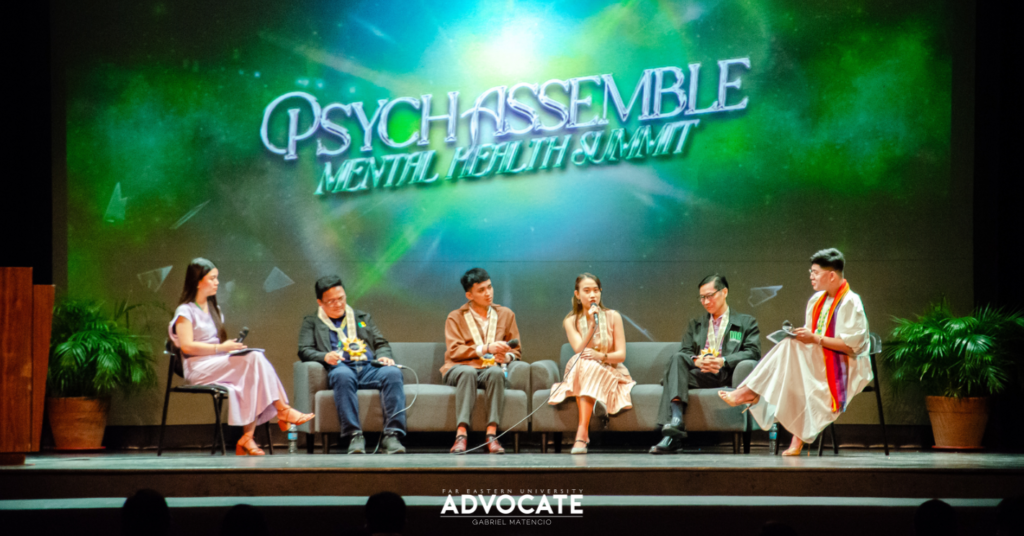
Delving into current perspectives and ongoing advocacies, Far Eastern University (FEU) Psychology Society (PsychSoc) encouraged students to raise mental health awareness and promote societal change during the ‘PSYCH Assemble: Mental Health Summit 2026’ at the Main Auditorium last March 24.
With the theme inspired by the film ‘Everything Everywhere All at Once,’ the forum seeks to shed light on the multiple realities of mental health in the Philippines and ways it can be prioritized by individuals and society.
‘Everything’ on the ground
The first panel discussion talked about the status quo of mental health in the Philippines across different settings.
National Center for Mental Health (NCMH) clinical psychologist Daniela Samaniego-Tividad shared that despite ongoing initiatives to address mental health problems, there is a primary concern with the limited resources and workforce.
“We have around 50,000 psychometricians, however, we all know that their practice is very limited. [For] psychologists, we have around 1,500 as of 2025. However, only a small portion of it is in actual clinical practice,” Samaniego-Tividad detailed.
She also highlighted the ratio of one psychologist catering to 100,000 Filipinos — a scarcity especially felt in rural areas where there is limited access to mental health services.
“We have patients all the way from the far end of the Philippines. Literal na tumatawid sila ng bundok at dagat (They literally cross mountains and seas) just so they could get mental health services and consultations from us. And that really breaks our hearts because in NCMH, we're around 20 clinical psychologists. Very limited talaga ‘yung workforce natin… also with the funds, the other resources allocated for it,” she recalled.
FEU guidance counselor Miguelito Relente echoed the psychologist’s sentiments with the lack of counseling professionals in educational institutions.
He stated that they need to accommodate the ideal ratio of 1:250. Even so, there are only 18 guidance counselors in the University at the moment, and they have to handle more than a thousand students in each department and institute.
Meanwhile, psychologist and counselor Eric Dimar shared that Filipinos with mental health problems statistically increased, and his clinic encountered difficulties in catering to all clients.
“Maraming kliyente talaga… This week nga, eh, there are people that are calling us, nahihirapan akong mag-schedule kasi talagang puno na (There are a lot of clients. Just this week, I had a hard time because a lot of people are calling but my schedule is already full). And of course, I also have to take a rest so that I can be at optimum with my client… [But] if there's a client that is beyond my expertise and beyond my time, I refer them,” Dimar expressed.
On the other hand, human resources clerk and mental health first responder Steven Dayanghirang affirmed that there is more visibility when it comes to mental health in the workplace setting. Still, many employees are struggling silently, which necessitates the proper implementation of mental health programs.
Proceeding to the misconceptions and disparities between mental health and what is being practiced, Dayanghirang shared that there is a misalignment on the ‘work-life balance’ that companies promote with the actual experiences of employees.
“For example, 8 a.m. ang pasok mo (You need to come to work at 8 a.m.). You have to wake up at 5 a.m. just to prepare — ‘yung commute hours pa lang, malaking kain na ‘yon sa oras mo (The commute hours already take up a lot of time). And of course, employees are expected to be available at any time. Kahit rest day ‘yan, ‘Oh, dapat sasagot ka sa email,’ ‘Ba’t hindi ka sumagot [sa call] (Even on rest days, employees need to answer emails and are questioned when they don’t pick up calls)?’’’ he cited.
The industrial-organizational professional said that mental health programs should align with the employees’ actual working conditions in order for them to feel supported.
Relente then discussed how people often see the guidance office as a place where students are disciplined rather than an avenue for counseling.
“Ang tanong ko lang, ‘How come ganiyan ang nararamdaman mo?’ They said, ‘Baka mapagalitan niyo po ako, eh (When I ask, ‘How did you come to feel this way?’ They said, ’You might scold me).’ No. You are in the guidance office because we are here to listen to your needs… your ideas, your emotions openly. You can say it. We want to listen to you… and we are here because this is your safe space,” he corrected.
Samaniego-Tividad and Dimar also answered that mental health issues are not resolved through isolated, one-and-done interventions, but through collaborative efforts by professionals, which may take some time.
“When we seek support, sana one-time din lang. Mayroon namang ganoon, eh, may mga brief therapy. Pero many times kasi, it will take some time. Ang objective namin [ay] the sooner, the better. buthindi natin siya puwede madaliin (We hope that we can provide one-time support, just like brief therapy. But therapy usually takes some time. While the sooner, the better is our objective, we cannot rush the process),” Dimar conveyed.
They also clarified that these interventions may require medication or psychotherapy, which the public should not be ashamed of.
Moreover, psychosocial support can also factor into their healing process — one that is more helpful than long-term institutionalization.
“Never underestimate the power of having a strong support system. And that goes beyond family, friends… We do not advocate long-term institutionalization of patients because it affects their overall well-being, and mahirap ‘yung (the process is difficult for) reintegration sa (in) community and society,” Samaniego-Tividad declared.
‘Everywhere’ we can reach
While the first session introduced the reality on ground, the second panel discussion focused on translating this knowledge into building a better future for mental health.
Television personality Kim ‘Kuya Kim’ Atienza considered mental health awareness an important and personal topic in relation to his late daughter, Emman Atienza. He believed that he should honor her death and become a mental health advocate not only for her but for everyone.
Clinical psychologist England Castro added that in envisioning a mentally healthy society, it goes beyond displaying awareness and institutionalizing mental health support.
Castro delved into the ‘cultural hegemony’ that perpetuates the stigmatization in society, including the recent controversial remark by Quezon City Representative Bong Suntay against Anne Curtis.
“Kahit sabihin nating hindi tayo agree sa sinabi nung congressman, may mga nagde-defend sa ganoong diskurso. ‘Yung kultura do’n, patriyarkal [at] misogynistic pa rin. Katali din do’n ‘yung hindi pa rin maisulong-sulong [na] SOGIE Bill… Paano tayo magkakaroon ng mental health para sa lahat kung may mga karapatang ginigipit (Even if we don’t agree with the congressman’s comment, some still defend it, and it stems from the patriarchal and misogynistic culture. This is also connected with the SOGIE Bill that cannot be legislated. How can we have mental health for all if human rights are put in a tight rope)?” the psychologist emphasized.
He also mentioned other aspects of Filipino culture such as toxic resilience and prioritizing harmony over communication as barriers to elevating mental health discourse.
On the other hand, Kuya Kim cited the generation gap as a defining limitation, asserting that to label the current generation as weak is ‘not that simple.’
“During our time, wala naman kaming internet… Ang kaalaman namin ay limitado. Ngayon… ang internet ay kabilang na sa social life niyo… Kung ano man ang pressure na napupunta galing doon sa digital life niyo, real ‘yan sa inyo… Kung kaming mga boomer ay binigyan ng internet noong panahon namin, baka mas maraming nagpakamatay sa amin (There was no internet during our time and we had limited knowledge. Today, the internet is part of your social life, so whatever pressure coming from it is real for you. If us, boomers, had the internet back then, maybe more of us could have ended our lives),” he reflected.
Atienza also relayed that stigma is still evident even though society has become more open with mental health, as a large number of youth struggle to open up to their loved ones, especially about their suicidal ideation.
Moving forward, Castro encouraged clinicians to use their power beyond diagnosis and initiate conversations on mental health and social ills outside the clinic.
“Mahalaga na pag-usapan ‘yung nangyayari sa labas ng clinic. It's to go beyond the DSM (Diagnostic and Statistical Manual of Mental Disorders). Maraming mga estudyante, [sinasabi na] Bible natin ‘yan [DSM] (It is important to talk about what is happening outside the clinic and go beyond the DSM. Many students say that it is our Bible). But when you frame it as a Bible, it holds so much power; that when we see other people, we reduce them to some psychological processes. When in fact, these people are located in society,” he said.
He stressed that the topic must be communicated without demeaning other people and in a language that can be easily understood by all.
While Atienza is not a psychologist himself, he treats social media and his position as a celebrity as his own clinic — a power he can use to reach out to people and offer acts of kindness.
“Ang clinic ay nasa social media, nasa TikTok… Even before Emman, very aware ako sa mga comment ng mga netizens dahil alam ko (The clinic is on social media, on TikTok. Even before Emman left, I was aware of the netizens’ comments because I know)… the Lord gave me a platform. That maybe just a comment or two can save lives… I can see the power also of social media and the power of [being a] celebrity that God gave me, [and] be able to reach out to you guys, Emman’s tribe,” he stated.
Castro added on to Kuya Kim’s story by emphasizing allyship, and how centering kindness in its practice can provide hope amid the ‘bleak state of the world.’
Empowering movements ‘all at once’
The panelists challenged future practitioners to contribute to mental health acceptance in the country, including creating safe spaces for everyone and helping other people in an intentional, heartfelt manner.
The speakers also reminded students that despite the harsh and exhausting conditions that people are put through, all it takes is ‘a little kindness, every single day,’ and maybe it can help save lives.
Moreover, they wanted everyone to acknowledge that mental health is not just an individual struggle, but a systemic, political issue — its acceptance cannot be realized when marginalized sectors continue to be oppressed every day. By demanding accountability from the government, it can push them to create necessary programs and policies for the people.
PSYCH Assemble: Mental Health Summit is an annual event organized by PsychSoc, allowing Tamaraws to learn more about well-being and champion mental health causes.
(Photos by Gabriel Matencio/FEU Advocate)