






By Shayne Elizabeth T. Flores
In time for the Far Eastern University (FEU) Elections 2026, FEU Mathematics Society (MathSoc) commenced their data-driven initiative to address last year’s low voter turnout by promoting informed voting through the launching of ‘TAMStats 2026: Connecting the Pieces through Unbounded Polling’ last April 13.
In an interview with FEU Advocate, MathSoc Vice President Marco Morillo underlined TAMStats’ goal to keep Tamaraws well-informed throughout the elections.
“Ang goal talaga ng MathSoc is to help na mas ma-inform pa ‘yung mga students regarding sa elections as well as ‘yung mga [platform ng] candidates. So this year, we’re trying to partner up with different organizations so that we can empower pa ‘yung ginagawa namin sa TAMStats (MathSoc’s goal is to help students be informed about the elections and candidates’ platforms. So this year, we’re trying to partner up with different organizations so we can empower TAMStats’ initiative),” he said.
Among partner organizations this year is the FEU Commission on Elections (COMELEC), with MathSoc officially recognized as one of the Commission's deputized student organizations.
“May mga plan kami ng FEU COMELEC to further improve pa kung ano ‘yung mga steps na puwede pang gawin so that mas marami pang students ‘yung maabot namin at mas marami pang students ‘yung mas maging informed pa regarding sa platforms na mayroon ang mga candidates as well as the University elections itself (We have plans with FEU COMELEC to further improve the steps that we can do to reach more students and make them more informed regarding candidates’ platforms and the University elections itself),” Morillo added.
One of these plans is the upcoming FEU COMELEC website that aims to provide students with all-in-one access to candidates’ stances, platforms, and other election-related statistics.
This is in line with TAMStats’ goals to align its methodologies and analysis with the student body and democratize election data.
As for TAMStats’ objectives this year, MathSoc aims to measure the candidates’ favorability among the student body and the Tamaraws’ readiness in terms of voting.
The polling coverage also plans to determine the projected turnout for each position, along with students’ perspectives on the positive change that candidates could bring to the University, which is a newly introduced metric for this year.
As of writing, MathSoc has finished TAMStats’ preliminary wave, which gathered students’ present experiences and sentiments about the elections.
Wave 1 was launched last April 16 and will remain open until April 22, seeking to determine the Tamaraws’ initial voting preferences.
Meanwhile, the Wave 2 survey will run from April 23 to 29.
To boost the data collection process, MathSoc President Zion Ramilo said that they will set up on-site survey stations across the campus.
“For example, ‘pag [from] Nursing ka or IHSN [Institute of Health Sciences and Nursing], mayroon kaming people na naka-station sa Nursing Building or sa Science Building. Or if you are part of IAS [Institute of Arts and Sciences], we're stationing people [in] the Arts Building (For example, if you’re from Nursing or IHSN, there will be people stationed in the Nursing or Science Buildings. Or if you are part of IAS, we’re stationing people in the Arts Building),” he stated.
‘Students are not apathetic, but rather unimpressed’
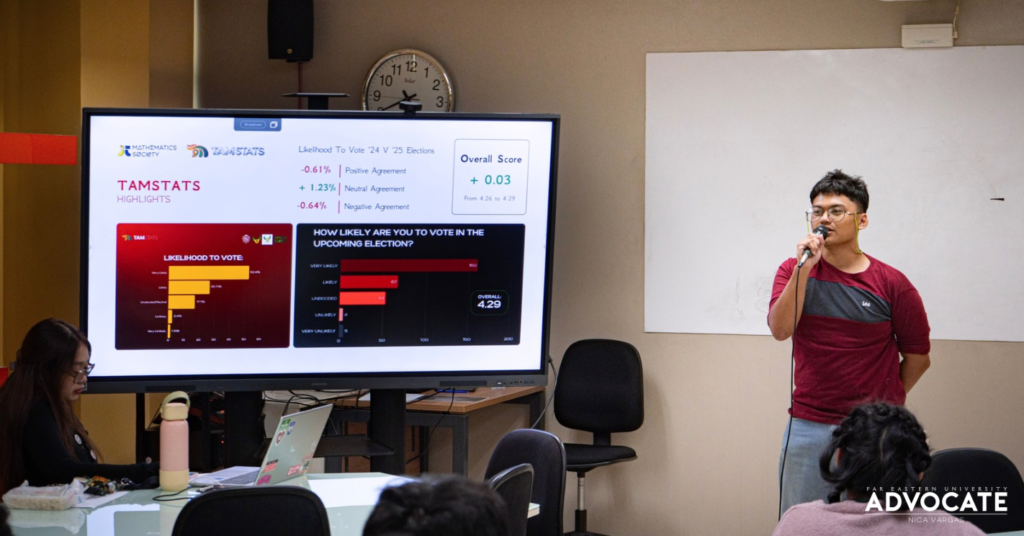
Highlighting the significance of public polling in understanding voter behavior, MathSoc unveiled the ‘TAMStats Highlights’ as spearheaded by Ramilo, detailing the findings they have gathered over the past elections surveys.
According to Ramilo, the voter turnout in FEU has been declining since 2023. With a turnout of 24.27 percent, approximately three out of four students were not able to cast their vote in the last elections.
He also compared the Tamaraws’ likelihood to vote over the last two years, which barely increased from 4.26 in the 2024 elections to 4.29 in 2025. While a 0.3 increase was observed, Ramilo maintained that it’s a ‘false positive.’
“It's not that there are more people expressing their want to vote. There are just fewer people that don't want to vote,” the MathSoc president explained.
Ramilo further noted the students’ neutral approach to the elections given the additional 1.23-percent neutral agreement observed in 2025, which sets a problematic connotation on the Tamaraws’ engagement with the elections.
“Ang mahirap sa mga (What’s difficult with) neutrality is that it's a lot of volatility. Meaning, there's a lot of dependent [variables]. Kumbaga, depende sa kandidato, depende dito, depende diyan (It’s dependent on various factors)… which cannot be directly accommodated by a lot of our student leaders, by our FEU COMELEC… So that's why that neutral agreement is a little bit dangerous. It's uncertain. We don't know,” he emphasized.
Moreover, citing last year’s survey that weighed in on voter behaviors, the MathSoc president underlined that the majority of the Tamaraws have spatial voting preferences, which means they choose candidates based on how close they are to their set standards.
“‘Pag hindi ‘yung standard na ‘yun [ang] nakamit ng isang kandidato (If these standards are not met by a candidate), they are less likely to compromise. They are more likely to abstain,” Ramilo pointed out.
Similarly, it was also found that most FEU students are ‘endogenous’ decision-makers, implying that Tamaraws base their voting decisions on internal or personal factors rather than external ones.
“Meaning, sa sarili nila manggagaling ‘yung desisyon, hindi sa mga peers nila, hindi sa hype, and hindi sa marketing (This means that they decide for themselves, rather than being influenced by peers, the hype, and marketing),” Ramilo added.
Overall, these findings establish that Tamaraws have generally high standards when it comes to electoral candidates.
And when candidates fail to meet these standards, students are less likely to engage with them and participate in the elections as a whole, which could explain the low voter turnout.
“Voters are not apathetic. They're unimpressed,” Ramilo argued.
Now in its fourth iteration, TAMStats is FEU’s official polling coverage conducted annually to measure election-related statistics.
(Photo by Nica Vargas/FEU Advocate)