Bali-Baling Balarila
- August 12, 2023 07:02
FEU Advocate
February 10, 2026 12:43
PSYCHE
By Phoemella Jane Balderrama, Head Layout Artist
When professional healthcare becomes a luxury, alternatives become our only option—whether reliable or not. In a world where a doctor’s visit can cost a week’s pay, asking for health advice from a chatbot becomes a practical choice.
In the current state of our economy, where the cost of living continues to rise, everything is about convenience. Asking generative artificial intelligence (AI) chatbots like ChatGPT costs us nothing and requires no transportation. There is no need to spend an entire day lining up for a free check-up—no fare to pay, no hours to lose. And we are led to believe that this is normal.
Before chatbots and Google, Filipinos had long turned to cheaper, more accessible healthcare options. Many of these include herbal medicine, hilot, and other folk practices that emerged as practical solutions to a healthcare system that was too expensive.
Herbal medicine, for instance, offers remedies from locally available plants. One popular example is Lagundi. When it was first introduced, many were skeptical of its effectiveness. Over time, however, it gained credibility after the Department of Health (DOH) endorsed it for its proven medicinal claims.
Traditional practices like hilot, which involves massage and bone-setting, provide relief for aches, injuries, and other body concerns, without the need to spend a large amount of money. Other folk practices, from suob to spiritual rituals, were also practiced.
During the COVID-19 pandemic, suob or tuob gained attention. Many people turned to the practice as a remedy for COVID-19–related symptoms, despite the lack of scientific consensus supporting its effectiveness.
To some, those who continue to practice these methods may seem stuck in olden ways. But in reality, for many, they are simply doing what they must to survive. This same instinct to cope with limited access to healthcare has not vanished. It has only evolved into a more modern form.
Now, the situation has only grown more alarming as we begin to settle for AI in place of doctors. “Internet muna, ‘pag lumala, saka na lang magpa-doktor.” This has become a common mindset among Filipinos who turn to AI or the internet before seeking professional medical help.
Some even believe that consulting AI is better than doctors, who will only drain their pockets. Consulting AI, in itself, is not wrong. Asking chatbots can help us understand our symptoms and guide us toward what could be wrong. It helps us recognize signs we might not notice and know when seeking professional help is immediately needed. However, what makes AI dangerous is when it starts to replace real medical care—when people solely rely on it and perceive doctors only as a last resort in worst-case scenarios.
Doctors are meant to be the first line of care when health concerns arise. Unlike chatbots, they can conduct physical examinations, obtain proper background history, request diagnostic tests, and prescribe the appropriate medication.
This growing dependence on AI is alarming not only for patients but also for our medical professionals. It is deeply unsettling that a broken healthcare system has slowly turned people against doctors, who should have been our allies in the first place. In the absence of reform and support from the government, doctors are being cast as villains in public discourse, even as they, too, struggle within the failing system.
It is easy for some to ridicule these people. “Lahat na lang inaasa sa AI.” So easy to say when you can afford everything, when consulting a doctor does not mean sacrificing a week’s budget for your family. People turn to AI not out of complacency, but because the state itself can no longer be relied on. Public health services have become more difficult to reach.
Inflation has made an already fragile healthcare system even harder to survive. Small private hospitals are left with no choice but to raise their fees as the cost of medical supplies continues to rise. According to the Private Hospitals Association of the Philippines, they needed to increase their prices as it is necessary to keep operations running, pay hospital staff, and cover overhead expenses. This situation, however, could have been at least minimized if the government had better control over the price of healthcare commodities.
Yes, there are free billings under the Zero Balance Billing policy, but only DOH-accredited hospitals are included. Even lining up for free services is not something everyone can afford, especially for those supporting large families. And if these hospitals become overloaded, where are people supposed to go?
While there are many public hospitals, not all are DOH-accredited and free of charge. People live with the constant fear that they might still be asked to pay, because without that assurance, treatment simply becomes unaffordable.
The reliance on AI is not just about convenience. It is the byproduct of a system that leaves us with no other viable option. With AI, answers may be uncertain, but at least everything is guaranteed free and instant. No worries for expenses, all done from the comfort of your home. You do not need to take a day off to consult a professional.
It is pathetic that we have been conditioned to think that this is okay. It is slowly becoming normal because we have grown tired of relying on a system that keeps putting public healthcare on the back burner. It is almost ironic that technology is evolving faster than the government is taking action to make healthcare truly accessible to Filipinos.
The question is not whether we should trust AI or not, but whether professional healthcare is even something we can access. Until the system catches up to our needs, then maybe AI will continue to feel more caring than the government would ever be.
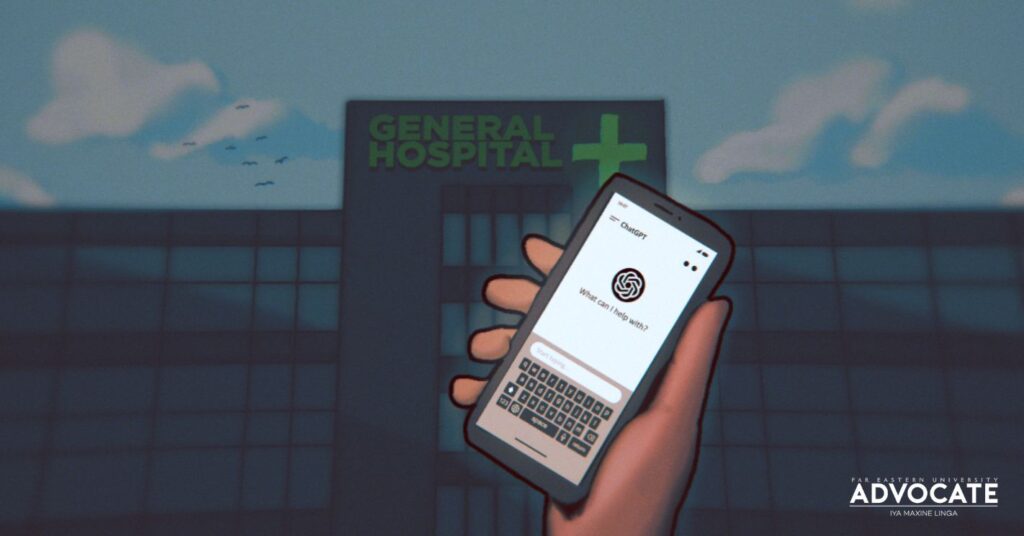
(Illustration by Iya Maxine Linga/FEU Advocate)