







By Ishia Eleanor F. Marquez
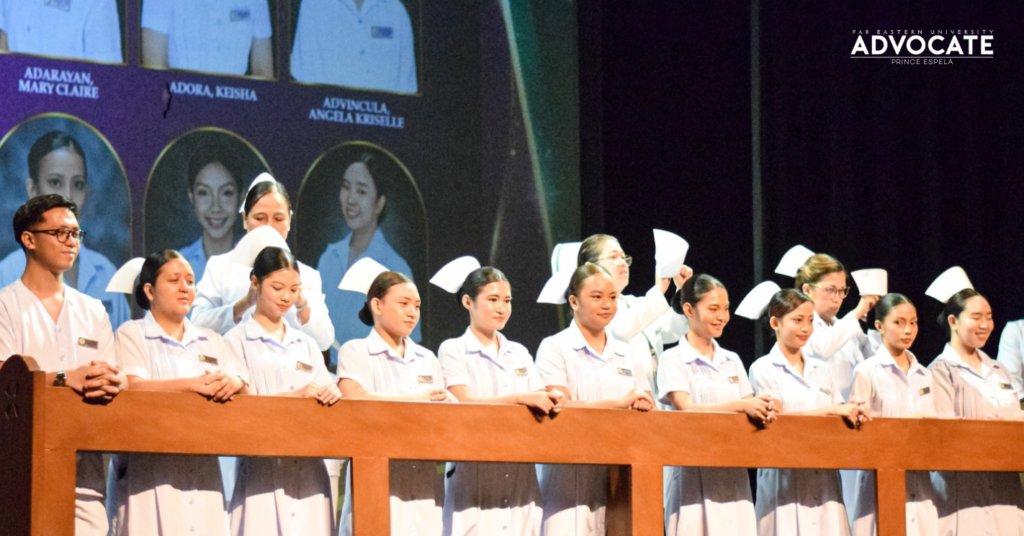
Despite major revisions in the program that prompted student concerns, Far Eastern University (FEU) capped 989 second-year nursing students during the 72nd Capping and Candle Lighting Ceremony (CCLC) at the Main Auditorium last September 26.
With the theme ‘The Light that We Carry: A Generation Called to Care,’ the ceremony centered on the lantern as a symbol of student nurses’ responsibility to provide healthcare for people.
In her keynote address, Institute of Health Sciences and Nursing Associate Dean Rachelle Sarmiento emphasized how student nurses will face challenges that will test their physical and mental state.
“You will be deployed in government hospitals. Your heart will break seeing some of the patients who hardly even get the right medical management because they don’t have the financial [means]… There are times we see that they are deprived,” she said.
Recalling her own nursing journey, Sarmiento reflected on the compassion she developed during her clinical duties as she witnessed the hardships of individuals lacking proper access to healthcare.
“We [were] to stay there and endure their lives that made us more empathetic because we were able to see and feel how it is to be uncomfortable, to be less privileged. Sometimes, for you to have that kind of empathy, you really have to wear the shoes of others,” she shared.
Aside from carrying a rational mindset, the associate dean urged the newly capped student nurses to pour their hearts out to their patients as they perform their duties in healthcare.
Before the CCLC, second-year nursing students raised concerns over the modifications to the event’s guidelines, particularly on their parents’ attendance, program flow, and being required to attend lectures after the ceremony.
Protocol changes, issues raised
In a memorandum distributed by the Batch 2029 class mayors last September 20, it was stated that only students and faculty members could attend the capping and pinning ceremony.
Although it was already stated during the CCLC orientation that parents would not be allowed to be present during the event, the Nursing Society (NurSoc) filed two petitions urging the department to reconsider the decision. However, the student body received no response until the policies were finalized.
Unlike the traditional approach where clinical instructors place caps and pins on stage, faculty members would instead place the students’ accessories upon inspection of proper grooming outside the venue prior to the ceremony.
Moreover, the event was held in a single session, unlike the previous years’ two-session setup.
Nursing students were also expected to attend their lectures and duties after the ceremony, unlike last year's batch wherein they did not have classes after.
Following the grievances, NurSoc President Angel Claire Orense, along with Batch 2029 Government President Howard Xyrus Ocampo, engaged in a dialogue with the department’s administrators to discuss concerns last September 21.
Consequently, in a post made by the NurSoc president, it was clarified that the budget for the CCLC is excluded from the tuition as it is a ‘separate institutional activity with its own financial breakdown,’ which the student body posted in Batch 2029’s private Facebook group.
Orense further explained that the department’s firm decision regarding the parents’ participation is due to a dialogue between the department and Academic Affairs Office on the number of activities involving parents, and the integration of the ‘traditional’ CCLC format.
“There was coordination between the Nursing Department and Academic Affairs Office regarding the increased number of activities conducted by the department and the inclusion of parent participation in such events… The decision was based on the intent to maintain the traditional format of the Capping and Candle Lighting Ceremony, which has been conducted without parent participation. Therefore, the department is firm that there will be no parent,” the Facebook post read.
As a compromise for not allowing parents to attend, NurSoc shared that they have requested for the event to be livestreamed instead, which was approved last September 16.
According to the department, students are expected to wear their caps and pins upon entering the venue due to limited manpower available, as clinical instructors will still be conducting classes on the day of the ceremony.
In line with this, NurSoc Secretary Marcus Stephen Faustino clarified through a comment in Facebook group One Piyu Community that they have already proposed arrangements regarding the matter and the use of kneelers.
“Regarding the use of kneelers, we were later informed that these would not be allowed due to a stated ‘lack of sufficient clinical instructors’ and ‘it was not requested.’ We respectfully disagreed with this reasoning, as we believe there are enough count for clinical instructors who will be assisting the capping and pinning. We also proposed that we would be the ones requesting the kneelers,” the comment read.
Additionally, the student council submitted plans to the Nursing administrators regarding the approach for the ceremony, including number of students on stage, time allocated for photo taking, and the distribution of faculty members.
Town hall dialogue
With issues still unresolved, NurSoc, along with the Nursing Department, decided to hold a town hall meeting to address the grievances and reach a compromise last September 23.
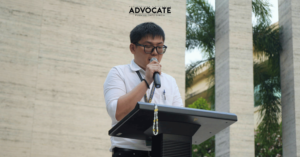
During the meeting, Nursing Dean Moira Uy stated that she wanted to restore the ‘traditional’ form of the CCLC as it is a student-faculty event meant to pay homage to the founder of Modern Nursing, Florence Nightingale.
Along with concerns on overcrowding, the tradition was also cited as the main basis for excluding parents from the ceremony and requiring students to attend clinical duties and lectures afterwards.
The dean later clarified that student nurses will no longer be required to attend their clinical duties, but classes are still set to push through after the ceremony.
Additionally, Uy reiterated the shortage of instructors as the reason behind not being pinned and capped on stage, emphasizing that the change does not diminish the meaning of the ceremony itself.
Reaching a compromise, the dean asked the student representatives to create a poll on their group chat on two options: allowing parents to attend without guaranteed entry, as it is beyond her authority, or having instructors perform the capping and pinning ceremony with kneelers available during the ceremony.
After conducting polls in their respective group chats during the town hall meeting, the students chose the latter option.
NurSoc, batch government sentiments
Following the dialogue, the department and second-year nursing students agreed with the presence of the kneeler, with instructors conducting the capping and pinning on stage. Consequently, parents will not be allowed to attend the ceremony.
Uy further clarified that parents would not be permitted to enter the campus due to security concerns over the number of students to maintain crowd management and to uphold the traditional form of the ceremony.
In an interview with FEU Advocate, Orense revealed that contrary to the previous CCLC, the batch 2029 CCLC was organized by the Nursing Department.
“Unlike before na FEU Nursing Society ‘yung nagpeprepare before ng RFA [Request for Approval], so from the planning… hanggang sa implementation or sa event proper. Ngayon kasi, iba na, ang administration na mismo nagpeprepare ng RFA. Even sa program flow, wala din say ang aming organization kasi ang lahat na nag-decide na lang ay ‘yung ating admin. (Unlike before where the FEU Nursing Society was the one preparing the RFA, from the planning all the way to the implementation or event proper. This time, it changed, the administration themselves are preparing the RFA. Even with the program flow, our organization no longer has a say because everything was decided by our administration),” the NurSoc president said.
Aside from concerns raised, Orense also stated that there were still unresolved issues regarding uniforms and clinical duty schedules among student nurses.
In a separate interview, Ocampo expressed dismay over the changes in the ceremony, stating that the new protocols deprive them of the celebration they expected.
“Medyo nakakalungkot siya, kasi knowing na last year and ‘yung previous batches naman is naging possible ‘yung mga ganitong events… Parang ang dating kasi sa amin, since nabago na nga and hindi na matutuloy sa amin ‘yung naging tradisyon ng CCLC sa FEU… naging pagkakait [siya] ng opportunity for us to celebrate that milestone and the achievement na sa second year magduduty na kami (It is a bit saddening because we know last year and in the previous batches, events like this were possible. It seems to us, since there are changes and we can no longer have the traditional CCLC here in FEU, it has deprived us of the opportunity for us to celebrate that milestone and the achievement of having a clinical duty for our second year),” the batch president said.
Despite the exchange during the town hall dialogue, both presidents found the meeting helpful in addressing grievances about the ceremony. However, they also noted the constraints students faced while voicing their concerns and suggestions during the dialogue.
“I wish na sana nabigyan din ‘yung students ng time to speak up with their own thoughts and suggestions, because although nagkaroon naman tayo ng time ng open forum and some students were able to share their opinions… a lot of them felt hindered na parang marami sa kanila nakaramdam na hindi napakinggan talaga during the town hall (I wish the students were also given time to speak up with their own thoughts and suggestions, because although we had time for open forum and some students were able to share their opinions, a lot of them felt hindered because they felt like they weren’t being heard during the town hall),” Orense expressed.
Likewise, Ocampo acknowledged the opportunity to speak, but he still hoped that the next town hall meeting would provide more room for communication between the students and the administrators.
“I wish, kung magkakaroon man next time ng town hall, sana mas maging open for communication between the student body and the administration themselves,” he said.
Nursing administration’s side
In an online interview with FEU Advocate, following the town hall meeting, Uy reiterated that the intervention in this year’s CCLC was made after considering the ceremony’s historic significance, emphasizing the obligation of student nurses.
“We have long wanted to make it simpler yet meaningful, anchored on the ceremony's historical purpose. We informed all at the start of the semester that from this school year and moving forward, we wanted to focus on a solemn professional rite, emphasizing commitment to service, professional responsibility, ethical practice, the legacy of nursing, [and] readiness to care for the sick,” she said.
Addressing the absence of parents, the dean stated that it was intended to highlight the distinction and impact of the pinning ceremony, where family members will be present.
“We also want to highlight the milestone impact of the pinning ceremony after our graduation ceremony. The pinning ceremony or clinical graduation, involving family members, more meaningfully indicate academic achievement or completion of the rigors of nursing education,” she said.
While acknowledging the issues raised during the town hall meeting, Uy shared that the department and the University made arrangements to accommodate parents who wished to watch the ceremony via livestream at the University Conference Center.
“To address the situation and minimize any inconvenience to parents on the day of the CCLC, the University promptly coordinated appropriate accommodations, including campus access, a designated waiting area at the University Conference Center, and facilities that allowed parents to view the livestream of the ceremony,” she shared.
The dean further said the decision for students to attend their lectures after the ceremony was sought to maximize learning opportunities following the numerous class suspensions.
“The nursing profession is very demanding. We wanted our students to maximize any learning opportunity, given the many class suspensions due to extreme weather events and the requirement to pass the board exam in the future. So, after the ceremony, we wanted our students to go back to study,” she stated.
According to Uy, a ₱63 ceremony fee was collected from 983 nursing students, amounting to an estimated ₱61,929 revenue. However, NurSoc’s budget report revealed that the total fixed cost approximately amounted to only ₱53,350.
The dean also explained that the event had an estimated fixed cost of ₱61,929, which remains as a subject for reconciliation with the actual collection after accounting for students who did not attend the ceremony and thus, did not make any payment.
As of writing, the dean is awaiting the release of the ceremony’s official audit by the Accounting Department. However, she stated that any excess amount from the budget would be allocated to future Batch 2029 events.
The CCLC is an annual ceremony for sophomore nursing students, where they receive their nursing caps to formally start their clinical duties.
Last August, FEU produced 567 new Tamaraw nurses in the Philippine Nurses Licensure Examination, yielding a 93.41-percent passing rate.
‒ With reports from Julienne G. Tan
(Photo by Prince Espela/FEU Advocate)