







Le Petit Prince
By Sean Clifford M. Malinao, Junior Literary Writer
Student elections occupy an indispensable place in the formation of students’ civic consciousness. Yet, the gravest peril to democratic life is when students habitually withdraw from their obligations to keep the student government in check and participate in the University’s political processes. If students get used to treating campus elections as trivial, they are being trained — subtly but effectively — to approach something bigger, such as national elections, with the same detachment.
The political environment that we have in our campuses is not merely reflective of our national political culture; it is constitutive of it. These are preparatory grounds, where the practices of participation, discernment, and accountability are first acquired.
For that reason, the act of choosing a class representative or a student council officer is an exercise in judgment, one that demands the evaluation of platforms, the weighing of character, and the consideration of collective welfare.
Yet, in my two years in Far Eastern University, what prevails is what seems to be the students’ emerging disinterest in choosing their leaders.
Campaigns are ignored, oftentimes just enjoyed for the spectacles that political parties bring. Candidates’ platforms are frequently left unread or at best skimmed with minimal attention, and voting is treated as burdensome.
In fact, last year’s University elections were decided by only 24.27 percent of the student body, a number significantly lower than the 36.46-percent turnout rate in 2024, neither of which even reached half of the student population. An outcome like this pushes an early formation of indifference that manifests at the national level.
But this indifference does not arise in isolation, nor should it be dismissed as the sole negligence of the studentry. It is, in part, a response to a leadership that has failed to compel attention, inspire trust, or prove its relevance to the everyday realities of students.
When platforms read as hollow promises and when those elected fade into obscurity after victory, disengagement becomes less an aberration than an understandable reaction.
Students, after all, do not withdraw arbitrarily — they refuse to engage when their concerns are met with perfunctory acknowledgment and when the leaders meant to represent them feel distant and self-serving.
For this reason, student leaders must understand that their responsibility goes far beyond winning and occupying positions. Their role is fundamentally tied to maintaining the health of student democracy itself and ensuring that there are means to keep the student body meaningfully engaged in university politics.
They are responsible for cultivating a political environment where students are encouraged to think critically, participate willingly, and understand the value of their voice beyond the dynamics of traditional political contestation.
Unlike traditional politics, where participation is frequently shaped by entrenched interests, political machineries, and transactional engagement, student governance is meant to function as a formative democratic space — one where participation is exercised and not merely performed.
When student leaders reduce their function to ceremonial visibility or episodic activity, they inadvertently affirm the very skepticism that sustains apathy. They transform governance into performance and in so doing, erode genuine political participation.
But the obligation of keeping democracy alive cannot just be exclusively assigned to those who hold office.
More importantly, indifference signals to aspiring leaders that there is little gain from doing better. Because why invest in more meaningful platforms and transparent campaigns if the broader student body already has no interest in it?
If students are truly invested in reform, then disengagement cannot be their primary language. To long for change while refusing to engage in the process that produces it is not idealism but hypocrisy.
A reimagined political culture within the student body will not emerge simply because people are tired of the old one; the student body itself must reckon with its own role in defeating apathy. If we dream of parties drifting away from the same hollow theatrics and predictable campaign routines, then we cannot remain as mere spectators.
While the presence of abstention gives power to the students to legitimately refuse flawed systems, habitual use of this stance ceases to function as a statement. When it is deployed not as a deliberate critique but as a default reaction, it loses its sharpness and stops being dissent.
If democracy is to be sustained beyond rhetoric, it must be cultivated in practice — and there are few practices more fundamental than the act of choosing one’s representatives. To vote critically, to organize, to demand, and yes, even to risk disappointment.
Otherwise, the call for change becomes little more than superficial dissatisfaction, which contributes to the erosion of the very political capacities upon which democratic society depends.
If we allow indifference to be learned in the University, it will eventually be enacted in the nation. And if engagement is not demanded here, it will not be sustained elsewhere. The question, then, is no longer whether University elections matter; it is whether students will allow their apathy to become the template for a democracy they will one day inherit and inevitably shape.
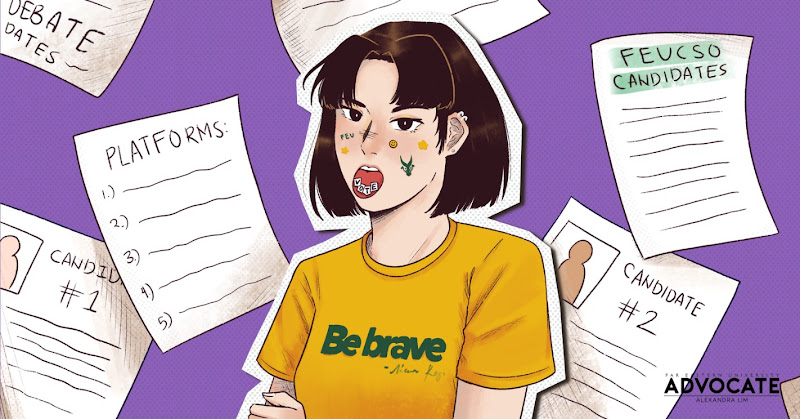
(Illustration by Alexandra Lim/FEU Advocate)