
SC urged to reject P89.9B PhilHealth fund transfer
- February 07, 2025 20:31
FEU Advocate
March 03, 2026 19:45
By Eunhice Corpuz
A match made in heaven does not exist. It is a standard of perfection that leads couples to believe they are bound forever. When tensions start to rise and the path forward blurs, one starts to constantly wonder whether their partner was actually ‘the one’ intended by Cupid.
Don’t lose hope because of uncertainties, Tamaraws. This curated checklist of compatibility will try to help and provide answers as to whether you and your partner are indeed a mix-and-match of destiny.
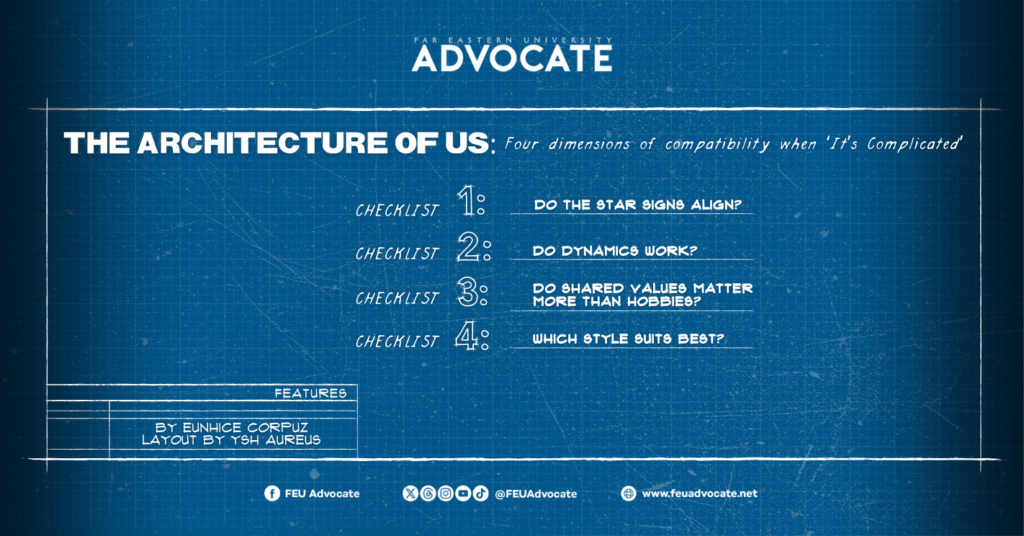
Checklist 1: Do the star signs align?
Before meeting the prospective partner, their zodiac sign has been background checked as if it were a mandatory credential. From the perspective of Generation Z, zodiac signs have been a primary metric of romantic viability, serving as a shorthand for emotional and social alignment.
Zodiac signs are structured around a quartet of elements: fire, water, air, and earth—each offering a distinct lens to discover personalities and explore modern dating. In the search for a destined match, many gravitate toward the friction of opposing forces. This concept posits that contrasting elements, such as fire and water, create a more dynamic tension compared to those similar signs that offer stability and comfort.
Further, it is no longer about the sign itself but the distinct energy that informs one’s personality. Consider a fire sign like Leo, for example; they radiate an innate confidence and a commanding, charismatic aura. Dating such an individual presents a unique set of challenges; as natural leaders, Leos often carry a dominant presence that requires a partner capable of navigating their high-wattage facade.
When one chooses to date a Leo, a water sign often emerges as the ideal counterpart. While water signs generally provide a nurturing contrast to fire, the Scorpio possesses a bold and fearless edge.
As the most fearless of the water signs, a Scorpio demands a partner with the emotional fortitude to match their own. It requires someone brave enough to anchor the relationship, creating a sanctuary where the Scorpio people feel safe to submerge into the profound depths of their own secrets.
Pairing a Scorpio with a Leo highlights the friction that occurs when two dominant personalities occupy the same space. Though they represent opposing elements, their shared trait of boldness creates a paradox: both are attracted to each other’s power, yet that same power often sparks a struggle for control.
In the end, why do students check birth charts? Perhaps the true test of destiny lies not in how perfectly two signs align, but in how successfully they clash. When two lovers persist despite a lack of elemental compatibility, they move beyond the fantasies of astrology and delve into the territory of genuine connections.
For them, the written ‘fate of the stars’ is a secondary concern, eclipsed by a lived reality that proves to be a choice made on earth rather than a gift granted by the constellations.
Checklist 2: Do dynamics work?
The transition from small interactions to having a long communication marks the beginning of a ‘getting-to-know-you’ process. As likes, dislikes, and personalities are unveiled, the focus shifts from physical attraction to relational viability.
This is where one starts to evaluate if the established chemistry can become a real-world deal. It is the pivotal stage at which the logic of the connection is tested before a new chapter is embraced.
One enduringly popular dynamic is the pairing of the celebrated athlete with the high-achieving scholar. It’s a classic blueprint of a ‘power couple.’ While on the surface they may seem like opposites, they actually mirror each other as they strive to excel within their respective fields.
Another dynamic is the birth order theory; the ‘eldest daughter-youngest son’ archetype explores the intersection of authority and ease. The eldest daughter is known for being the carrier of a lifetime of high expectations and self-reliance, which manifests as a facade of a dominant personality.
Meanwhile, the youngest son counterbalances this with a more carefree and intuitive approach. Thus, this dynamic hinges on whether the youngest can soften the iron heart of the eldest, allowing a more vulnerable connection to flourish.
However, this rom-com setup dynamic does not always work for everyone. When partners focus too heavily on fitting into societal norms, they risk prioritizing the aesthetic of the relationship over its substance.
Dynamics are structured and built during the getting-to-know-you phase, but shared experiences and personal revelations carry more weight than any societal norm or romantic cliché.
Checklist 3: Do shared values matter more than hobbies?
Beyond the steady rhythm of ‘good morning’ and ‘good night’ messages lies a deeper layer of discovery. As the surface-level conversations fade, the couple begins to uncover the intricate quirks and hobbies that define one another.
Many enduring connections find their footing in a shared mastery—a mutual interest where both partners excel and indulge. This common ground often serves as the foundation for a relationship built not just on words, but also on one shared passion.
Compatibility often manifests through shared micro-interests that facilitate easy engagement. When two people are ‘coffee enthusiasts,’ even if their orders differ—a caramel macchiato versus a Spanish latte—they possess a common language.
This shared framework allows them to transition seamlessly from lighthearted banter about roast profiles to deeper, more intimate conversations. In this dynamic, the niche interest functions as an icebreaker that gradually reveals the compatibility of their underlying thought processes.
Similarly, a shared field of study offers an immediate intellectual bond; when two people speak the same academic language, the barrier to entry is lowered, allowing a connection to be built on a foundation of mutual understanding and shared ambition.
Since the art of exchanging questions during review sessions has been the lovey-dovey time for both of them, they think that those hell weeks were bearable because they shared the same sufferings.
However, this seamless overlap of interests is not a universal requirement for a lasting connection. For many, love is found in the deliberate act of exploration rather than preexisting commonalities.
These partners thrive by stepping into each other's unfamiliar worlds; they find joy in the process of learning a partner’s quirks and hobbies, recognizing that the true bond lies not in the activity itself, but in the desire to understand what brings the other person happiness.
Sometimes, true compatibility does not require one to be a mirror image of their partner; rather, it is found in the meticulous study of their soul. It is the act of memorizing a partner’s vulnerabilities—their silences, their fears, and their hidden joys—that builds an unbreakable bond.
So, as long as two hearts beat in synchronicity, their differences do not become divisions; instead, they become the very bridges that allow a couple to navigate the steepest cliffs of conflict without falling apart.
Checklist 4: Which style suits best?
As a relationship deepens and the question of ‘labels’ arises, the focus inevitably shifts toward attachment styles. These blueprints of connection, rooted in the transition from childhood to adulthood, serve as the invisible framework of a couple’s dynamic.
The decision to date someone with an avoidant attachment style is often met with controversy. To many, the avoidant’s instinctual withdrawal feels like a deliberate act of selfishness—a self-preservation tactic that leaves their partner’s emotional needs neglected.
Conversely, others enter these relationships driven by the hope of ‘healing’ their partner through unconditional love. They believe that with enough patience, they can break through these defensive mechanisms, leading to a cycle of pursuit and withdrawal.
Moreover, the anxious-avoidant dynamic is a paradoxical match where contrasting fears collide. While both individuals may enter the relationship with the intent to work things out, their core wounds often prevent progress.
The anxious partner tends to overfunction, driving themselves toward emotional exhaustion to maintain the connection. While the avoidant partner ends up trapped in a pothole of persistent long-term self-sabotage, viewing intimacy as a threat to their autonomy rather than a source of comfort.
Others seek out a partner with a secure attachment style, assuming that stability is the simplest path to a healthy dynamic. However, these relationships can still falter due to profound internal conflict; the secure partner’s consistency can act as a mirror, exposing the other person’s deepest insecurities.
Faced with a healthy love they don’t feel they deserve, an individual may begin to resent their own perceived self-rejection reflex. Ultimately, they choose to leave, not because the partner is flawed, but because the stability makes them feel like a version of themselves they have grown to despise.
Attachment styles are a significant factor for a relationship to work, but sometimes learning the concept of compromise in a give-and-take relationship can also make things work. Crucially, intimacy should never demand that individuals diminish themselves to accommodate a partner.
Sometimes, true compatibility ensures that neither person feels ‘too much’ nor ‘too difficult,’ but rather, that they are consistently and profoundly enough exactly as they are.
As you close this checklist, Tams, does it bring you peace, or does it bring a truth that stings? Either way, the realization is yours to own. But let this stick with you: compatibility is a living reality and not a static score. Whether you ‘fit’ the criteria or defy them, never forget that no set of rules can tell you that your relationship isn’t ‘right’ if both of you are willing to choose each other. Only by then can one say that two people are a match made in heaven.
(Layout by Ysh Aureus/FEU Advocate)