Tamaraw GO: Discovering the Green and Golden creatures
- September 23, 2016 17:30
FEU Advocate
March 25, 2026 18:48
By Franzine Aaliyah B. Hicana
“Are you man enough?” It is a phrase often thrown around as a challenge that measures courage, strength, and confidence against a standard that has long been coded as ‘masculine.’ To be decisive is to be ‘man enough.’ To speak up is to be ‘man enough.’ To lead is to be ‘man enough.’
But when women embody these same traits, the rules shift.
The confidence that earns men respect can make women seem abrasive, and the assertiveness that signals leadership can be mistaken for arrogance. What is praised in men is often questioned in women, revealing how strength, even today, is still judged through a gendered lens.
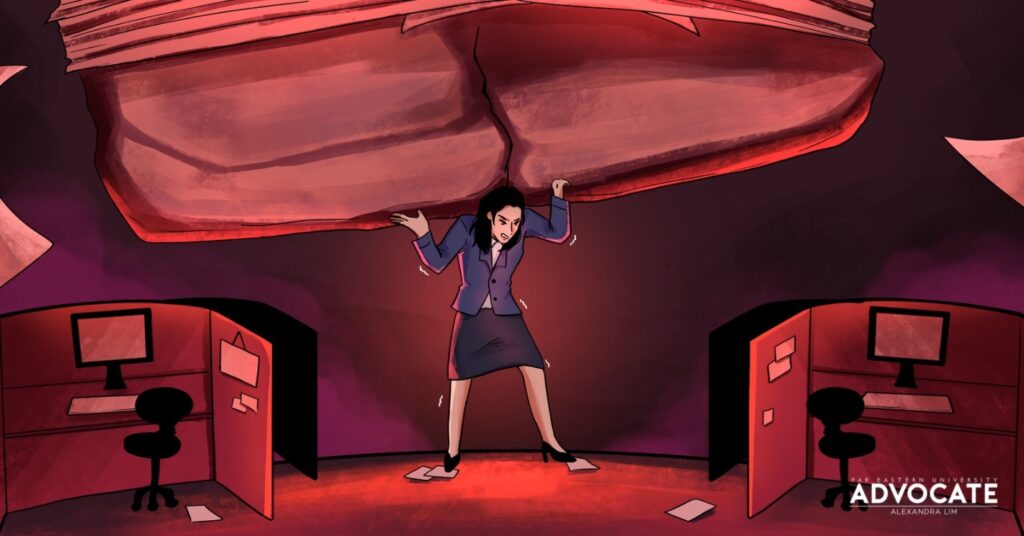
In classrooms, meeting rooms, and everyday conversations, women are constantly navigating an invisible test.
Speak too softly, and they risk being overlooked. Speak too firmly, and they are labeled as intimidating. Lead a group project, assert an opinion, or question a decision, and suddenly the burden of proof becomes heavier, as if competence alone is not enough without first proving they can carry themselves with the same toughness often reserved for men.
Strength, after all, has rarely been seen as neutral.
For generations, society has packaged traits like confidence, resilience, and authority under the label of masculinity, suggesting that to be taken seriously, women must first prove they are ‘man enough.’
The irony, of course, is that the very qualities women are pressured to adopt were never inherently masculine to begin with.
Tough it out, girl!
When endurance is valued over vulnerability, women are often pressured to keep going despite pain, fatigue, or stress instead of reaching out for support.
For Marianne Steffany Capulong, a second-year Bachelor of Science (BS) in Nursing student, this reality became clearer as she stepped into the clinical setting and began studying women’s health.
What she once understood as strength gradually revealed a more complicated side, one where resilience can sometimes mask neglected health needs.
“Societal expectations often portray women as naturally strong and capable of enduring many things. But sometimes that expectation makes women neglect their own health. Many women are taught to keep going despite exhaustion, pain, or stress because they feel responsible for others first,” Capulong explained.
In hospitals and classrooms, Capulong began to see how deeply embedded this mindset is in healthcare experiences. Strength, she realized, is often interpreted as silence, especially when women feel pressured to minimize their discomfort.
Through her training, Capulong learned that womanhood is far more complex than the narrow roles often assigned to it. Caring for patients and witnessing real-life struggles revealed that compassion and resilience often exist side by side with vulnerability.
“Being a nursing student has shaped me deeply. Caring for patients, studying women’s health, and seeing real-life struggles in clinical settings made me realize that womanhood is not just about softness—it’s about strength, endurance, and compassion,” she shared.
Yet the expectation to endure can come at a cost.
Women’s health concerns, Capulong noted, are sometimes dismissed or simplified in ways that prevent proper care.
“There are moments when women’s concerns are brushed off as ‘just stress,’ ‘just hormones,’ or something emotional rather than something that deserves proper attention. Sometimes, this happens because of stereotypes that portray women as overly sensitive or dramatic about pain,” the nursing student said.
Such dismissals reflect a broader issue in healthcare: the tendency to underestimate women’s symptoms or frame them through emotional explanations rather than medical ones. For many women, this results in delayed diagnoses, overlooked symptoms, or hesitation to seek help at all.
Capulong believes cultural expectations also play a role. Women are often encouraged to embody patience, sacrifice, and resilience—qualities that, while admirable, can create pressure to endure suffering quietly.
“Some women may feel that expressing discomfort makes them appear weak or incapable. This can affect how openly women talk about their health and how quickly they seek help,” the student nurse said.
Even in her own life, she saw how this quiet endurance unfolds.
At home, she watches her mother navigate daily responsibilities with relentless dedication, often without recognition.
“I saw resilience, sacrifice, and unwavering dedication even when no one was applauding. Through her, I learned that womanhood is not a weakness. It is endurance. It is courage. It is showing up every single day despite exhaustion,” she shared.
But Capulong now believes that redefining strength is essential not only for women themselves, but also for the healthcare systems that serve them.
“True strength should also include recognizing when we need care and support. Taking care of one’s health should not be seen as [a] weakness, but as an important form of self-respect and responsibility,” the sophomore emphasized.
As a future healthcare professional, she also sees the need for more open conversations around women’s well-being—topics that often remain uncomfortable or overlooked.
“Mental health, reproductive health, and the everyday struggles women face balancing responsibilities are still difficult to talk about openly. Many women carry emotional, physical, and societal pressures that are not always acknowledged,” the nursing student asserted.
For Capulong, improving women’s healthcare goes beyond clinical treatment. It requires listening more closely, validating experiences, and creating spaces where women feel safe expressing their concerns.
“Communities and institutions need to promote more awareness, education, and empathy when it comes to women’s health. Women should feel heard, respected, and supported when they speak about their concerns,” she stated.
Ultimately, her reflections highlight a significant issue: strength should not be measured by how much pain women can endure alone.
Sometimes, the most powerful act of resilience is choosing not to tough it out, but to seek care instead.
Suck it up, girl!
Strength is often framed as something women must constantly prove. But for some, the real challenge is not proving strength—it is redefining what it means in the first place.
For Alessandra Jose, a third-year political science student, the phrase “Are you man enough?” raises more questions than answers. Instead of accepting the challenge embedded in the words, she finds herself questioning the assumptions behind them.
“When I hear the phrase, my thought response is to ask, ‘What made a person think that questioning this would describe a person?’ ‘Why would one question be perceived as a definition of worth, bravery, or character?’” she said.
To Jose, the phrase reflects a deeper societal habit of measuring courage and resilience through gendered expectations. The idea that strength belongs to men—and that others must prove themselves against that standard—ignores the reality that bravery exists across all identities.
“It saddens me that our society tries to describe individuals by classifications, roles, or assumptions, particularly linking courage to only men. But strength is not owned by a sole gender—it is found in both men and women,” she stated.
Her reflections come from experiences that many women recognize: the persistent scrutiny placed on their choices, appearances, and personal lives. Sometimes, these expectations appear in ways that seem harmless on the surface but carry heavier implications beneath.
“‘Bakit wala ka pang boyfriend? Tatanda kang dalaga niyan.’ ‘Bakit ganiyan ka manamit?’ It looks light, but it is heavy inside. It is disguised as a joke, but it is embedded with certain expectations,” she admitted.
While such remarks may be brushed off as casual comments or family banter, Jose describes them as moments where her identity as a woman felt measured against standards she never chose.
“Those words are not just about clothing or dating. They reinforce my worth as a woman,” Jose admitted.
For a time, she adjusted herself to avoid criticism, allowing others’ expectations to shape how she presented herself. But over time, that constant adjustment became suffocating.
That realization eventually became a turning point. Rather than continuing to conform to external expectations, Alessandra began to reclaim the choices that defined her sense of identity.
“I started to stand firm by my principles and declare my own sense of worth, even when it does not reach others’ conformity. I am not yours to judge. I am not yours to shape. I am mine—fully, fiercely, unapologetically,” she declared.
Through those experiences, her understanding of strength began to shift. Instead of seeing it as the absence of vulnerability or doubt, she came to view strength as something rooted in authenticity and conviction.
For her, being ‘enough’ means presenting oneself genuinely—staying true to one’s core principles and choices. These experiences have also shaped how she approaches leadership and self-expression, choosing to lead with honesty and intention rather than conforming to expectations of how women should act.
“Being sexualized or judged for how I express myself made me face whose approval I was seeking. I learned to make and show ideas rooted in my values, not in the way others objectify me,” the political science student said.
In environments that still favor traditional images of authority, Jose believes strength does not have to look rigid or unshakable. Instead, it can appear in the courage to speak up—even when doing so feels uncomfortable.
“Strength, to me, is having a voice that defends what’s right even when it shakes,” she said.
Her reflections echo a reality that many women experience: strength is not always loud or dramatic, but found in choosing authenticity, standing by one’s values, and refusing to let outside expectations define one’s worth.
For women who still question whether they are ‘enough,’ she offers a reminder: every time they reclaim their choices, assert their voice, or hold their ground in a world that questions them, they are quietly, profoundly enough.
Chin up, girl!
Strength often starts as a lesson whispered early, shaping how a person carries themselves in spaces that expect them to shrink.
Winona Shelley Caudilla, a second-year political science student, recalls one phrase from her childhood that stuck:
“Never let anyone make you small in every way. My mom said back then [that] if I don’t speak up for myself, who would?” she recalled.
That lesson became her compass, guiding her through moments where society tried to define how a woman should act.
For Caudilla, being ‘man enough’ isn’t about toughness defined by others; it’s about standing firm in your own voice.
“Failures and heartbreak are part of the process, but you shouldn’t stay in that place. If you dwell on it too much, you won’t move toward where you’re supposed to go,” she reflected.
Growth, she realized, comes from challenges, not avoidance.
College reshaped her understanding of leadership, moving away from the shallow fixation on dominance some still mistake for strength, and toward responsibility, empathy, and collective growth.
“In collaborative work, it shouldn’t be led by one person only. It should be a group of ideas that result in a bigger output,” Caudilla said.
She learned to trust others, guide when necessary, and lead without needing to control everything.
Caudilla emphasized that confidence is not about showing off—it is about believing in yourself enough for others to notice. Though self-doubt still surfaces, she reflects on her past to recognize growth and identify both strengths and areas to improve.
Raised in a family with traditional expectations that women should be quiet, conservative, and deferential to men, she learned to resist those expectations and assert her own path.
“I stood my ground to show my little cousins that I am not a doll that is dressed up and played in the role the owner wants, I am a woman who is fearless, outspoken, brave, outgoing, and liberated,” she asserted.
For her, empowerment begins within.
“Confidence takes you anywhere. Empowerment shouldn’t just focus on other people—it should start within ourselves so we can empower others too,” Caudilla said.
She also questions the idea that motherhood should define a woman, noting that women have their own dreams, ambitions, and passions to protect and pursue.
“Women have dreams, ambitions, minds, and souls that they want to protect and develop,” she noted.
Stand tall, girl!
Strength has too often been framed as a standard set for men, as if courage, leadership, and resilience are theirs to own first.
Yet in reality, these qualities are human—and women claim them every day, in classrooms, homes, and workplaces, often without recognition. True strength shows up in standing firm in one’s voice, making choices with integrity, and pursuing a path defined by self, not by others’ expectations.
Confidence, leadership, and resilience are not borrowed from masculinity; they are lived in the decisions, the boundaries set, and the courage to grow despite doubt or judgment.
To move through the world with conviction, to insist on being seen and heard, and to honor one’s own values is a demonstration of strength that needs no comparison.
The question “Are you man enough?” has long suggested that courage and leadership belong to men. But women have never needed permission to be enough. Strength has always lived in their choices, their voices, and the paths they carve—without ever having to measure themselves against anyone else.
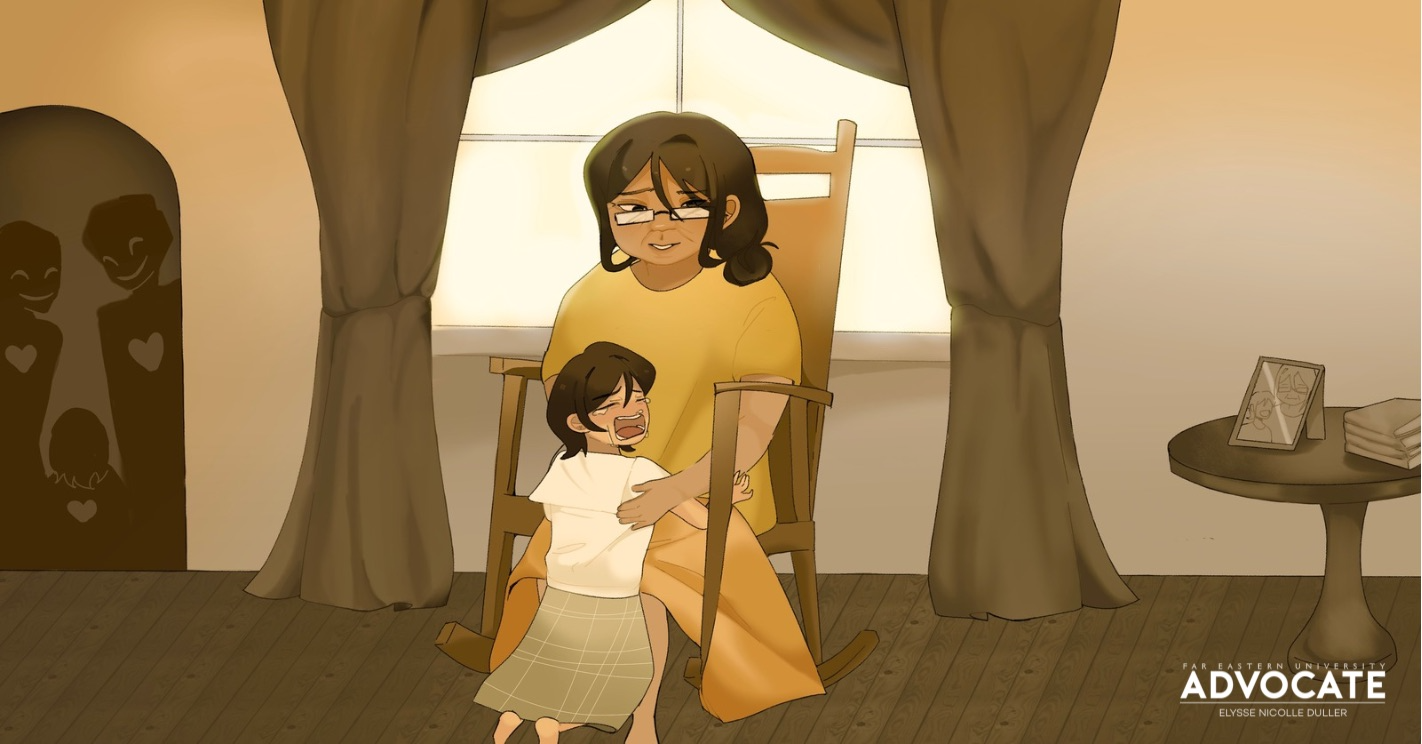
(Illustration by Alexandra Lim/FEU Advocate)