Faces against corruption, impunity, and dynasties
- November 15, 2025 17:20
FEU Advocate
February 12, 2026 21:25
By Crystal Soriano
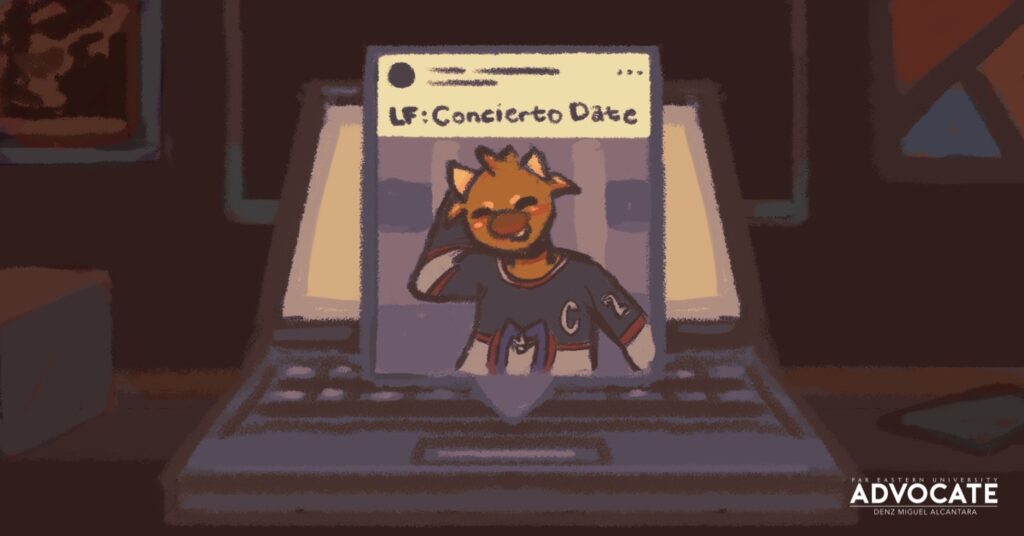
‘LF Concierto date’
Pros:
- Likes Coffee
- Approachable
- Can go with you on Valentines
Cons:
- Has avoidant attachment
- Easily irritated
Every year, these posts surface as Concierto draws closer—some looking for someone to be with just for the night, others hoping to find a connection that lasts beyond the event. With Concierto falling on February 13, just a day before Valentine’s Day, single students often feel mounting pressure—not because they’re excluded from celebrating, but the weight of expectations—from social media, peers, and even oneself—can feel overwhelming.
For single students, Valentine’s Day has become less about romance itself and more about how visible one’s relationship status has become.
The pressure does not always come directly from peers, but from an environment saturated with curated couplehood—online and offline. Scrolling through social media during this time can feel less like a celebration and more of a reminder of what they do not have.
Valentine’s Day largely centers on couples, branding February as the month of love and turning loneliness into something that feels inevitable rather than a personal choice—not because being single is inherently painful, but because the cultural narrative surrounding the day makes romance seem like the default. In moments like these, isolation can feel like an attack, and having someone or anyone to share the experience with suddenly feels essential.
Loneliness, in this sense, is not always about being physically alone.
It is about navigating a culture that still treats romantic relationships as milestones of fulfillment. Valentine’s Day magnifies this narrative, turning personal timelines into public spectacles.
For students juggling academics, family expectations, and personal growth, the added emotional weight can feel especially heavy.
It is within this context that many students navigate the Valentine’s-Concierto season in their own ways. In an online interview with FEU Advocate, Oscar Antonio Umali, a first-year Bachelor of Fine Arts (BFA) major in Studio Arts student, has faced the familiar question of whether to find a date just to avoid being alone at the event.
Instead, he chose to approach it lightly—posting about it online as a playful experiment rather than a serious search, gauge his own expectations, and momentarily join the conversation surrounding the Valentine’s season without fully surrendering to its pressure.
“To be honest, yes. I feel tempted [to look for a date] especially because I'm single right now,” Umali admitted.
The student asked a friend to post a “looking for Concierto date” entry on his behalf as a way to join what he saw as an emerging campus trend, rather than as a serious pursuit of romance.
“I asked my friend to post it because I saw it as a trend, like [in] TatakTams [Tatak Tamaraw]. The intention was somewhere between genuinely looking for a date and simply going along with the trend,” he stated.
The pressure, however, does not come from romance alone, but from the expectation that Valentine’s Day must be experienced with someone romantically. This mindset often frames being single as a lack rather than a choice.
That perspective began to shift as Umali reflected on who he already had around him.
“But realizing it right now, I won’t be lonely on February 13 and 14 because I have my friends to spend the day with,” he shared.
His realization highlights how companionship does not have to follow a romantic expectation to feel meaningful. In choosing to spend Valentine’s Day with friends, loneliness becomes less of a threat and more of a misconception.
As a freshman, Umali’s anticipation for the day of hearts is also shaped by participation rather than expectation.
“What I’m really looking forward to on Valentine’s Day or Concierto itself are the performers and events. Since I’m a freshman, I want to join those or watch them to make my first year more memorable,” the fine arts student asserted.
For him, the celebration is not centered on coupling but on being present during campus events that mark the beginning of his college life.
Umali also points to how the celebration can affect students on a personal level. He notes that the widespread belief that the occasion should be spent with a romantic partner can influence self-perception, creating an unspoken pressure to meet expectations that are not always one’s own.
Despite this, Umali does not see being single as a setback. He emphasizes that Valentine’s Day can celebrate love in many forms.
“For me kasi, Valentine’s Day is a day that celebrates love in general, so we can spend the time with our families and especially our friends,” the interviewee stated.
In choosing friendship and shared experiences over romantic obligation, Umali’s perspective offers a broader understanding of love—one that exists beyond couples and thrives in community. For many students, Valentine’s Day becomes not a reminder of what is missing but an opportunity to celebrate the connections that are already present.
Within this atmosphere, some students are beginning to reframe what the season means for them—not as a test of romantic success, but as a space for connection in different forms.
Second-year visual communication student Ayessa Ramilo reasoned that she posted a ‘looking for Concierto date’ entry for her friend, Umali, largely for support and having fun.
“I honestly don't care about what people think, I posted it because my friend asked me to and I'm very much cooperative and I support him in every kalandian moment that he has. It all comes to the experiences that they had, and as for me and my friend, it's our first time to post, so we're just there to vibe and be silly,” she expressed.
For Ramilo, the Valentine’s season still brings a mix of contentment and fleeting envy—emotions she has learned to sit with rather than suppress.
“I can say that the peace of mind that I’ve acquired is really strong,” she conveyed.
However, this sense of peace does not mean the absence of longing. Ramilo acknowledges that jealousy still slips in, particularly when confronted with public displays of romance that dominate the season.
“Sometimes you can’t help but think, aww, I wish someone would do this or that for me,” Ramilo narrated.
Instead of letting those feelings linger, she chooses to redirect her attention, finding genuine joy in watching others search for connection and take chances on love.
Beyond the playful aspect, Ramilo sees these posts as more than just pre-event banter. In a digital space where couples often dominate Valentine’s narratives, seeing single students openly acknowledge their status offers her relief.
“It lets people know that being single is experienced by everyone—not just them,” she expressed.
In this way, the One Piyu Community becomes more than a platform for pairing; it transforms into a space where solitude is normalized rather than stigmatized, easing the loneliness that many feel but rarely articulate.
Rather than viewing singlehood as something to endure, Ramilo treats it as a learning space. Each situation, she believes, shapes her understanding of love and relationships.
“I feel like every scenario I’m in gives me perspective. It helps me become a better and wiser person—both as a lover and as an individual,” she explained.
For Ramilo, love is not something she actively searches for but something she helps make space for—sometimes by playing Cupid for the people around her. By posting a ‘looking for Concierto date’ entry on behalf of a friend, she treats the act less as a serious pursuit of romance and more as a lighthearted gesture of support.
Rather than framing relationships as measures of fulfillment, she views these moments as shared experiences meant to be enjoyed, learned from, and laughed about.
At this stage in her life, Ramilo grounds her sense of fulfillment in self-awareness and self-support, values she admits she once overlooked. Helping a friend put themselves out there becomes part of that growth—not a reflection of her own longing, but a reminder that love can also show up as encouragement, companionship, and the willingness to cheer others on from the sidelines.
In a season that often measures happiness through romantic pairing, fulfillment can exist in growth, reflection, and choosing oneself—long before the right person arrives.
Beyond self-love and friendship, Valentine’s season also brings forward another quiet longing: the desire to be seen.
For some students, posting about looking for a Valentine’s or Concierto date is less about romance and more about testing whether there is space for them in a culture that often equates desirability with worth.
For Gabriel Francis Garcia, a second-year BFA Visual Communication student, that decision was shaped by uncertainty rather than confidence.
“It’s a mix of everything, I went into it expecting at least one encounter [of a possible partner] but also tried to not give it too much importance,” Garcia shared.
His approach reflects the careful balance many students adopt during Valentine’s season: allowing themselves to hope while trying not to be consumed by expectation.
Underlying that decision was a need for acknowledgment.
“There’s also a sense of validation that one gets from feeling seen, and I guess that contributed to the creation of the post. I was naturally anxious,” the visual communication student asserted.
In a digital environment where attention often signals worth, Valentine’s Day amplifies the pressure to be seen. Posting becomes a way to step into visibility during a season that celebrates connection—even if that visibility comes with discomfort. For Garcia, the post is a tentative return to dating after a long pause, prompted by a holiday that makes being alone feel louder than usual.
“Also, I haven’t dated in a while, so it was nice to put myself out there, regardless of the outcome,” he shared.
That vulnerability came at a cost. By putting himself out there publicly, Garcia knew he was opening the door to scrutiny. Even before the post gained traction, he had already braced himself for judgment.
“Considering myself to not be conventionally attractive, I expected troll comments under the post and I was right to expect them,” he admitted.
Rather than seeing these responses as isolated incidents, he recognizes them as part of a larger pattern, reflecting broader societal notions of value and who is taken seriously in spaces dominated by conventional norms.
The desire to be seen, however, often exists alongside feelings of exclusion. Garcia admits that he sometimes feels left behind or out of place, particularly as a member of the LGBTQIA+ community, noting that heteronormative expectations can make dating feel easier for some.
“There’s a sense of wanting to feel seen and validated, but also, I could understand how seeing couples on campus spending time with each other may lead to feelings of frustration, bitterness, or insecurity,” he asserted.
For Garcia, posts searching for dates are not simply about finding someone to spend Valentine’s Day with.
They are about visibility, recognition, and the quiet hope of being acknowledged in spaces where not everyone is equally seen. In choosing vulnerability despite anxiety, his story underscores how, for some students, Valentine’s season becomes less about romance—and more about the courage it takes to show up.
It is not exclusively a celebration for couples. It highlights different ways love and connection can be experienced—whether embracing self-love, cherishing bonds with friends, or stepping into visibility despite anxiety—showing that fulfillment does not hinge on having a romantic partner.
Valentine’s Day becomes less about meeting societal expectations and more about honoring the relationships and growth already present in one’s life. Single or not, the celebration of February 14—and the surrounding Concierto events—can be an affirmation that love, in its myriad expressions, is for everyone.
(Illustration by Denz Miguel Alcantara/FEU Advocate)