Villanueva urges team to ‘stick to the plan’ after 18-point game vs DLSU
- November 16, 2025 15:53
FEU Advocate
March 08, 2026 20:46
By Jiann Delumen
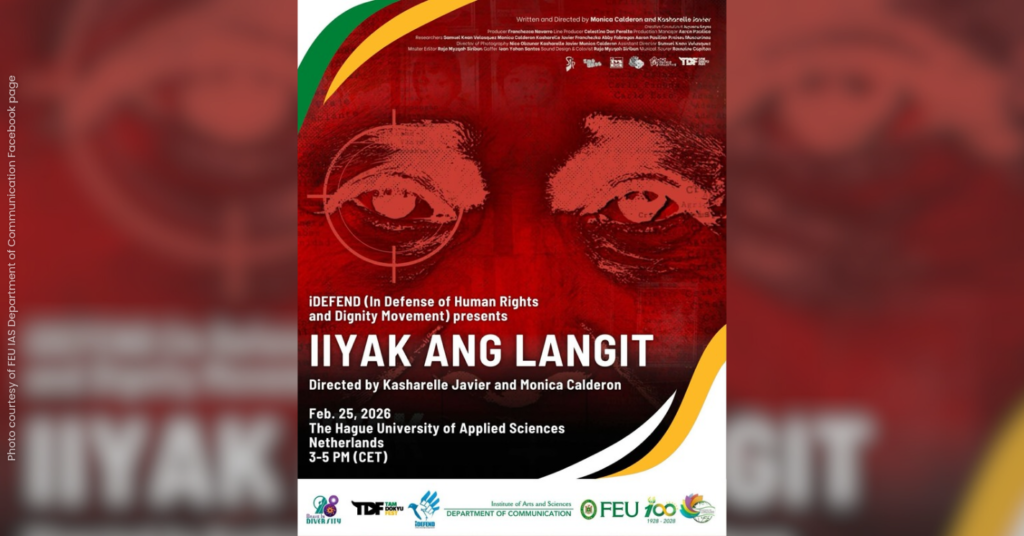
Far Eastern University (FEU) student filmmakers presented their documentary ‘Iiyak Ang Langit (Heaven Will Cry)’ in a special screening hosted by In Defense of Human Rights and Dignity Movement (iDEFEND) at The Hague University of Applied Sciences in the Netherlands last February 25.
The film follows Nanay Melinda, whose son Angelo was killed during the country’s ‘war on drugs’ campaign in 2016, situating her story within a life shaped by different forms of violence.
Through her work with the Silingan Candlemakers in Navotas City, she continues to keep his memory alive while honoring other victims.
Directed by communication students Kasharelle Javier and Monica Calderon, the documentary previously won Best Documentary and Best Director in the 2025 TAM DokyuFest.
In an online interview with FEU Advocate, both directors described the screening as a reminder that student films can carry stories beyond the classroom and into wider conversations about justice.
“I always remind myself that as a student filmmaker, I don’t create films or [documentaries] just to win awards, travel abroad, or enter festivals… We made this documentary for Nanay Melinda, her son Angelo, and all of the thousand lives stolen by Duterte,” Javier remarked.
She added that screening the film in The Hague placed the experiences of the victims’ families within a city closely associated with international justice and accountability.
Likewise, Calderon viewed the opportunity as both unexpected and significant, pointing to the city’s global association with international justice institutions.
“Honestly, sobrang surreal. The Hague is known globally for international justice, so the fact [that] a student documentary from FEU was screened there, especially in time with discussions related to the drug war, it felt very important and very timely,” she noted, adding that the screening allowed the film to enter a bigger global conversation about justice and accountability.
At the center of the film, the filmmakers stressed that the narrative intentionally foregrounds families most directly affected by the anti-drug campaign.
“Since tungkol sa war on drugs ‘yung documentary namin, we knew that we had to center the most affected people—mga pamilya na nasa urban poor, since sila ‘yung pinaka-apektado ng campaign na ito (Since our documentary is about the war on drugs, we knew we had to center the people most affected by it—the families in urban poor communities, because they were the ones who bore the brunt of the campaign)… We didn’t want to impose an external judgment; we wanted the audience to feel what it’s like to live through this, to see the human cost up close… We let the visuals carry the weight of the message,” Javier explained.
She added that for her, the documentary functions not only as storytelling but also as a record of lived experiences tied to the campaign.
“We don’t just create documentaries or films for awards. We create it for us to have an archive, to preserve memory, and of course, to use it as a form of resistance against [an] abusive system,” she emphasized.
Similarly, Calderon highlighted the role of documentation in preserving historical memory.
“When you document stories, you prevent them from being erased… I see this film bilang marka ng nakaraan—parang marka siya ng kung ano ‘yung nangyari at kung paano tayo dapat matuto from it (I see this film as a mark of the past—a reminder of what happened and something we should learn from),” she reflected.
Both filmmakers noted that producing the documentary changed how they approach storytelling, especially when representing the lives of people directly affected by violence.
“The biggest shift has been realizing the responsibility that comes with telling someone else’s story… Storytelling isn’t just about making something watchable anymore; it’s about creating space for empathy, reflection, conversation, and justice, lalo na kapag tungkol sa human rights ang ikinukuwento natin (especially when the stories we are telling are about human rights),” Javier shared.
According to the filmmakers, the opportunity to screen the documentary in The Hague came through their documentary adviser, who is part of iDEFEND’s Social Justice Campaign Working Group, allowing the film to be presented during activities related to ongoing discussions about the drug war.
The Hague is home to the International Criminal Court (ICC), where proceedings related to alleged crimes against humanity linked to the anti-drug campaign of former president Rodrigo Duterte continue to draw global attention.
Duterte was arrested in March 2025 under an ICC warrant tied to an investigation into thousands of killings associated with the campaign, which prosecutors argue may amount to crimes against humanity.
Most recently, a confirmation of charges hearing held in late February 2026 examined evidence presented by prosecutors and the defense to determine whether the case against Duterte will move forward to trial.
Parallel activities in The Hague include iDEFEND representatives observing pre-trial chamber hearings and relaying updates to families participating in community watch events in the Philippines, as the coalition continues its documentation, legal advocacy, and human rights protection work.
(Photo courtesy of the FEU IAS Department of Communication Facebook page)