Women workers heighten demands for Menstrual Leave Act passage
- April 02, 2025 14:17
FEU Advocate
February 13, 2026 09:13
By Jiann Delumen
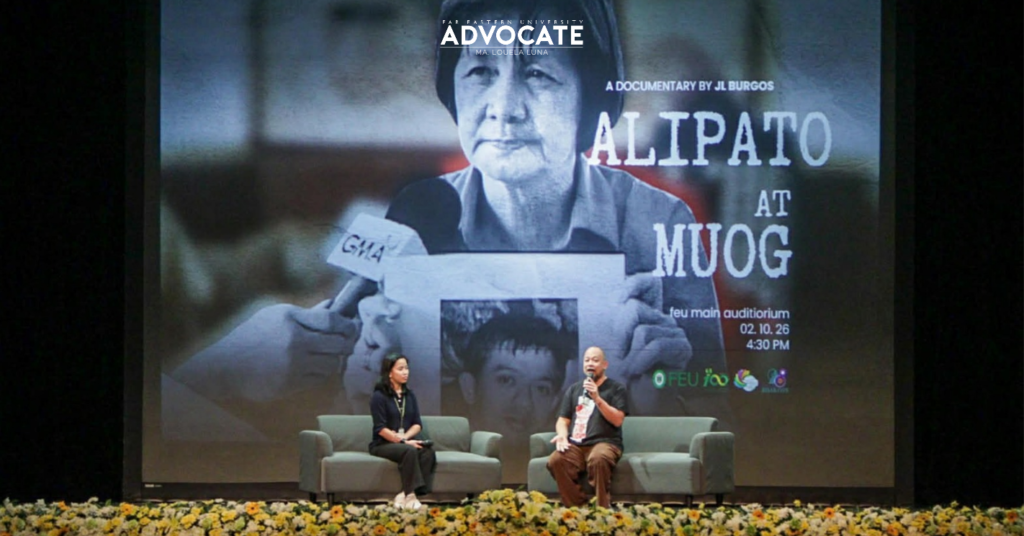
Cinemalaya 2024 entry ‘Alipato at Muog’ director JL Burgos called on students to root themselves in knowledge and collective effort on enforced disappearances, freedom of expression, and documentary cinema during the film’s post-screening talkback session at the Far Eastern University (FEU) Main Auditorium last February 10.
Alipato at Muog explores the unresolved case of activist Jonas Burgos, the brother of the film’s director, who was active in the peasant movement of the Philippines as a member of a peasant alliance in Bulacan to advocate for farmers’ rights and land reform.
He was allegedly abducted on April 28, 2007 in Quezon City by suspected military personnel and has not been seen since.
During the exchange, Burgos mapped out a sequence that advances from awareness to participation and collective presence, positioning engagement as a shared duty rather than a space exclusive to creatives.
“Hindi necessary [na] filmmaker… [o] artist kayo… Kailangan ninyo lang ng kaalaman… Kapag mayroon na kayong kaalaman [sa lipunan]… puwede na kayong mag-post, ikuwento ninyo sa mga kaibigan ninyo… We [need to] talk to like-minded people… [kasi] kapag marami tayo, mas ligtas… at kapag marami na tayo, kaya na nating baguhin ang lipunan (You don’t need to be a filmmaker or an artist. You only need knowledge. Once you know our society, you can start posting and sharing it with your friends. We need to talk to like-minded people, because when there are many of us, we are safer, and when there are enough of us, we can change society),” he stressed.
Moreover, Burgos traced the film’s release to a widening gap between younger generations and the history of enforced disappearances, pointing out that unfamiliarity among younger activists highlighted the urgency of recording and transmitting these narratives.
“Mayroon kasing mas batang aktibista kaysa sa’kin, kausap ko siya… pero hindi niya alam ‘yung case ni Jonas… heartbroken ako kasi responsibility ng family [namin] na mapakilala [sa kanila] kung sino si Jonas, kung ano ‘yung kaso ng mga desaparecidos… simula noon, [naisip ko na] kailangan ko na ‘tong gawin (I was talking to an activist younger than me and he did not know Jonas’ case. I was heartbroken because it is the responsibility of our family to introduce who Jonas is and what the cases of the disappeared are. From that moment, I realized I needed to do this),” the director recalled.
Burgos anchored this pathway on his family’s experience, conveying that speaking publicly often arises from obligation and care rather than from calculated bravery.
“Madalas na sinasabi ng nanay ko: ‘hindi naman ‘yan tapang—pagmamahal ‘yun…’ Kapatid ko si Jonas… wala kang choice kung hindi magsalita… Kailangan mo [lang] munang ihanda ang sarili mo… at eventually, ‘yung tapang ay darating dahil kailangan mong ikuwento ‘yung mga ganoong klaseng kuwento (My mother often says that it is not courage—it is love. Jonas is my brother; you don’t really have a choice but to speak out. You just need to prepare yourself, and eventually, courage will come, because you need to tell these kinds of stories),” he shared.
The filmmaker also detailed the obstacles he encountered during production, citing chronic funding limitations and minimal institutional backing for filmmakers in the Philippines, conditions that often constrain independent projects dealing with politically sensitive material.
Outside the production process, the documentary attracted official scrutiny after referencing former military intelligence chief, now National Security Adviser, Eduardo Año, which prompted a public response from National Security Council spokesperson Jonathan Malaya during early screenings.
According to Burgos, these developments preceded regulatory intervention by the Movie and Television Review and Classification Board (MTRCB), which flagged animated torture sequences as ‘too graphic,’ characterized portions of the documentary as politically partisan, and imposed an ‘X’ classification on August 22, 2024, effectively halting its commercial exhibition for allegedly eroding public confidence in government.
In response, the filmmakers lodged a formal appeal that summarized reviewers’ concerns regarding the film’s treatment of a case still pending before the courts and the need for additional contextual framing.
“There is nothing subversive about a family’s search for justice. Alipato at Muog is a stand against enforced disappearance and human rights violation… there is no subversion law in the Philippines,” the letter stated, addressing allegations of subversiveness.
After public pushback from artists, human rights advocates, and cultural workers, the MTRCB lifted the film’s X rating—previously barring it from public exhibition—and reclassified it as R-16 on September 5, 2024.
It later screened at the 20th Cinemalaya Philippine Independent Film Festival, earning the Special Jury Prize, and went on to receive six nominations at the 73rd FAMAS Awards—winning Best Picture and Best Director for JL Burgos—before being awarded Best Editing, Best Documentary, and Best Film at the 48th Gawad Urian Awards in 2025.
Across the Philippines, human rights alliance Karapatan has documented 1,918 desaparecidos since the Marcos Sr. dictatorship, with additional cases recorded across successive administrations, including at least 18 reported under the Marcos Jr. presidency since July 2022 and around 30 individuals who were abducted and later resurfaced dead or alive.
Under international law, enforced disappearance refers to the arrest, detention, or abduction of a person by state agents or actors acting with state consent, followed by the denial of the act or concealment of the individual’s fate or whereabouts, effectively removing them from legal protection.
FEU Department of Communication mounted the screening and discussion as part of its program to immerse students in socially grounded Philippine cinema through campus-based dialogue.
(Photo by Ma. Louela Luna/FEU Advocate)