13th Sinepiyu Film Festival: The Last Call
- July 19, 2021 11:01
FEU Advocate
February 28, 2026 12:50

By Sean Clifford M. Malinao
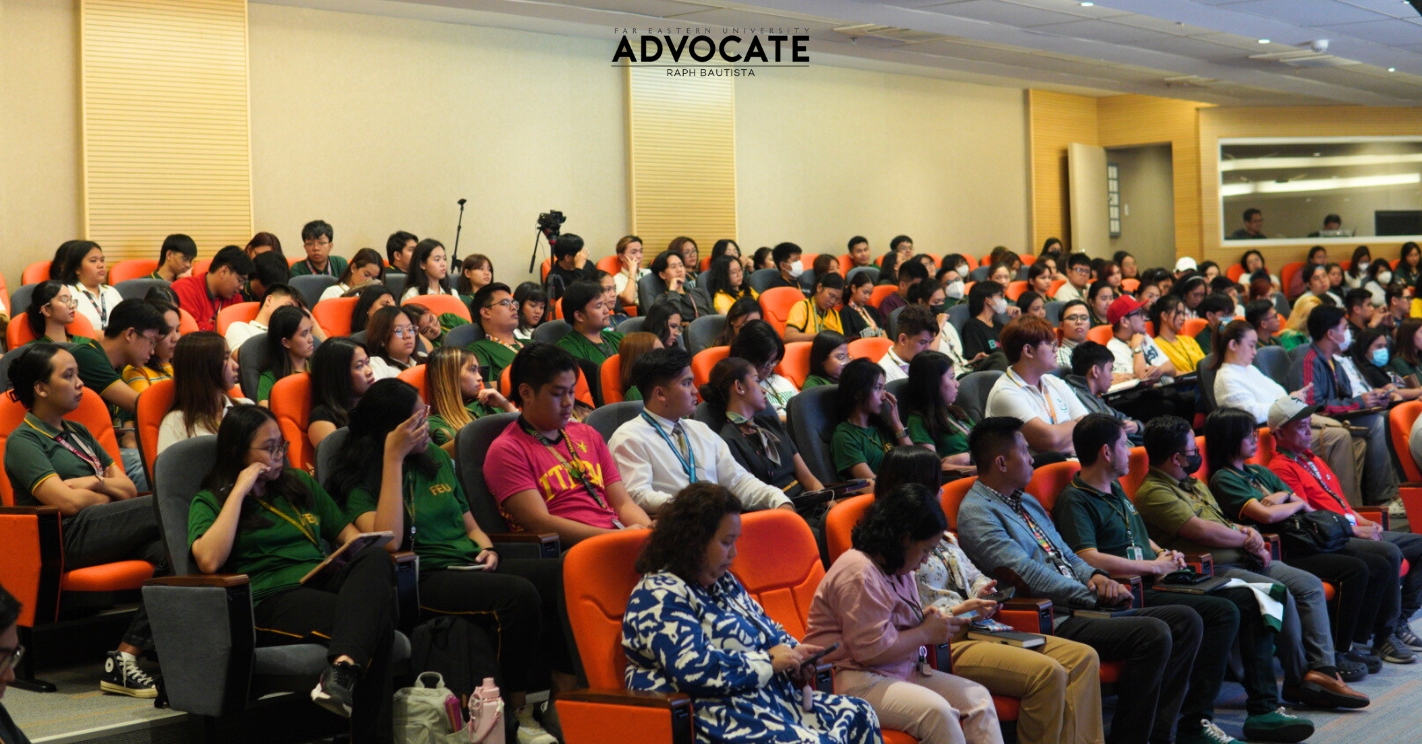
Speakers urged students to demand accountability and organize collective action against corruption during the forum ‘TAMA NA: Resibo, Hindi Perwisyo! — A Forum on Accountability and Good Governance’ held at the FEUture Center Auditorium last February 24.
“There is a need to change the system, dapat mabago ang sistema na kasama ang mga kabataan dahil kayo ang pag-asa ng bayan (We need to change the system, and that includes the youth as the catalyst of tomorrow),” said former Gabriela Women’s Party Representative Emmi de Jesus in her lecture.
The former representative then cited concerns over the current Ferdinand Marcos Jr. administration in the continuation of neoliberal policies, which have deepened economic vulnerabilities, pointing to ballooning national debt projections, issues of insertion and corruption in public services such as education, health, and flood control programs.
De Jesus also flagged the pervasive issue of political dynasties, which remains a key barrier to reform, stressing the need for systemic change through strong youth participation.
Additionally, the former representative underscored how programs meant to address social issues remain temporary fixes rather than long-term solutions, with significant portions of government budgets reportedly susceptible to corruption.
“Walang mali na tulungan ang mga mahihirap, pero kung ‘yung buong programa mo ay nasa balangkas na ng band-aid solutions, nakakabahala lalo [na’t] malaki ang nakalaan na pondo (There is nothing wrong with helping the poor, but if the whole program only serves as band-aid solutions, it becomes concerning that it accumulates too much in our national budget),” she stated.
Moreover, FEU Department of Political Science Faculty Dr. Amr Solon Sison emphasized the critical role of universities in shaping civic consciousness among students. He noted that universities remain ambiguous spaces as they risk becoming exclusive due to knowledge and research remaining within the institution.
“The quality of good [governance] is actually connected to universities that function as formal institutions that shape narratives, values, and actions within the society,” he stressed.
The professor further critiqued how universities often fail to encourage students to act as bridges for those who are unable to access education; instead, they foster a sense of elitism that distances graduates from the communities they should serve.
“The metrics that are set in universities further exacerbate the issue of exclusivity, publish ka nang publish [ng journals], sinong nagbabasa? Kami-kami lang (you continuously publish journals, but who’s reading it? Only a few),” he said.
In line with this, Sison encouraged institutions to move beyond producing research and publication for prestige alone and instead engage with the communities that they write about.
As for the role of religious sectors in the fight against corruption, National Council of Churches in the Philippines Deputy General Secretary Mervin Sol Toquero asserted that faith and compassion should go beyond the church to improve the lives of the people, especially the marginalized.
“Para mapangalagaan ang wangis ng Diyos na nakikita sa bawat isa, kailangan lumabas sa simbahan at tumulong sa pagpapaganda ng buhay ng mamamayan (To protect the image of the Lord that we see in everyone, there is a need for the Church to go outside and extend help to improve the life of the people),” he emphasized.
Furthermore, Main Convenor of Youth for Justice and Peace Kyla Sofia Benedicto discussed the nature of activism and the capacity of youth to spark the fight against persistent injustice in our country.
“Ang activism, kung antithesis siya, ay pino-promote nito ang collective action (Activism, as an antithesis, promotes collective action),” she said, citing cases of red-tagging in various universities.
Benedicto also highlighted that the idealism of youth is not wrong because it is rooted in their lived realities. She also encouraged the youth to take the more uncompromising road against the imperialist system that controls the government today.
“Antithesis tayo [kabataan] ng system, hindi lang tayo product ng system o mundo (We, the youth, are the antithesis of the current system, we are not just products of the system we live in),” she added.
Along with this, she also noted that the youth alone is not enough to change society, stressing the need to organize with different societal sectors to awaken sociopolitical consciousness.
The forum was spearheaded by the FEU Political Science Society in partnership with the FEU Department of Political Science.
(Photo by Nica Vargas/FEU Advocate)