Tigil-pasada, kinasa kontra sa pagpatuloy ni BBM ng PUVMP
- August 14, 2024 21:30
FEU Advocate
March 16, 2026 19:58
By Franzine Aaliyah B. Hicana
It begins long before graduation, sometimes in the middle of senior high enrollment, sometimes in hushed conversations during college application season. A selection of courses opens for students, weighed, and rearranged. On one side are degrees that promise titles and board exams; on the other are programs often described as ‘passion’ or, worse, ‘sayang.’ Students learn early on that dreams, too, are subject to practicality.
In the Philippines, where professional licenses are framed as milestones and stability is treated as the ultimate goal, pursuing an arts-related course can feel like stepping into uncertainty. Medicine, engineering, accountancy, and education carry a certain assurance: clear career paths, recognizable success, answers ready for family gatherings.
The arts field, on the other hand, is often haunted by one lingering question: Will it be enough?
Over the years, this mindset has shaped how programs are valued within campuses and households alike. Non-board courses are labeled as less secure, less practical, sometimes even less serious. The stigma does not always appear as open criticism; it shows in raised eyebrows, in suggestions to do double degrees, and in the subtle pressure to turn talent into a hobby rather than a profession.
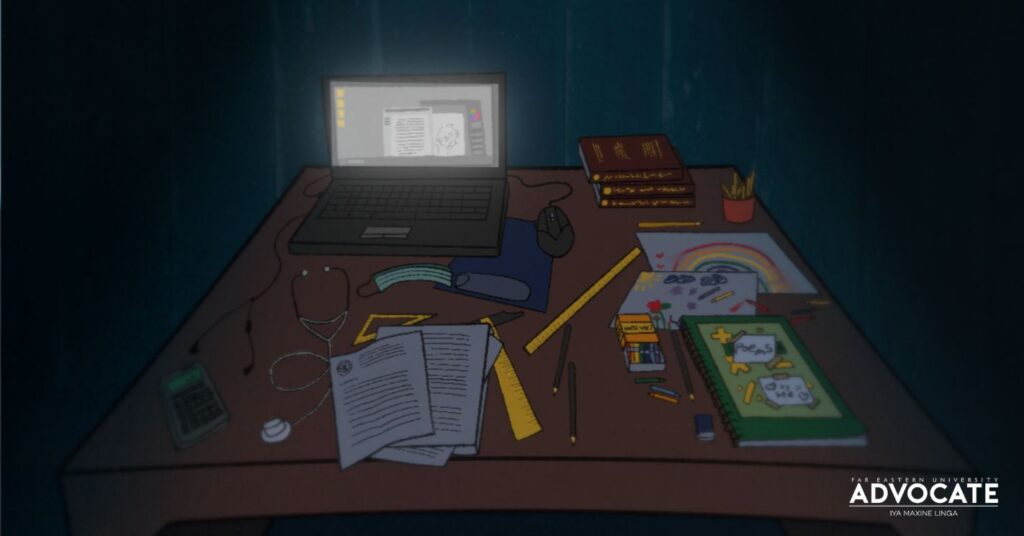
Despite these expectations, creativity does not simply vanish. It finds its way into organization posters designed between lectures, poems drafted after clinical duties, and theater rehearsals squeezed into already packed schedules. Even among students who chose the safer route, art lingers—not always as a career, but as something that refuses to be outgrown.
Navigating the middle ground
In an interview with FEU Advocate, Bachelor of Science (BS) in Nursing second-year student Francesca Ysabel Castro looked back on the first time she realized art was more than just a hobby.
“Lagi akong pinapakanta sa family gatherings noong bata ako. Doon ko unang na-realize na kaya ko pala (I was always asked to sing at family gatherings when I was a child. That’s where I first realized that I could actually do it),” she shared.
Over time, singing led to learning instruments, then to writing and filming. What affirmed her talent, she said, was not just the enjoyment but the encouragement she received.
“When people started praising me and urging me to join competitions or share my art, doon ko siya mas tinanggap (that’s where I really came to accept it) as something real,” Castro admitted.
Despite this, she chose to pursue nursing—a decision she admitted that did not feel easy at first.
“It felt like I was betraying a part of me that really yearns to perform and produce art,” she said.
With several realities to weigh in, the decision gradually leaned toward practicality. However, choosing a non-arts course did not equate to turning her back on creativity; instead, it meant redefining its place in her life.
Over time, she came to see that taking the more practical route did not have to come at the expense of her artistic side, and she can find ways to continue creating on her own terms.
When asked whether she would choose differently if given the chance, Castro responded thoughtfully.
“If I had the resources, the time, and the privilege, I would have definitely chosen differently. But I don’t regret my decision. I still would’ve chosen my course today. I feel more inclined to have a practical skill or job that would sustain my true passions in the real world,” the student nurse asserted.
Despite the heavy demands of the nursing program, she still finds ways to keep her creativity alive. Singing and playing instruments at home, joining competitions when possible, and sharing her work online have become part of how she stays connected to art. Even casual projects serve as a personal outlet, while she also makes it a point to support peers who are pursuing the arts professionally.
However, balancing both spheres comes with challenges. As a nursing student, she admits that her schedule often leaves little room for creative immersion.
“My course takes up most of my time. Sometimes, I don’t even have an ounce of free time to sit and immerse myself in my artistic expressions. I use most of my brain power to memorize modules and review lectures, so I rarely get creative enough to make art,” Castro admitted.
In those moments, she said she has to consciously remind herself not to be numb and too detached from the things she truly lives for. To manage the tension between passion and stability, Castro sets clear boundaries.
“I tell myself that I can choose both in the future, but I need to have a job to ensure [a] stable income first,” she explained.
While she remains open to monetizing her talents, she believes that it is more sustainable to have her practical career support her passions, rather than the other way around.
Castro also acknowledged the broader societal perception of arts careers in the Philippines.
“I think careers in the arts are looked down upon quite a lot,” she said, attributing this to older generational beliefs that there is ‘no future’ in the field.
While she recognizes that the arts can be highly competitive, she noted that social media and the commercialization of creative work may gradually shift these views.
Ironically, she has also faced judgment for not pursuing art professionally. Some friends and family questioned her decision, suggesting she might be choosing out of fear.
“I was told something like, ‘Hindi ka ganun ka-passionate at takot ka kaya hindi mo kayang i-pursue,’” she recalled. The comments were hurtful, especially since her choice was not rooted in a lack of passion but in careful consideration.
Looking back, Castro offers grounded advice to students who find themselves in a similar position.
She often encourages others to follow their passions, particularly when they have the means to do so. At the same time, she stresses the importance of grit and preparation, noting that pursuing the arts requires the ability to handle mental strain, creative burnout, and significant risks, as well as the strength to tune out outside judgment.
Though nursing is now her primary path, Castro is certain of one thing: art remains central to who she is.
“Art makes up most of my personal identity. I’m not who I am without it,” she reflected.
Choosing to understand
For Margaret Kirsten Dizon, a fourth-year BS Psychology student, art was never rooted in performance or recognition. It began with a desire to create what she wanted to see in the world.
“What drew me to my passion in art was that I wanted to create things that I wanted to see as some form of forming connection for self-improvement in socialization and patience,” the fourth-year student shared.
Over time, that desire grew into something more personal.
“This personally means a lot to me in a sense [that] art has become a part of my identity as a human being,” she admitted.
Despite her deep connection to art, however, Dizon realized as early as Grade 8 that it would not be her professional path.
By 2018, she had come to understand that pursuing art did not align with what she envisioned for her life—to help and understand people who needed it, particularly in a country where mental health is often treated as taboo, dismissed as a joke, or regarded as an unnecessary foundation in the healthcare system. In that moment of clarity, she resolved to become part of the manpower working within the mental health field rather than the arts industry.
Unlike narratives steeped in regret, Dizon’s realization was steady.
“For me, when I had this realization, I didn’t feel upset or disappointed since my path in [the arts] was never certain in the first place,” she admitted.
Still, she was fully aware of the trade-offs.
“I know there will always be drawbacks in whatever decision I make. If I took up a medicine-related course, I would have less time to create art—or even engage with other people’s art,” Dizon added.
Balancing psychology and art has since reshaped how she approaches both. She reflected that navigating a non-arts program alongside her creativity has influenced how she perceives situations and how she strategizes her skills to fit into the limited time she has for herself. With constraints in both time and privacy, adaptation became less of a choice and more of a necessity.
Discouragement has also been part of her experience.
“I have personally felt discouraged in pursuing art both as a profession and as a hobby despite not having arts as an option for a professional career and despite me having so little time dedicated to it,” she shared.
Rather than confronting the criticism directly, she coped quietly.
“I was able to deal with it not because I fought for it, but rather, I minded my own business and genuinely couldn't stop doing art because it felt like something was missing in me if I stopped,” Dizon asserted.
Looking ahead, Dizon envisions art as remaining a constant in her life, primarily as a hobby and coping mechanism she intends to carry into adulthood. Regardless of where her psychology degree leads her, she is certain she will continue making space for art.
The art that won’t fade
Within the demands of nursing, second-year Dexter Frogoso III carries creativity not as an afterthought, but as something inseparable from how he understands both his craft and his calling.
For Frogoso, the most rewarding moments in art are not measured by compliments alone, but by resonance.
“For me, I think ‘yung rewarding moment is, of course, when your art is being recognized not just because it is pleasing to the eye but because it speaks. [What] I mean by my art speaking is when my art is able to advocate what needs to be seen and heard. Having this talent in art to express creative freedom is not only a talent nor a skill, but it is a privilege,” he said.
Although he once believed that nursing and art belonged to entirely different worlds, his perspective gradually shifted.
“Actually, I did not expect that creativity in art is being utilized in the course of nursing. I was obviously wrong. Because in nursing, the phrase ‘nursing is an art’ is really what they said it is. Being creative teaches you how to be more resourceful, and by being resourceful, you begin to make use of things you wouldn’t expect that you will be using or expect the unexpected,” the nursing student shared.
Frogoso’s artistic journey has been one of growth and adaptation. He reflected on his early sketches, which he once considered ‘lame,’ and how learning graphic editing last year transformed his approach. Mastering these new tools, he said, allowed him to move from struggle to skill, turning editing into a talent he now takes pride in.
Like Castro, Frogoso also faces the strain of balancing both worlds as a nursing student.
“Of course, being a nursing student can be stressful and draining. It is hard to keep a creative mind while you are stressed and overwhelmed… However, usually even if you don’t get drained with the course, in creating art naman ikaw na-drain, sometimes you will feel [like] you are lost or nawalan ka na ng gana (you have no more motivation) to do what you are passionate about. But sometimes, you just need a little step back to take a breath,” the nursing student explained.
Art has shaped how Frogoso sees the world, especially when it comes to advocacy. He noted that creating pieces that speak requires understanding the subject fully, ensuring his work is factual, unbiased, and visually compelling.
He has also been surprised by the impact of his art, particularly when others seek his guidance or express how his work has inspired them. These moments, he said, are meaningful because they allow him to mentor and support fellow artists.
Balancing creativity with the demands of nursing requires grounding and taking breaks when necessary. Frogoso emphasized that maintaining joy in art means staying realistic about time and energy while still making space for his passion.
Even in the face of societal skepticism, he rejects the idea that passion cannot become a livelihood.
Frogoso understands why some might say it is hard to make a living from art in the Philippines, but he believes that there are many ways to earn through creativity. He feels such discouragement can be harmful, as it may prevent aspiring artists from pursuing their passions.
Looking back, he would advise his younger self to be grateful and hone the talents he already possessed.
“I would tell my younger self to be grateful and excel in the talents and skills he has to have. Because one day, he will catch up from this point where he can freely express his art without limitation and judgement,” the nursing student said.
Frogoso envisions himself as a graduate nurse in the next five years, though he hopes to return to studying art in some capacity. He acknowledged that while his nursing career may limit time for creativity, his passion for art remains strong, having already shaped him both academically and personally.
The tension between choosing a practical path and following a passion is something many students know all too well.
Even when stability and career certainty take priority, creativity does not disappear; it pushes through. It shows up in small moments: a sketch during a break, a song sung quietly at home, a poem drafted between deadlines. These acts of creation shape identity, offer comfort, and influence how one views the world.
Taking the safer route does not mean giving up on what one loves. Instead, it becomes a matter of finding a balance of making room for art alongside responsibility, of letting passion exist even when it cannot take center stage. Ultimately, it is a reminder that creativity is ever-present. It adapts, it persists, and it continues to define those who refuse to let it fade, no matter the path they take.
(Illustration by Iya Maxine Linga/FEU Advocate)