Spot the difference: #FEU96 shifts from customs last foundation anniversary
- February 22, 2024 10:27
FEU Advocate
January 04, 2026 17:10
By Cassandra Luis J. De Leon and Jiann Delumen
Eight years after 17-year-old Kian Loyd Delos Santos was dragged into a dark alley in Caloocan City and shot dead, the Supreme Court on December 22 affirmed the murder conviction against three police officers, closing one of the most closely followed cases linked to the previous administration's ‘war on drugs’ and marking a rare instance of a drug war killing reaching final judicial resolution.
Public outrage over Kian’s killing brought his case under scrutiny, triggering Department of Justice (DOJ) investigations, Senate hearings, and closer review of police operations.
During the war on drugs, there were 122 documented deaths of minors, including an unnamed 20-month-old girl—the youngest recorded victim—who was killed during a police-army anti-narcotics raid in Maguindanao.
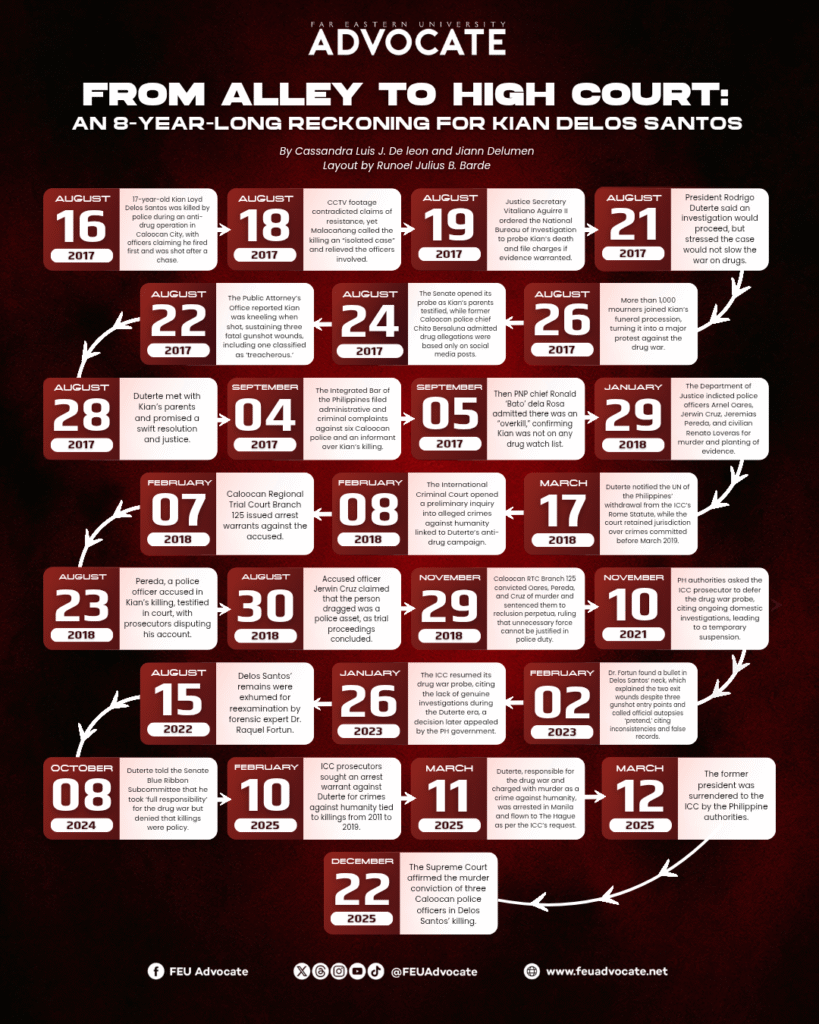
2017
August 16, 2017
Seventeen-year-old Kian Loyd Delos Santos was shot dead by the police during an anti-drug operation in Caloocan City, with officers initially claiming that he fired at them and was killed after a chase. Based on separate affidavits of two witnesses, Delos Santos begged for his life, saying, “Tama na po. May test pa ako bukas (Please stop, I still have a test tomorrow),” before he was shot.
August 18, 2017
CCTV footage showed Delos Santos being carried away by the police, contradicting claims that he resisted arrest. The Malacañang later deemed the killing an ‘isolated case,’ and the officers involved were removed from their posts.
August 19, 2017
DOJ moved to investigate, with Justice Secretary Vitaliano Aguirre II directing the National Bureau of Investigation to build a case on Delos Santos’ death and file charges if evidence warranted.
August 21, 2017
Former president Rodrigo Duterte stated in a dinner with journalists that an investigation should proceed, but insisted the case would not slow down the government’s war on drugs.
August 22, 2017
Suffering from three fatal wounds with one ‘treacherous,’ the Public Attorney’s Office said that Delos Santos was kneeling and slumped to the ground when he died. His gunshot wounds were inside his ear, at the back of his left ear, and at the back of his body. In legal terms, a treacherous wound is fatal with the intent to ensure the victim’s death.
August 24, 2017
The Senate began probing the case, hearing from Delos Santos’ parents, including his mother, an overseas Filipino worker who returned to confront those linked to her son’s death. During the hearing, former Caloocan police chief Chito Bersaluna admitted that the allegations of Kian’s drug involvement were based solely on social media posts. Individuals believed to be Facebook trolls have claimed to be neighbors of the victim, saying that he was a known drug addict in their area.
August 26, 2017
Thousands ofThousands of people joined Kian’s funeral procession to La Loma Catholic Cemetery and demanded justice, turning his burial into one of the largest protests against the drug war.
August 28, 2017
Duterte met with Kian’s parents and vowed the case would be resolved ‘as quickly as possible,’ and justice would be served.
September 4, 2017
Administrative complaints for grave misconduct and neglect of duty as well as criminal complaints against the involved Caloocan policemen—namely Roberto Fajardo, Chito Bersaluna, Amor Cerillo, Arnel Oares, Jeremias Pereda, Jerwin Cruz, and civilian Renato Loveras—were filed by the Integrated Bar of the Philippines. The policemen were named respondents in multiple complaints, including murder, violation of domicile, planting of evidence, violation of the rights of a person arrested, and violation of the Juvenile Justice and Welfare Act.
September 5, 2017
Then Philippine National Police chief Director General Ronald ‘Bato’ dela Rosa admitted that there was an ‘overkill’ after it was confirmed that Delos Santos was not part of the drug watch list and had no records of offenses within their barangay.
2018
January 29, 2018
Facing charges of murder and planting of evidence, the DOJ indicted police officers Oares, Cruz, Pereda, and civilian Loveras, who accused Delos Santos as a drug runner.
February 7, 2018
Warrants of arrest against Oares, Cruz, Pereda, and Loveras were issued by the Caloocan Regional Trial Court (RTC) Branch 125.
February 8, 2018
The International Criminal Court (ICC) opened an initial inquiry into allegations that President Duterte committed crimes against humanity during his anti-drug campaign, citing decades of extrajudicial executions dating back to his time as Davao mayor.
March 17, 2018
Duterte formally notified United Nations Secretary-General António Guterres of the Philippines’ withdrawal from the ICC’s Rome Statute, effective one year later, though the court retained jurisdiction over crimes committed from November 1, 2011 to March 16, 2019.
August 23, 2018
Pereda testified in court, but prosecutors argued his account was false, contradicting key details about the events leading to Kian’s death.
August 30, 2018
Cruz insisted that the person they were dragging during the incident was a police asset and not Delos Santos. The Caloocan RTC Branch 125 concluded its trial.
November 29, 2018
The Caloocan RTC Branch 125, through Judge Rodolfo Azucena Jr., convicted three policemen—Oares, Pereda, and Cruz—of murder and sentenced them to reclusion perpetua while clearing them of planting firearms or drugs, noting that unnecessary force cannot be justified even in dangerous duties—a ruling that would undergo years of appeals before reaching the Supreme Court.
2021
November 10, 2021
Philippine authorities asked the ICC prosecutor to defer its investigation, pointing to ongoing national inquiries into alleged drug war killings, which led to a temporary suspension as the prosecutor evaluated the adequacy of local efforts.
2022
August 15, 2022
Nearly five years after his death, Delos Santos’ remains were exhumed with the help of St. Arnold Janssen Kalinga Center to be reexamined by forensic expert Dr. Raquel Fortun.
2023
January 26, 2023
The ICC authorized the resumption of the probe into drug war killings, ruling that authorities under former president Rodrigo Duterte failed to show genuine investigations—a decision later appealed by the Philippine government.
February 2, 2023
Months after reexamining the body, Dr. Fortun found a bullet in Delos Santos’ neck, which explained why there were only two exit wounds despite three gunshot entry points. She also criticized government authorities’ autopsies, describing them as ‘pretend autopsies’ due to inconsistencies and false records of victims of police operations but were recorded as deaths due to natural causes. The findings indicated that ‘falsified death certificates’ may have concealed the actual number of drug war deaths.
2024
October 28, 2024
Duterte appeared before the Senate Blue Ribbon Subcommittee, claiming ‘full responsibility’ for the drug war while denying that killings were policy, as lawmakers renewed scrutiny of the campaign.
2025
February 10, 2025
The ICC prosecutors sought an arrest warrant against Duterte for crimes against humanity, with judges finding reasonable grounds to link him as an indirect co-perpetrator in killings from 2011 to 2019.
March 11, 2025
Duterte, the man responsible for the implementation of the war on drugs, was arrested in Manila and flown to The Hague per the ICC’s request, marking a sharp escalation in the international case over the drug war. Details of the ICC arrest warrant were made public, charging Duterte with murder as a crime against humanity and citing alleged ties to the Davao Death Squad and systematic attacks on civilians.
March 12, 2025
Duterte was officially surrendered to the International Criminal Court following his arrest by the Philippines authorities.
December 22, 2025
Amid continuing domestic and international scrutiny of the drug war, the Supreme Court affirmed the murder conviction of three Caloocan police officers in Kian Delos Santos’ killing, closing one of the campaign’s most closely watched cases after years.
From the alley to the high court, justice for Delos Santos was gradually built through witness accounts, court proceedings that reopened old wounds, and years of appeals—and with the Supreme Court’s ruling now final, his case stands among the few drug war killings to complete the full judicial process—its trajectory of protests, hearings, and international inquiries offering a rare glimpse of accountability in a campaign where most killings went unpunished.