
FEU-RCYC fosters campus volunteerism in annual first-aid training
FEU Advocate
February 01, 2026 20:16
By Shayne Elizabeth T. Flores
Highlighting the importance of comprehensive first-aid knowledge and training, Far Eastern University (FEU) - Red Cross Youth Council (RCYC) underlined their goal to produce volunteers who can serve the FEU community in times of emergencies through ‘Operation Salvus XVI: R.A.D.A.R.’ last January 24 and 28.
Held at the Engineering Building Mini Auditorium, the first day of the event focused on lectures on basic knowledge and theoretical concepts, with the topics spanning from disaster management to the principles of first aid.
“It is very necessary to conduct this training kasi nga po, ano ba ‘yung basic goal namin dito? Ang goal namin dito is makapag-produce tayo ng trained volunteers that can serve, that can help the FEU community (It is very necessary to conduct this training because our goal is to produce trained volunteers that can serve and help the FEU community),” third-year Medical Technology student and Disaster Management Services Committee Head Gilianne Luz Galolo said in an interview with FEU Advocate.
This was followed by the second day, where the participants were pushed to put what they learned into practice as hands-on demonstrations commenced, offering a more holistic training.
“So, kapag mayroon silang na-encounter na person—na students—in need of first-aid help, they are equipped and they have the holistic knowledge that they can execute para ma-help ‘yung person na ‘yan (So when they encounter people or students in need of first-aid help, they are equipped with holistic knowledge that they can execute to help them),” Galolo added.
Specifically, the morning session of the second day involved mass CPR training and first-aid skills demonstrations led by external medical instructors.
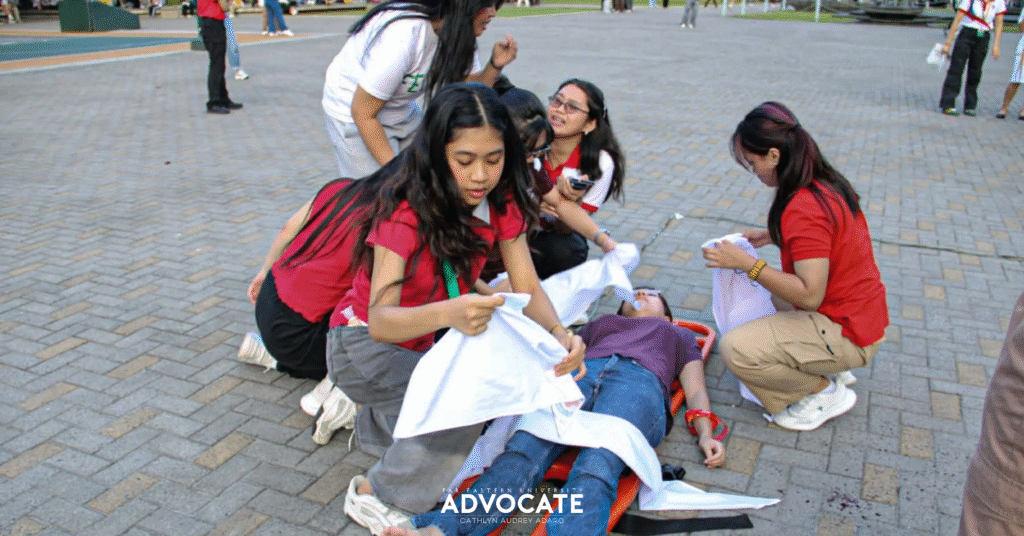
All of these served as a build-up to the Mass Casualty Incident (MCI) response simulation conducted later on at the FEU Grounds, where the participants had to conduct first-aid and disaster response in a controlled mass casualty situation with mock patients.
“Pupunta po ‘yung mga responders natin sa mismong actors themselves. And then, i-e-execute po nila paano po, ano po ba ‘yung natutunan nila sa first day and then sa demonstration part ng Day 2 para ma-gauge natin [kung] effective ba ‘yung talagang training natin (Our respondents will go to the actors themselves. They will execute what they learned on the first day and the second day’s demonstration sessions to gauge if the training was really effective),” the RCYC proponent explained.
As such, in a separate interview, third-year Nursing student and RCYC member Precious Gem Anilao cited the MCI as the activity she looked forward to the most as a participant as she hoped to prepare herself for real-life emergencies.
“Kasi upon learning, parang marami kang kailangan gawing assessment… so parang iniisip mo na agad [kung] paano siya mapu-put into practice, [kung] ano kayang gagawin ko sa ganitong casualty incident. Kasi although parang controlled ‘yung simulation, parang entry point na ‘yun or introduction sa kung ano talagang puwede mangyari in real life (Upon learning, we need to conduct many assessments on how to put our knowledge into practice in a specific casualty incident. Although the simulation is controlled, it is already an introduction on what could possibly happen in real life),” she claimed.
Regardless of a student’s program, Anilao emphasized the importance of being knowledgeable in first aid both in theory and skill to cultivate one’s capacity to help and uphold safety in unexpected situations.
“It's important na may basic knowledge ka about things and para makatulong ka rin… kung hanggang saan [‘yung] kaya mo, and maging prepared… It's important to engage ourselves in these kinds of events para may alam. Ligtas ang may alam palagi (It’s important to have a basic knowledge about things so you could help as much as you want. It’s important to engage ourselves in these kinds of events so we have knowledge. Knowledge is safety),” she stated.
Meanwhile, with Operation Salvus now in its 16th year, Galolo noted how this year’s training differs from past implementations in terms of having a more specific scope.
“What I can say na very new ngayon is ‘yung Day 1 namin na concept is much more integrated siya… ‘Yung concepts na tinuro namin diyan, hindi mo masasabing lengthy pero mas specific siya sa kung ano ‘yung kailangan pag-focus-an when it comes to Operation Salvus (The lectures in Day 1 are much more integrated this year, specifically tailored to what Operation Salvus focuses on),” she remarked.
Operation Salvus is an annual training event organized and participated by FEU-RCYC members. Not exclusive to nursing students, it aims to provide lecture-demonstrations to equip Tamaraws with lifesaving and disaster response skills.
(Photo by Cathlyn Audrey Adaro/FEU Advocate)
Other Stories
FEU honorary doctorate recipient, chef Margarita Forés dies at 65
- February 12, 2025 14:41

FEU students’ films selected for Cinema Rehiyon 14
- March 03, 2022 02:55

DepComm launches FEU SCREEN
- December 10, 2021 04:37
Cabatac suffers injury, FEU bows down to NU
- March 18, 2023 13:40
Bugaoan, Saavedra attains individual awards in UAAP bronze finish
- May 15, 2024 07:44


Kababaihan: Tanglaw ng Lipunan
- March 08, 2025 20:35

FEU NurSoc, Batch Government partner for Capping and Candle Lighting 2023
- November 06, 2023 05:05

Bakit Mo Binenta Ang Iyong Boto? Masama ‘Yan
- March 03, 2025 19:53